
I have known Diana L. Roberts since interviewing her husband, sculptor Danville Chadbourne, over 14 years ago for my first book of interviews with Texas artists. She is an independent arts writer, curator, and arts administrator in her hometown of San Antonio, Texas. She earned a BA in Music from The University of Texas at Austin and an MA in Art History and Criticism from The University of Texas at San Antonio. For 30 years she has worked with artists, musicians, arts nonprofits, galleries, museums, and corporate collections across the state. She has been Art Gallery Director for Musical Bridges around the World, Director of the Center for Spirituality and the Arts, and continues to serve on the board of SOLI Chamber Ensemble.
Roberts has contributed to many exhibition catalogs and periodicals, including Ceramics Monthly, Sculpture Magazine, Art News, Art Lies, Voices of Art, San Antonio Magazine, and the San Antonio Current. She has curated, organized, or installed more than 100 exhibitions around Texas and beyond. Since 2017, she has been Membership and Administrative Coordinator for the Texas Sculpture Group (TSG).
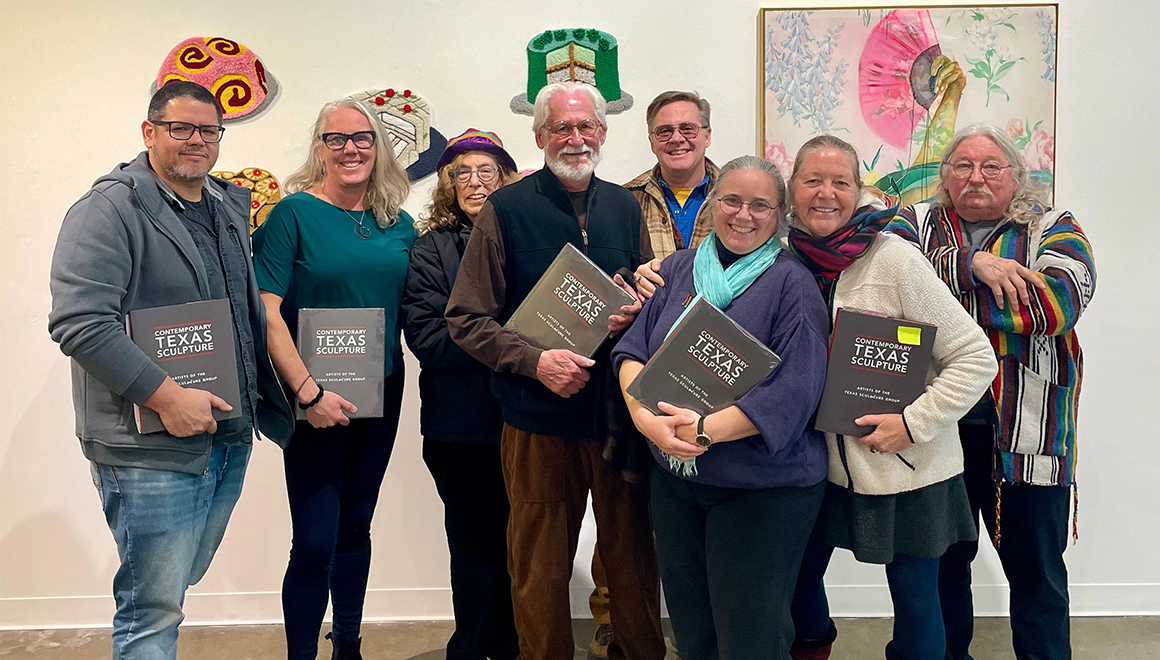
Founded in 2010, the TSG is a statewide, member-based nonprofit organization dedicated to promoting contemporary sculpture and sculptors. Roberts was editor and production coordinator for Contemporary Texas Sculpture: Artists of the Texas Sculpture Group, published in 2025, a 244-page book celebrating the organization’s 15th anniversary. The publication highlights over 100 TSG artist members with biographical information, artist statements, and more than 600 photographs.
Our paths have crossed dozens of times in the intervening years, mostly at gallery events (once at the Menil Collection’s fabulous 2014 Magritte show), but nearly as often at Roberts’ and Chadbourne’s art-and-book-filled home and studio some ten blocks away on the street we share in San Antonio. They are true friends. On one of these recent visits, to purchase the TSG book that is the subject of this interview (and which I had not yet seen), I was so impressed that I asked Roberts then and there if I could try to arrange a Glasstire interview. I am thrilled with the outcome!
 “Contemporary Texas Sculpture: Artists of the Texas Sculpture Group.” Photo: Diana L. Roberts
Robert Craig Bunch (RCB): Congratulations on a beautiful and expansive book, Contemporary Texas Sculpture: Artists of the Texas Sculpture Group. I know it has been a long and complex undertaking to document visually and in writing the highlights of nearly 100 living artists as well as ten in the “In Memoriam” section. How long has it taken?
Diana L. Roberts (DLR): That’s a more complex question than it seems. The short answer is that it took about five years from conception to completion, but that implies a linear, clear progression that just isn’t the way things work in real time. First, I should state that this was not a solo project, it’s a publication of the Texas Sculpture Group. It took a lot of conversation to define what we, as an organization, wanted the book to be and how to bring it into being. There were a lot of opinions about the scope, scale, timelines, budget, fundraising, the format and design, and how to get it produced and published. All of that required significant debate and consensus building, along with a degree of fortitude and bullheadedness to keep it going.
With over 100 artist profiles, it’s also just a lot of material to get through, and a lot of images to grapple with. There was also the COVID-19 pandemic to factor in, which had both subtle and not so subtle impacts, ranging from the capacity to maintain focus and energy for the project, to pragmatic long-term impacts like production costs, shipping and availability of materials, that sort of thing. It was an eye-opening experience, to be sure. So, while five or six years sounds (and certainly felt) like a really long time, when you consider the timing, the scope of the project, and the fact that it was our first major publication, I think we did okay. You’ve been through this process a couple of times yourself. To some extent, it’s just the life cycle of a major book project.
 Diana L. Roberts reviews the artist profile for Houston artist, Patrick Medrano. Photo: Conan Chadbourne
RCB: I found your two-page introduction, “Contemporary Texas Sculpture: Points of Departure” masterful. Who is the book for, how has it been received, and how do you see its future?
DLR: Initially, the goal was to document the work of our artist members and to get the book in the hands of curators, collectors, gallerists, and sculpture enthusiasts. It’s been successful on that front. It was also a way to celebrate the history of the Texas Sculpture Group (TSG) as a whole, which is why I felt the “In Memoriam” section was so important, along with the TSG exhibition history in the back of the book. That’s a direct link to our mission as a nonprofit, to promote Texas sculpture and sculptors.
What I found interesting, and what I discuss in my essay, is that going through all of the artist profiles, all the image credits, and the 40-plus exhibitions we’ve organized as a group over the past 15 years, you see the collective involvement of TSG artists with a huge number of major academic institutions, galleries, museums, art centers, private and public collections, major exhibitions, and various projects. Taken together, it reveals a pretty vibrant arts “ecosystem” both within the state and beyond. So, as much as it’s a book of images and artists, it’s also a pretty good guide for anybody looking for places to engage with the arts, from local community and artist-run spaces to major institutions.
We are very pleased with how the book is being received so far. It’s a durable document of Texas-based sculpture on lots of levels, including both well-established and emerging artists from all over the state. People are impressed with the range of aesthetics and ideas, and they’re responding to the notion that, although this book includes over 600 images by over 100 individual artists from all over the state, it’s only “this” 100 artists, who happen to be associated with this one group. That’s eye-opening for a lot of people who don’t recognize the broad-ranging and aesthetically rich artistic resources we have here in Texas. If our book opens people up to appreciating that bigger picture, so much the better.
People are impressed with the quality of the book itself. I think even some of our members didn’t really understand the scope or the professional quality we were working toward, and we’ve gotten a lot of comments on how much they appreciate getting to know more about their colleagues within the group.
Obviously, the future is hard to predict. We’ve discussed the possibility of a second printing, depending on how things go. It’s available at several galleries and museum bookstores, including the Menil and the Modern Art Museum of Fort Worth; it’s being acquired by university libraries; and I’m getting direct requests from curators and other folks, so that bodes well. It’s functioning well as a promotional tool for both TSG and the individual members.
True story: I was recently on a road trip and stopped in at a local art center with some friends. As we walked in, the curator was walking out, and while we visited briefly, I noticed she was carrying our book with a whole bunch of little sticky notes popping out all around the periphery of the book block. Mission accomplished!
 Artist profile for Caprice Pierucci. Photo: Conan Chadbourne
RCB: I find the alphabetical arrangement and two facing pages for each artist both democratic and easy to navigate. Was this your feeling, and did you have other considerations?
DLR: The alphabetical order question is interesting to me; several people have commented on it. The short answer is no, we didn’t really consider any other arrangement. I suppose we could have forced some other order on it, but I’m not sure what that would be or what it would have accomplished. Geographical location? Medium? Alphabetical just seemed like the simplest, most logical way to organize it.
The only exception was the “In Memoriam” section: I debated about putting them in the order in which they died, which seemed like a weird thing to focus on. Ultimately, and sadly, we lost two members during production, Meredith “Butch” Jack and Steve Daly. Strangely enough, Steve was the deciding factor in this, as in so many other ways in the history of the TSG. His death was the most recent, he was one of the co-founders of the group, our founding President and, alphabetically, first on the list. I do not mean that in any flippant way, or in any woo-woo spiritual way, but I do like that the universe sometimes hands you simple, logical answers in random coincidences.
The two-page spread was one of the first questions we addressed, and it was primarily a budget issue – how big of a book could we afford to make? Ultimately, the whole point was to create a large format, hardbound book that included multiple images, a headshot, plus the written material. In terms of design, that’s almost impossible to do on a single page, especially in a vertical layout, and somebody else’s work is always in the reader’s peripheral vision. It just didn’t make sense. The two-page spread gives each artist a focused piece of real estate, within which we could design a layout that fit the aesthetic, image formats, and tone of each artist’s work.
 Diana L. Roberts reviews the artist profile for Dripping Springs artist, Christine Rojek. Photo: Conan Chadbourne
RCB: How have you managed collecting so many bios and quality images (600!) in a timely manner and wrangling them into cohesive form?
DLR: I’m not sure anybody, including myself, would use “timely” to describe the process, but “wrangling” is certainly an apt term. Again, it sounds simple in the abstract: we established a deadline, put out a call out to our members, and they submitted images, bios, and artist statements using an online form that more-or-less kept all the information sorted and the related components tethered. I first did a lot of tedious text editing to bring things like dimensions, image credits, and captions (which were provided by the artists) into a consistent format. I edited all the written materials for length and typos and, for example, checked to see that institutional names were accurate and consistent, that academic degrees were listed in a uniform way, that kind of basic editorial “stuff.”
I didn’t want to get too far into the weeds in terms of editing content. Again, the exception was the “In Memoriam” section, which required a certain amount of research and writing on my part to compile the bios and to get the images and permissions. In general, I like to keep the artist’s voice intact, to retain their particular use of language, their individual expression of perception and form — I mean, that’s the point, isn’t it? It’s tempting to say, for example, we want this many words, with the bio in third person and the statement in first person, in a given order, but in reality everybody does it a little differently. I attempted, at first, to impose a basic formal consistency on them, but it just didn’t work. Ultimately, as with the image layouts, it was way more interesting, dynamic, and meaningful to tailor each spread to the artist’s images, voice, and aesthetic.
Now, photography is a whole other can of worms. This is an issue that needs to be addressed more bluntly and pragmatically in the contemporary art world. We spent an inordinate amount of time assessing image files and kicking out, trying to fix, or replacing images that were not up to par. Ask any gallerist, curator, graphic designer, publicist, or publisher: clean, high-quality images are the primary currency of the art world and, for better or worse, digital literacy is part of that package.
Documenting artwork is tricky, and sculpture is particularly so. Most people gave us good images, but there was also a lot of fumbling around with bad images and problematic files. I won’t name names, but there are people out there who should not be allowed to use Photoshop. Also, unless you really know what you’re doing, your cell phone will distort and compress your images, and screenshots are not legitimate image files for print publications. Everybody in the artworld needs to learn how to recognize what a quality image is, what makes an image “high resolution,” and understand how to maintain that integrity when you send it to somebody digitally. If you don’t know, hire somebody who does.
 Designer Conan Chadbourne and editor Diana L. Roberts. Photo: Danville Chadbourne
RCB: What have been the multiple roles of designer Conan Chadbourne? How closely have you two worked on this?
DLR: Oh, gosh, where do I start? First, we’ve worked on multiple catalogs together, and I trust his judgement on pretty much all aspects of this kind of project. We have similar ideas about how things should be organized, how they should look, and we’re both sticklers for detail. He’s worked on the production side of digital imaging and processing for years, so he understands all those technical details. He’s savvy about automation and streamlining certain processes, he understands what the printer needs in terms of file output, he’s a stickler for grammar, a wizard at typesetting, and he has a clean design sensibility paired with the gift for packing as much as possible on the page without it looking cluttered. He has a tremendous capacity to keep track of all the tedious details nobody else sees — spacing, alignment, line breaks, that sort of thing. Yet, he’s also an artist, so he’s super respectful of other people’s work and aesthetic sensibilities, which is one of the things I appreciate most about working with him. We also have similar tolerances for nerding-out over details most people see as insignificant, but which ultimately give a project like this the cohesiveness you’ve remarked on.
Generally, I was responsible for overall content, text editing, and communicating back and forth with the artists, printer, TSG Board, keeping things moving, etc. Conan was the all-purpose “behind the scenes” technician, layout master, and aesthetic collaborator. Sure, we squabble and quibble at various points, but he also went with me to every press check and meeting at the bindery and helped navigate multiple potential disasters (not of our making) that all worked out in the end, in part because of his patience, diligence, and intelligence.
RCB: Why has this book been privately produced, from editing and design to printing and binding, in San Antonio? The result is very impressive. What have been the benefits and drawbacks? Why not go with a university press?
DLR: Again, it happened sort of organically. I don’t know that we even considered going through a university press or other publisher, simply because we didn’t know any better. I think all of us thought of it more like an expanded exhibition catalog, which we’ve done lots of, so we just dove in with that mentality. It’s not that simple of course, and we found that out along the way but ultimately, I love the fact that it was a fully local, handmade production. It started with our printer in San Antonio, Lithopress, who we’ve worked with for many years, and they were willing to work with us on the costs.
Mark Mayfield, our contact there, put us in touch with Universal Bookbindery, one of the main binderies in this part of the country, which turned out to be located about a mile from my home. That made things quite convenient. We also got the very cool experience of watching our book get physically put together.
It sounds dumb to say we were figuring it out as we went along, but learning how to get an ISBN and Library of Congress Control Number for the first time, or how distribution works, or how to get books into academic libraries, was all part of the process. And now, the Texas Sculpture Group now has a publishing arm in San Antonio, Texas, because we just did it, starting with what we knew. Ultimately, it paid off: it might be cheaper to print overseas, but you can’t go to press checks and you can’t oversee the binding. A publisher might handle all those details, but I’m pretty sure it would have cost more than what we had to spend, and you have little to no control over the design or distribution, or whether production contracts will be honored, or if the content will run afoul of whatever powers that be, or if your book is going to get stuck on a boat in some harbor. We drove to the bindery and picked ours up off the loading dock, after watching it come into being every step of the way. That was a really good day.
The bottom line is that the publishing and printing industry is changing rapidly. Technology is making some things easier, but also forcing out other processes that make more sense to be mechanical. Material costs are absurd, availability is questionable, and reactionary politics is infiltrating everything we do or don’t do. The more control you can exert over your project, the better off you’re going to be.
 Artist profile for Houston artist, Jeff Forster. Photo: Conan Chadbourne
RCB: Short of naming all of the artists and donors, who else has played a key role in this publication?
DLR: This was an epic project for a small organization and it wouldn’t have happened without a lot of support from a lot of people. We toyed with the idea for a few years, and it was ultimately our President at the time, Sabine Senft, who really pushed for the project to become a reality in fall 2020 and, along with other Board Members, got going on the fundraising.
It was grassroots at first, and then we received a major gift from Craig and Kathryn Hall, which put the whole project in the realm of feasibility. That’s the gift that made it real. Patricia Meadows gave us lots of encouragement and assistance along the way — what an amazing gift that woman is to the Texas art scene! James Surls, who has been involved with TSG since the beginning, wrote a beautiful foreword about the physical and poetic nature of sculpture and object-making, which sets a great tone for the book. Several galleries and institutions were very generous in providing images and permissions to reproduce various works, especially for the “In Memoriam” section and the exhibition photos sprinkled throughout the book.
For example, the Umlauf Sculpture Garden + Museum went so far as to take a new photo of their Damian Priour piece, especially for our publication. And in terms of commitment and encouragement, I really have to thank past-President Gary Webernick, current President Brian Wedgworth, Vice President Bill Fitzgibbons, and all the TSG members whose enthusiasm and expectations for the book fueled my own. And of course, my husband, Danville Chadbourne, who both cooked and sat through many, many dinners with me and Conan (his son) listening to endless production details, frustrations, and milestones.
RCB: What’s next for you?
DLR: Resting on laurels! Just kidding. I’m still working through book distribution and sales, and organizing book events. We’re also working on several upcoming TSG exhibitions with various partner organizations, and that’s always great. And who knows, now that I’m getting the hang of it, another book?
Contemporary Texas Sculpture: Artists of the Texas Sculpture Groupedited by Diana L. Roberts was published in 2025.