

Chris Cuellar’s eyes scan the eight-inch pipe that’s spewing water on the other side of the chain-link fence. Drawn from hundreds of feet below the surface, the water tumbles down a short spillway that leads straight into the Nueces River. It will flow roughly five miles downstream, to the intake pipes of the City of Corpus Christi’s O. N. Stevens Water Treatment Plant. From there, a vast network of pipes will carry it to homes and businesses.
We’re a dozen miles outside the city limits, in unincorporated Nueces County, just a couple minutes’ drive from Cuellar’s house. In one hand, the 65-year-old holds a water probe that’s attached to a spool of cord, and in the other, he holds a portable digital readout. With this gear, he’s waging a guerilla campaign of citizen science.
It’s not what he or his wife, Christy, envisioned for their lives when they retired two years ago. He was a wastewater manager at OxyChem in nearby Ingleside, and Christy worked for decades with hearing-impaired students in the Corpus Christi school system. They’ve lived in their pleasant one-story house, with a yard teeming with hummingbirds flitting around feeders, for twelve years.
But the Cuellars are now caught up in the South Texas water wars, cast in the unlikely roles of insurgent rebels. The fight came to their doorstep early last fall, when heavy trucks with drilling equipment appeared along County Road 73, on the western bank of the river near where the couple lives. In the eighties, city water officials say, Corpus Christi had used city-owned land in Nueces County as an emergency water source, but it abandoned those wells in the nineties, after surface reservoirs recovered.
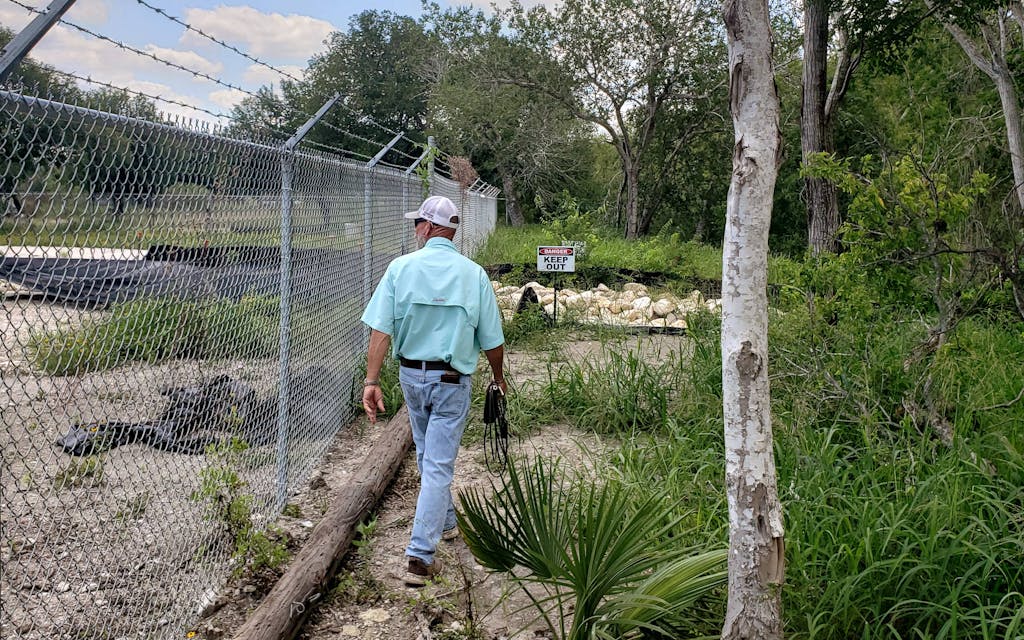 Chris Cuellar heading to measure the salinity of the water coming from a Corpus Christi–owned well as it enters the Nueces River.Joe Pappalardo
Now Corpus Christi is trying to avert an environmental calamity, brought on by the fifth year of an unprecedented drought. The lakes that feed the city’s water system are, even with recent rains, at only about 25 percent of their combined capacity. Projections indicate that the overall supply could fall short of daily demand by June of next year.
That emergency could trigger Level 1 restrictions in December, mandating 25 percent cutbacks by customers, including industrial users and neighboring rural towns that count on the city’s supply. In the past year, Corpus Christi has earmarked nearly $1 billion for new water infrastructure projects. Of those, the tapping of fifteen city-owned Nueces County wells, at a cost of $33 million (plus more than $230 million in water rights), is the only one already producing anything more to drink.
Cuellar sees the city’s desperate bid for water as an existential threat to his rural oasis. Like many of the roughly 20,000 residents of unincorporated Nueces County, he worries that the city of just over 300,000 people plans to take too much. He fears the draining of the local wells upon which homes like his depend. And the use of the river to transport so much underground water—which is brackish, because of its earthy storage—is of particular concern to other communities that count on the Nueces for their own supplies.
To prove his contention that Corpus Christi’s wells are making the river dangerously salty, Cuellar has been casting his probe at four sites nearly daily for seven months. It takes an hour and a half to visit them all. He scrambles down embankments, clutching trees and fences for balance and dodging snakes. He dutifully records salinity levels and posts the results weekly on social media. “Every day I take these damn samples,” he says. “Emotions are high. I want to put data to what we’re all feeling.”
Cuellar visits neighbors’ homes to offer advice on testing their well depths and using over-the-counter kits to record tap water quality, which he says is getting saltier. He even has forms for neighbors to fill out and send to him, so he can collect standardized data. “I’m a water widow,” Christy Cuellar jokes about her husband’s preoccupation.
To show how salty the underground water is, Cuellar visits that spewing pipe along the riverbank. I watch as he passes a “Danger: Keep Out” sign, drops the probe into the gurgling water, and then reels it out like a hand-caught fish. The reading shows that the water from this outfall is five times saltier than what the Environmental Protection Agency and Texas Commission on Environmental Quality consider acceptable to drink. A fingertip taste leaves bitter minerals on the tongue.
Cuellar started testing the river, outfalls, and taps when the city finished its first nearby wells and, by sharing the data on Facebook, got slowly pulled into a resistance movement. He had never before paid attention to local politics or waded into the public arena. Now he’s a founding member of the six-person “Proposed Nueces Groundwater Conservation District Organizing Committee.”
Forming a conservation district would give representatives of unincorporated Nueces County the ability to impose regulations on the removal of the water under their land. The interests of such a district could clash with Corpus Christi’s emergency need for water. It could also lead to a lawsuit, with millions of gallons a day on the line.
“I never planned on being here, I can guarantee you that,” Cuellar says of his rebel status. “I have so many other things that I would love to be able to do in retirement right now.”
In Texas, groundwater is governed by the rule of capture. Property owners own the water beneath their land and can do pretty much whatever they wish with it—unless the land falls within the bounds of a groundwater conservation district, or GCD, which can regulate the water’s removal.
GCDs cover roughly 70 percent of the state. Districts can be set up either by the Legislature or by local landowners filing a petition with the TCEQ. Nueces County is one of the few in South Texas to not have a conservation district in place.
Without a conservation district, says Scott Barraza, who owns a local trucking company, it’s open season on his and his neighbors’ water. “Nueces has more to worry about than just Corpus Christi,” he says. “That’s just the current high-volume pumper.” He cites a proposed ammonia plant and Tesla’s lithium refinery as the county’s thirstiest new industrial users.
Months after Corpus Christi began tapping its emergency wells in Nueces County, 270 people signed their names to a petition asking for a local GCD. It was part of a package of information submitted in early September to the TCEQ, which oversees the application process. If all goes smoothly and the commission approves the paperwork, a vote to establish the district could be held in November. The proposed district does not encroach on the Corpus Christi limits, so residents of the city would be excluded from its regulations and the vote.
Last October, a month after the petition was delivered, Corpus Christi leaders countered the insurgents’ effort. City attorney Miles Risley told the city council that a Nueces County conservation district would have the legal power to curb the city’s well-field pumping and added that this might include the authority to shut down wells. For their part, Nueces district backers deny any maximalist not-in-my-backyard leanings. “Corpus as a landowner has a right to that groundwater,” Barraza says. “A GCD just can’t say ‘No, you can’t have any.’ But at the same time, a GCD can limit the amount of water taken.”
Risley also noted that the new district could make it far more expensive for the city to draw water from its wells, by levying taxes to fund the district’s operations. These export rates are capped by state law at 20 cents per thousand gallons, but in 2024 the Legislature allowed that maximum to increase by 3 percent a year. The city hopes to eventually draw tens of millions of gallons each day from its Nueces County wells. “It would be a significant potential fee we would have to pay,” Risley gravely told the city council in October.
So Corpus Christi leaders made use of a regulatory body that the state legislature had established in 2005 to facilitate the city’s ability to pump water underground, where it could be shielded from evaporation for use during drier days. The Corpus Christi Aquifer Storage and Recovery Conservation District has never actually gotten around to squirreling away any water, but that might change next year. According to a plan released in October, a pilot aquifer-replenishment program could soon launch, leading to the construction of a $20 million facility by 2030.
The city council voted to ask its conservation district to absorb the well fields into its jurisdiction before its Nueces County rival could form and claim authority over the land. Then, on November 4, the district’s board—all of whom were city employees or officials appointed by the council—likewise voted unanimously to approve the council’s request.
But the Corpus Christi ASRCD wasn’t set up to regulate groundwater removal. It assumed responsibility for the Nueces well fields before it was prepared to measure the impact of the city’s operations. For example, the district isn’t monitoring for subsidence—which is when the surface sinks and shifts because of groundwater removal, leading to infrastructure damage and flooding. It also doesn’t have instruments in the wells to monitor aquifer levels and water quality. The management plan it submitted to the Texas Water Development Board says the district “will consider a subsidence monitoring plan within two years” and establish a network of monitoring wells over the next five years.
The aspiring Nueces GCD committee is already doing some of this work. It received financial support from the Nueces County Farm Bureau to install four monitors in wells on private land that are now recording water levels and salinity. Naturally, they publicize any trends they spot. “The more pumping they’re doing, the water quality is actually degrading,” Barraza says. “We can see it in real time.”
The city contends that this isn’t true because the water its fields tap into is twice as deep as that in most area wells. “From the beginning, we worked hard to ensure that area wells would not be affected,” Nick Winkelmann, the chief operating officer of Corpus Christi’s water department, told me. “We do a lot of geophysical logging to understand the confining layers and to better understand how we can stay separated.”
Members of the Nueces GCD committee have vowed that once the TCEQ approves the establishment of their district, they will challenge the city’s move in court. They argue that the Corpus Christi district wasn’t formed to govern groundwater or expand outside its original limits, making the absorption of the Nueces County wells illegitimate. Cuellar says the TCEQ approval could come by early fall.
A legal conflict in the future would be intense. The eastern well field, the one the city started tapping near Cuellar’s home last summer, is the smaller of the city’s two groundwater-pumping efforts in Nueces County. The broader scope of the aquatic prize at issue—and the city’s commitment to claiming it—can be found across the river, in the sprawling western well field.
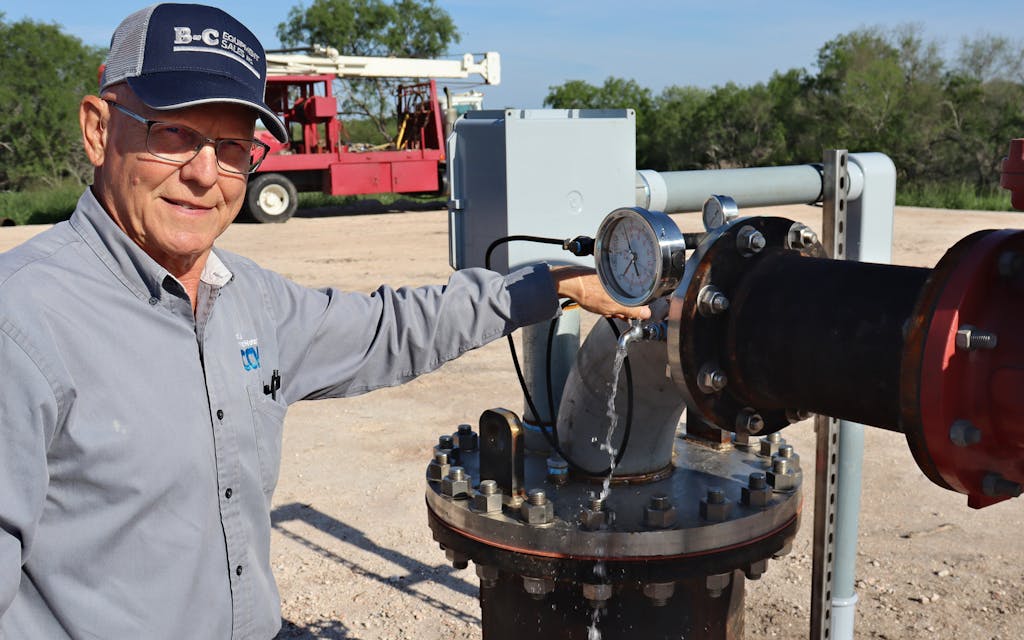 Len Dunphy, the Corpus Christi water department’s project manager for its western Nueces County well field, leads a small army of staff and contractors to build the city’s newest water supply.Joe Pappalardo
“There are a lot of things people can live without, for a while,” says Len Dunphy, driving past a towering well derrick, where a tungsten carbide bit is plunging into a borehole. “Water’s not one of them.”
The Corpus Christi water department’s project manager for its western Nueces County well field has a calm demeanor and is prone to understatement, but the 68-year-old can’t hide his pride in what his team has accomplished. Since construction started nine months ago, they’ve established seven working water wells capable of producing 10 million gallons daily. As of early May, five more are in various stages of construction, with more to come.
When finished, the Nueces well fields are projected to produce 26 million gallons a day. That’s enough to meet the needs of nearly 83,000 typical homes.
The long-abandoned city wells were too decrepit to be used, so Dunphy had to survey the scrub to lay out new ones, plus the roads and utilities to support them. “I’m building this to last,” he says. “I’m proud to be part of it.”
The city got help in extracting water from here so quickly. In March, Governor Greg Abbott waived TCEQ permitting so that pumping could start immediately. He also raised the amount of water per year that an emergency well can take from the ground, from about 3.3 million gallons to nearly 9.5 billion.
Unfortunately, much of the newfound water has been far too salty. TCEQ rules require the city to stop using the river to transport the harvested water if its salinity goes too high. When it does, the city must temporarily stop producing water from the wells. Because of these necessary pauses, the existing western wells are projected to deliver only 14 million gallons per day, instead of the hoped-for 26 million. Even higher salt levels are bedeviling the eastern field. Although permitted by the state to remove 10 million gallons per day, the eastern well field only releases 4.5 million into the river daily because of the elevated salinity.
When municipalities that rely on the Nueces River for water, like Robstown, saw the salt levels in their drinking water rise, water suppliers and local politicians both pointed to the Corpus Christi wells as the culprit. In response, the Corpus Christi City Council in January okayed emergency funding for a $1.7 million water line between Robstown and the Stevens plant. The pipe will be used to blend the local, overly saline supply with three million gallons of treated water per day from Corpus Christi. In exchange, the larger city gets repaid in water, including two million extra gallons per day, delivered over the next three years.
Nueces GCD committee members say that crowded well spacing and overproduction in the fields—conditions they wouldn’t countenance in their district—are to blame for these problems. But Corpus Christi officials argue that the drought has changed the conditions in the river more than their wells have. Drought-stricken waterways have less fluid to dilute minerals.
Winkelmann, the Corpus Christi water COO, told me there are streams near the eastern well field that enter the river with salt levels twice as high as the water from the outfall I visited with Cuellar. “We’re also seeing elevated levels coming out of the Lake Corpus Christi and Choke Canyon [reservoirs] as the water levels drop,” he says. “We don’t control the river.”
As a long-term fix for the salinity, Corpus Christi issued a $175 million construction contract this year for a new brackish-water treatment facility at the Stevens plant, with the salty groundwater delivered via a thirteen-mile pipe instead of the river. This plan literally bypasses the TCEQ’s regulations and could enable full production at both Nueces County well fields. It’s set to be completed in 2028.
Winkelmann says the city will never again abandon its groundwater wells, describing them as part of a diversified supply to better protect the city from future scarcity. Of course, once the city is taking maximum advantage of the water available from the Nueces County wells, the effects on the depth and quality of the water in other local wells could be even more significant.
The fight over water in Nueces County won’t stop whenever the drought eases. Neither will Chris Cuellar, whose daily river excursions continue. “However long this will last, I’m committed to seeing it through,” he says.
Nueces County is the front line of just one battle in a wider water war that’s reshaping infrastructure and upending lives in the Coastal Bend. The commonality on all sides is an existential dread of running dry. Primal fear is pushing people across the spectrum to pick sides, fast-track plans, organize resistance, defend turf. And as in any conflict, geography matters. In thirsty South Texas, the side you’re on usually depends on where the water in your tap comes from.
Read Next