
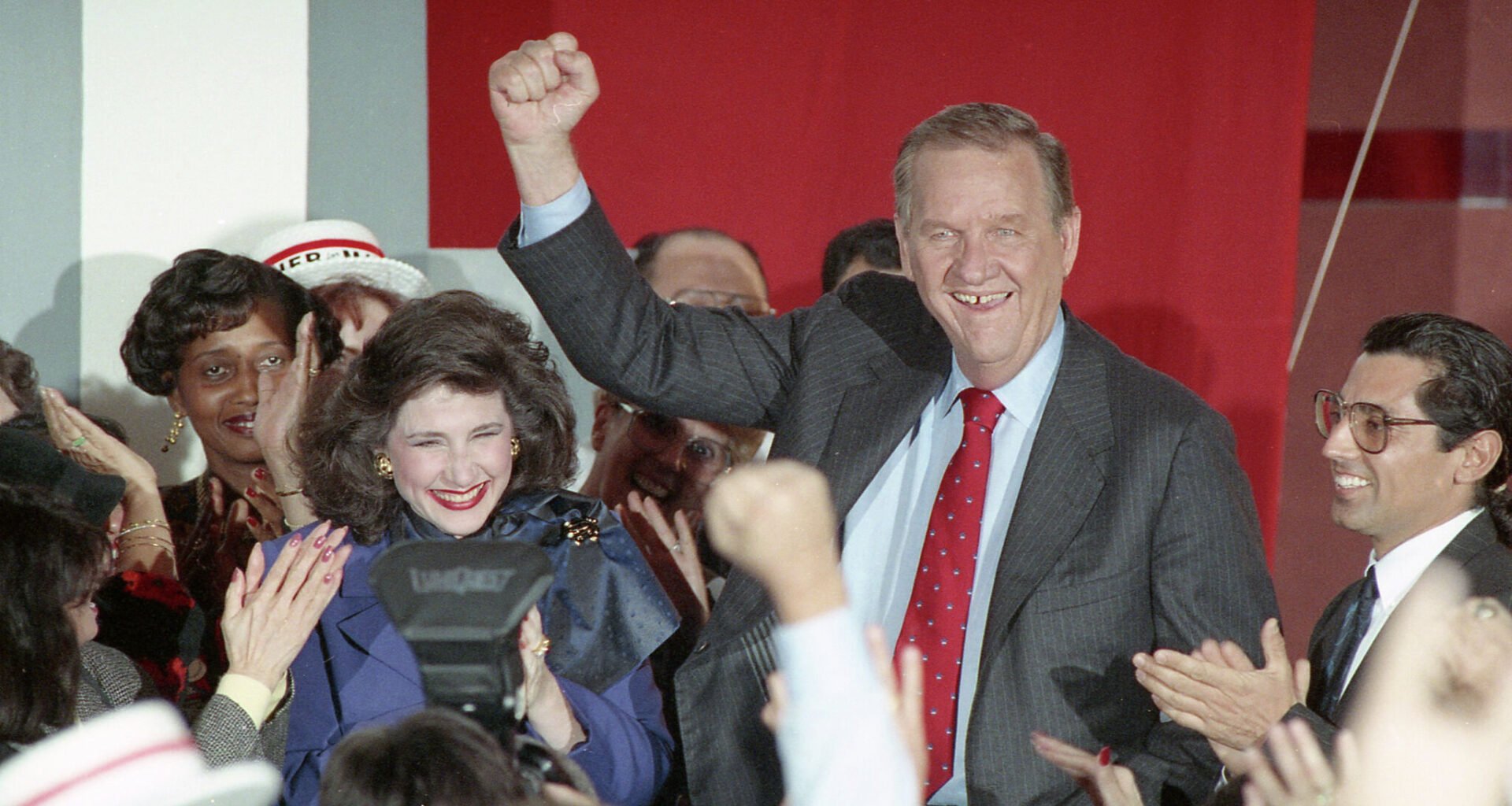
Houston mayoral candidate Bob Lanier and wife, Elyse, at left, Nov. 5, 1991, at the Hyatt Regency.
Dave Einsel/Houston Chronicle
If you want to understand Mayor John Whitmire, then you need to learn about Bob Lanier.
A swaggering and successful land developer, Lanier was swept into office in 1992 at a time of sky-high crime rates on a promise to halt plans for a mass transit system, repave streets and bolster funding for law enforcement.
Article continues below this ad
A proposed monorail was cancelled. Millions in taxpayer dollars were spent to add more cops to our streets. Crime rates plummeted. Lanier became wildly popular. President Bill Clinton even pointed to his fellow moderate southern Democrat when touting his own crime package.
If you listen to his podcast, you can hear Mayor Whitmire refer to Lanier as a model. You can also see it in his budget. Houston is spending a whole lot more on cops and our crime rate is way down.
That’s good, right? Who wouldn’t want Whitmire to be the next Lanier?
There’s just one problem: Even Bob Lanier wasn’t Bob Lanier. Poke at his successes a bit and they hold up about as well as a thin layer of asphalt slapped on a beat-up Houston road.
Article continues below this ad
You see, as Mayor Bob was reshaping our city, Dallas was dealing with its own crime problem, too. But that city’s leaders didn’t divert their transit funds. In fact, as HPD was boosting its ranks, Dallas was losing officers due to budget woes.
So did Dallas’ crime rates spike?
No. In fact, Dallas’ crime rate fell by more than Houston’s.
“While Houston grabs headlines for lowering crime a total of 21.7 percent in 1992 and 1993, Dallas did better,” the Houston Chronicle’s John Williams wrote in a March 27, 1994 front-page story. “In those two years, crime in Dallas dropped 28.5 percent below the 1991 level.”
To be fair, Houston had a lower crime rate than Dallas. And both cities had a similar number of officers per capita and per square mile — Dallas underwent a police hiring boom at the end of the 1980s.
Article continues below this ad
Still, it is interesting that Dallas found a way to improve public safety without having to divert massive amounts of public funds from other projects. The secret, Williams wrote, was how Dallas used its police. The department focused on neighborhood policing, community programs where officers interact with youth, and initiatives to improve neighborhoods.
“We’re not looking at police problems, we’re looking at the factors that lead to police problems,” said Dallas Police Chief Ben Click.
Click also attributed the fall in crime rates to Texas adding thousands of new prison cells, which made it easier to remove dangerous criminals from society.
Of course, it is hard to attribute that improvement in public safety to any one policy. Crime rates were falling all across the country at the time. Lanier could say it was because he hired more cops. Dallas leaders could say it was because they were doing smarter policing. But everyone was taking part in a national trend. To his credit, Whitmire has recognized on his podcast that Houston is riding a nationwide post-COVID wave of public safety.
The reality is that being a good politician is a bit like surfing: The wave does most of the work, you just have to stay on the board and look like you know what you’re doing — but even that takes some real skill. And Lanier was a skilled politician.
Article continues below this ad
The history is written, but sometimes I can’t help but wonder about that timeline where Houston actually builds the transit system imagined by Lanier’s predecessor — an elevated rail that followed the Southwest Freeway from downtown. Imagine a corridor of density, a mix of apartments, condos and office skyscrapers, with commuters and shoppers zooming along past the freeway congestion. Imagine a city that captures the best of all urban options — robust abundance of affordable housing and the opportunity to get around without relying on cars for every single trip.
Instead of ruminating on the past, it’s more productive to imagine a different future. After all, how could Houston be different if, instead of spending an extra $100 million on HPD’s budget, we dedicated those funds to safer streets designed to reduce dangerous crashes, improved parks in underserved communities, or even just cutting taxes? Would we see crime rates climb or would we find ways to do better policing with the same resources? Or is municipal public safety merely downstream of state and national trends we can hardly control?
Those are important questions — ones that deserve a more robust conversation at City Hall instead of being left to the archivists and historians.