
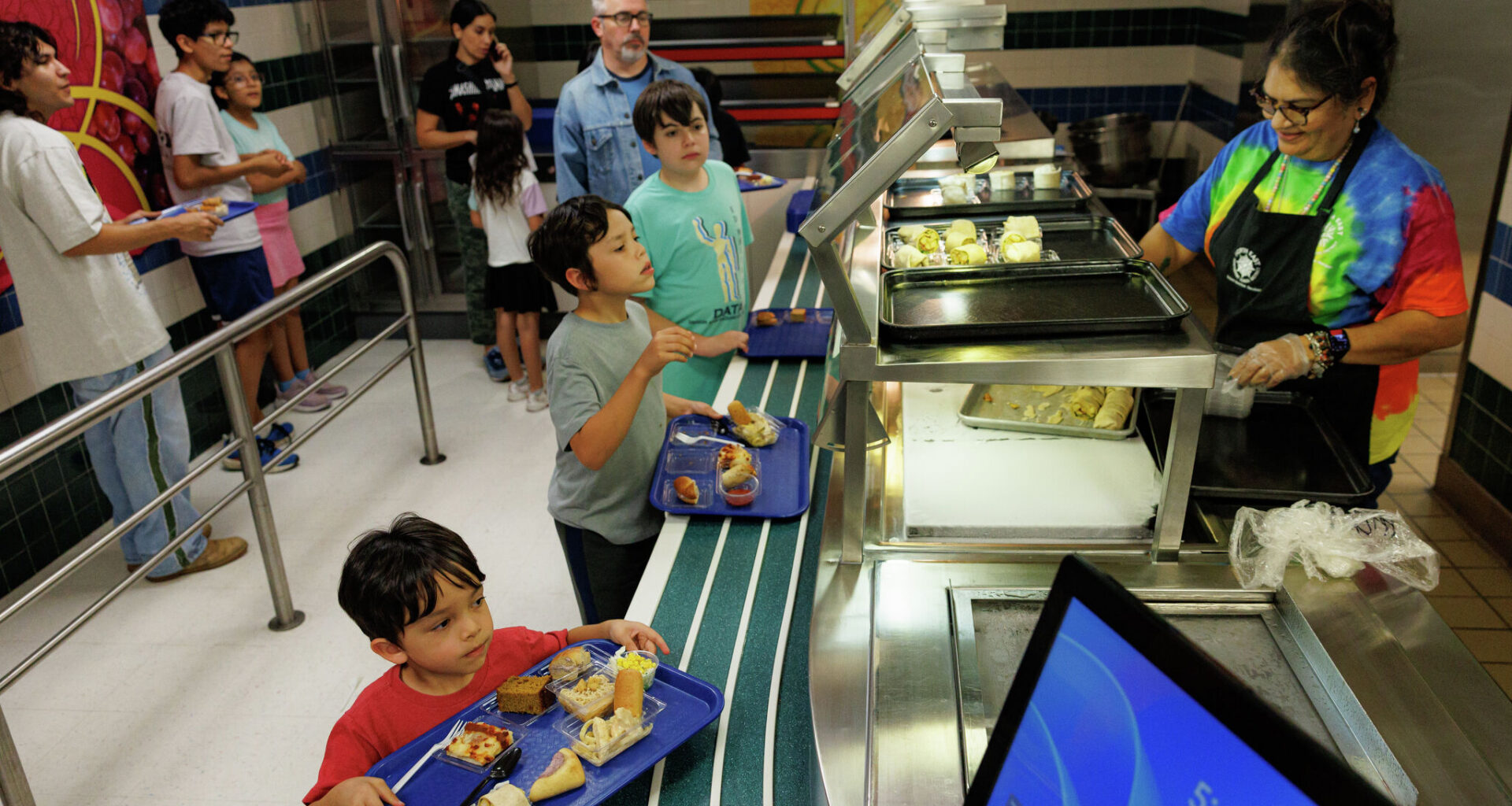
NEISD School Nutrition employee Sally Rojas, right, serves chicken shawarma and falafel and humus wraps to students and their families during a school lunch taste test event at Bradley Middle School in San Antonio, Thursday, Nov. 6, 2025.
Sam Owens/San Antonio Express-News
Goodbye to free lunch
Regarding “33 HISD schools will not participate in universal free lunch program,” (June 2): In the first week of school, a fifth grader at Sinclair Elementary in HISD stands in the lunch line holding his tray of food, but this year, the boy was stopped by the cashier. The boy is gently pulled to the side by his teacher, and as he watches the other students carry their heavy trays, he’s told that the school no longer offers free lunch to every student.
This could soon be the reality for thousands of students at 33 different HISD schools, where the district announced it would no longer offer universal free lunches.
Article continues below this ad
The removal of universal free school lunches is harmful not only to students’ stomachs, but also to their minds and education. First, the removal causes a stigma around low-income students, and research shows that children would be less likely to eat a school lunch unless it were free for all students. Students are also less focused and have difficulty learning when they are hungry.
Some may argue that the district is making a necessary financial decision. But, with Superintendent Mike Miles’ bonus of around $173,000, I find that hard to believe. If an average school lunch costs $2 to make, Miles’ bonus alone would be able to purchase 86,500 lunches for students.
In order for this to change, local politicians, leaders and even citizens must speak out and protest in any way they can. I encourage anyone reading this, parents, students and politicians, to speak out against these tyrannical actions, attend board meetings, pressure TEA and publicly challenge this change.
The Houston I know and love provides and gives a chance to everyone, and as a rising senior who attends one of the affected campuses, I would like to return to us doing so by providing fair and free school lunches.
Article continues below this ad
I was horrified to read that some HISD schools will lose their universal free lunch program. This is cruel. Low-income parents may not have the language skills or the knowledge of how to apply for their child’s free lunch. So those children go hungry. My grandchild, who goes to one of these schools, does not need a free lunch. I am speaking for the little ones who do need a free lunch.
It’s also foolish from an administrative angle. It’s likely that it is no cheaper to give all the children free lunches than it is to have a program that administers who gets lunch and who does not. HISD must restore the free lunch program for all its schools.
Plummer’s win
Regarding “Letitia Plummer’s upset win against Annise Parker wasn’t a surprise,” (May 27): Leah Binkowitz writes about the Democratic party’s run-off election for county judge. Former Houston Mayor Annise Parker was endorsed by the Houston Chronicle for being able to do business with all political factions in the county — in other words, “go along to get along.”
Article continues below this ad
I voted for Letitia Plummer for her record of not only taking on the owners of derelict apartment complexes, but also being the only one I can think of, in Houston or Harris County government, who actually stood up to the real estate developers who have had carte blanche to continue building and selling homes in known flood plains.
More power to her. If she wins in November, I hope she has the same courage in dealing with the various princelings and self-styled kingmakers on the Commissioners Court.
Texas farm chemicals
Regarding “Forever chemicals are poisoning Texas farms. These bills could protect,” (Feb. 23): Lawmakers are now investigating toxic gas emissions from animal farming, including ammonia pollution that threatens nearby communities. For residents living near these facilities, this isn’t new — it’s daily life.
Article continues below this ad
We often talk about factory farming in terms of animals or climate, but the human cost is just as real. Families are breathing contaminated air so the rest of us can consume cheap meat and dairy.
This raises an uncomfortable question: how cheap is “cheap” if others are paying with their health?
If we value clean air and public health, we must confront the true cost of industrial animal agriculture — and start supporting food systems that don’t harm communities in the process.
Article continues below this ad