
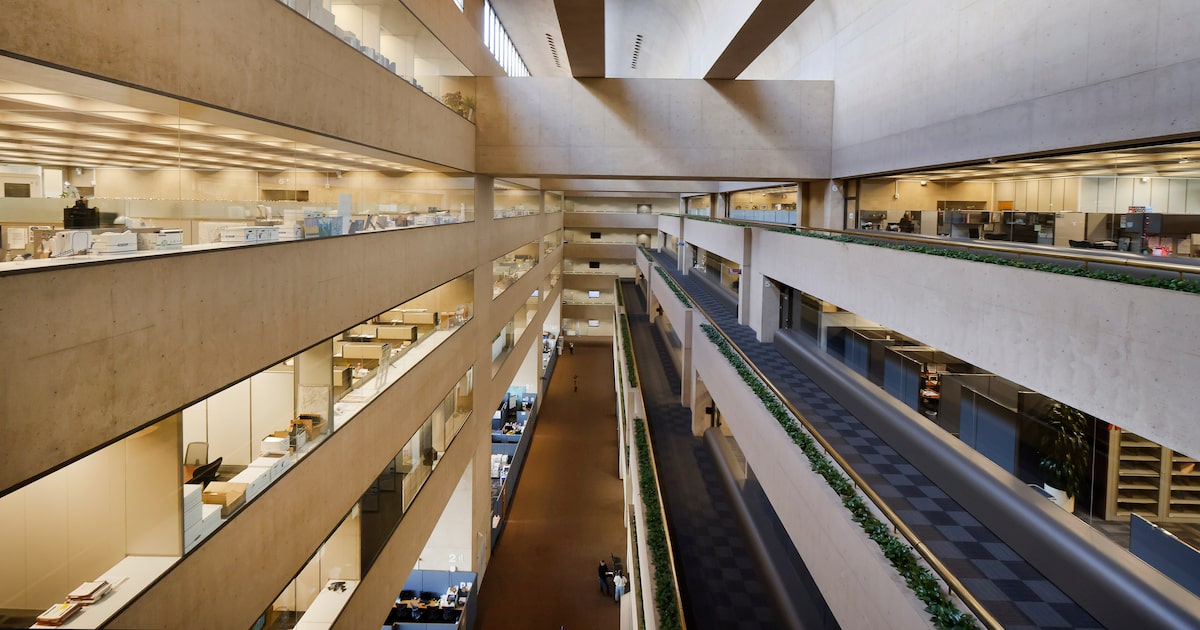
Recently, our City Hall has been the center of an important discussion. Our council members are diligently trying to decide its fate. While there is an argument of its beauty, historical meaning and preservation, the reality is that this building is riddled with multiple occupancy issues.
If City Hall were vacant today, there would be absolutely zero interest from any firm or corporation to occupy the building. For the same reasons hundreds of corporations have left downtown for uptown. The market place today demands a much different type of building.
Not worth restoring
Our firm is one of the largest historical preservation developers in the nation. In Dallas alone, we’ve preserved and adaptively repurposed two office towers designed by the renowned architect I.M. Pei, who designed Dallas City Hall. We’ve restored more than two dozen turn-of-the-century jewel box buildings in the East Quarter, the Tower Petroleum building, the historic downtown U.S. Post Office and courthouse and the First National Bank tower, which was the largest historic project in Texas history with a restoration cost of over $450 million. No one has developed more in downtown Dallas in the last 10 years than our firm.
And yet, if City Hall and the land it sits on became available, we would not pursue it.
Opinion
Building problems
City Hall’s design presents so many challenges to functionality it’s hard to list them all.
Since my first day of visiting in 1985, the parking garage has continued to leak and now floods.
There is zero sense of arrival. Where is the main entry? The building doesn’t reflect the character of a welcoming city, nor one where we take pride in our common areas.
The floor plates are enormous. The center atrium that divides each floor obstructs internal flow and access, not to mention creates a tremendous cost in heating and cooling.
The elevator banks are not centralized, creating confusion, so much so that color coding the elevator banks and long hallway stripes have been the solution to find the appropriate elevator.
The second floor, which is accessed by an escalator, is no longer activated, and the first floor has struggled for years as to utilization.
The exterior plaza which Pei stated would generate economic activity — well, that never happened.
These limitations make City Hall virtually unusable. In the private sector, builders and tenants focus on the needs of employees and other uses of a building, creating inviting work environments and aesthetically pleasing places for their clients. The current standards are efficient floor plates, abundance of immediately accessible parking, a tremendous amount of amenity space for occupants and an appealing exterior architectural aesthetic and design. Efficiency in design leads to less operational and mechanical costs. Our City Hall provides none of these benefits or ambiance.
Pei’s legacy
In the 1970s, Mayor J. Erik Jonsson and his council decided to move out of their municipal center: the beautiful structure which is now home to UNT Law School. They commissioned Pei to design what is now our City Hall along with the exterior plazas on each side of the building.
Pei has been noted as America’s father of modern-day architecture. He’s remarkable. A genius. A known pioneer and innovator. I feel the same about George Dahl and Harwood K. Smith.
But not all of the buildings the aforementioned have designed have been top hits. In fact, some of their buildings no longer exist, having been demolished for better or more current offerings.
I’m thankful for the federal historic rehabilitation tax credit, which allows for tax incentives to individuals and corporations that invest in historical buildings. It creates an economic incentive to take on very challenging factors of costly restoration projects. Yet, even with this catalyst for preservation, many projects are still too expensive to update.
Having repurposed over $2.5 billion of historical buildings, I can’t imagine that the cost of updating our City Hall would remotely pencil out. It’s too costly to occupy.
The building has too many limitations and not enough of the assets that make for a functional hub of office work or civic pride. Where are the natural elements? Stone, granite and marble? Terrazzo floors or terracotta tile? Where are the murals or monuments? They don’t exist.
What does exist is an incredibly unique and remarkable exterior design. A building made 100% of concrete. Inside, floors of glue-down carpet and hundreds of office cubicles are darkened because exterior light has been blocked by private offices.
A necessary ending
I will concede that beauty is in the eye of the beholder. Some may like the brutalistic design of City Hall. But the city should consider more than aesthetics here, or the legacy of an architect.
For me, Pei’s a genius. His genius on City Hall, however, is not lasting. It should be a relished memory.
We should allow this council to move out and find a better home that represents Dallas just as Mayor Jonsson led his council and city manager to do so in the 1970s.
As to the city’s enduring architecture, let’s direct our attention to Fair Park. What an opportunity to preserve and repurpose! Let’s spend our tax payer dollars on making Fair Park and each building within its 200-plus acres the best they can possibly be.
And let’s take down City Hall.
Shawn Todd is the founder of Todd Interests, a real estate development and investment firm.