
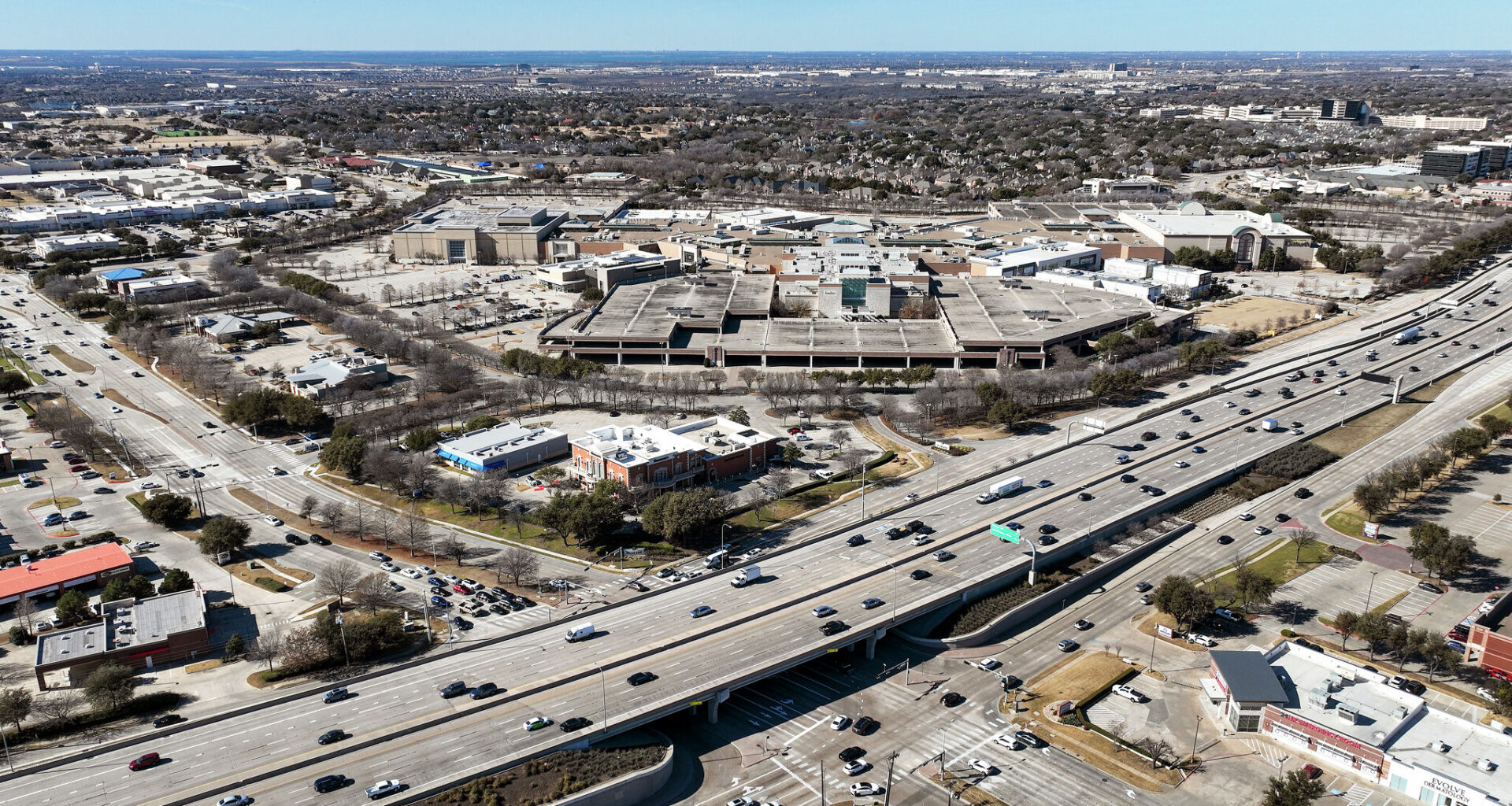
Aerial view of The Shops at Willow Bend, with the Dallas North Tollway at bottom, on Thursday, Feb. 5, 2026, in Plano.
Smiley N. Pool/The Dallas Morning News
Every hockey fan knows that game nights don’t actually start at puck drop.

Whether you get there in time to see warm-ups or after the Zamboni finishes its final pre-game pass is a matter of preference, but getting to the arena is when the night really starts.
American Airlines Center, though imperfect, was accessible by foot, train and car, depending on where you lived. How will that look at the Dallas Stars’ next arena at Plano’s The Shops at Willow Bend?
Article continues below this ad
In a wide-ranging interview with The Dallas Morning News, Stars president and CEO Brad Alberts and Steve Levin, Centennial CEO and part-owner of the Willow Bend site, discussed the team’s move up the Dallas North Tollway. Here’s how transportation to and from the stadium fits into the conversation.
“Clearly, listening to fans, I think the one thing that I want to reiterate to this group is we understand the transportation. We get it,” Alberts said. “We are 100% dedicated to getting that right. The last thing that anybody wants is to have the experience … be worse than the way it is right now at AAC. We’re going to try to enhance that, that’s the goal.”
Public transit
Alberts said the city of Plano and the Stars will conduct a “robust transportation study” this summer. That includes studying how people will enter the entertainment district, how people are directed to parking garages, how much surface parking is needed and whether or how to make the arena accessible by public transportation.
Article continues below this ad
“I knew that there wasn’t a DART station there a year and a half ago [when discussions in Plano started]. There’s not going to be a DART station there in 2031, so we understand that we need to study the transportation,” he said.
Related story: If Stars move to Plano, how will fans get to games? What to know about transit at Willow Bend
The nearest DART rail station to Willow Bend is in Addison, where the Silver Line stops at Addison Station and Knoll Trail Station, both about 6 miles as the crow flies south. There is a bus line that follows the Tollway north and stops near Willow Bend, but it only runs every 30 minutes during peak hours and every 40-60 minutes during off-peak hours. Alberts floated the idea of a shuttle from Addison on game days, which could be part of the transportation study.
The American Airlines Center, by contrast, is a block from Victory Station, which serves the Green and Orange Lines and is an easy connection away from the Red and Blue Lines. Even for drivers, seasoned Stars fans who didn’t want to deal with (or pay for) game-day parking knew that you could park near the Market Center Station off Stemmons Freeway and ride the train one stop to get to Victory Park.
Article continues below this ad
This is not to mention Fort Worth and the Trinity Railway Express, which directly connects downtown Fort Worth with Dallas by way of Victory Station in about an hour for $9. While Alberts and Levin did not address public transportation from Fort Worth, a committed public transit rider could still get to Willow Bend via a combination of the TRE and buses, but it would, at best, take 2½ hours.
Driving … then parking
Getting people in and out of Willow Bend — and supporting the parking necessary to do so — figures to be a much bigger piece of the puzzle.
Alberts said there are 4,200 existing parking spaces and three garages at the Stars’ Willow Bend site, thanks to outgoing tenants Neiman Marcus, Dillard’s and Macy’s. Those can be served by a variety of major arteries, according to Levin, including Plano Parkway, Park Boulevard, Midway Road, Communications Parkway, the Dallas North Tollway and the President George Bush Turnpike.
However, both emphasized that they are not looking to create an arena surrounded by surface parking lots, as some suburban sports venues tend to be (though they also emphasized they don’t think of Willow Bend as suburban). The transportation study will have to figure out how they can balance an entertainment district conducive to both 365-day-a-year revenue and managing a customer base that will mostly be driving into the area.
Article continues below this ad
Alberts also mentioned working with the North Texas Authority on mitigating traffic and possible new off-ramps as part of the transportation study, especially coordinating on potential highway traffic overlap with the Dallas Mavericks at their new Valley View arena.
“We do have a very good design site area, where there is a lot of infrastructure there, but we are looking at how to improve it,” Levin said. “The last thing you want is people to be frustrated coming in and out there, so that’s something we focus on everywhere. It’s got to be a place people really feel good about coming in, but the starting point is really a big advantage.”
Figure it out by 2035
While it’s no secret that trains and other forms of transit are generally a small piece of the transportation pie in the U.S. relative to other countries, every NHL arena in the country sells alcohol, making non-driving (at least by yourself) options important.
Alberts said ride-hailing figures to be a “big piece” of the transportation plan and study, calling to mind the dedicated ride-hailing pickup and drop-off lanes and areas at many airports these days. “By 2031, are we going to have robots picking us up and driving and dropping people off at events?” he mused, though Dallas’ robotaxi services, Waymo and Uber’s Avride, are both limited to specific neighborhoods in Dallas proper and ironing out some major kinks.
Article continues below this ad
In addition to transportation for fans, Alberts acknowledged that the move north is “a negative” to many game-day employees, noting that at the moment, a majority of employees live in the city of Dallas. Planning for the Willow Bend arena will include planning for whether they’ll be able to draw those employees from Collin County moving forward or need to help with transportation from Dallas.
Overall, Alberts and Levin’s approach to transportation is best characterized as, wait and see what the transportation study says. While they stand by moving to Willow Bend as in line with the movement of Dallas-Fort Worth’s center of gravity, transportation will be a work in progress.
“Think about the Texas Motor Speedway, when they first opened, and traffic, if you all remember that, it was a nightmare. Now think about how good the Cowboys in the city of Arlington have gotten over there. This will be an evolution,” Alberts said, calling transportation “No. 1” on his priority list. “100% we’re going to be on that, but at the same time, you’re not going to really know until 2031 when you have events. So this may be an evolution until 2035 to get all of that right. Who knows? We’re certainly going to study it.”