
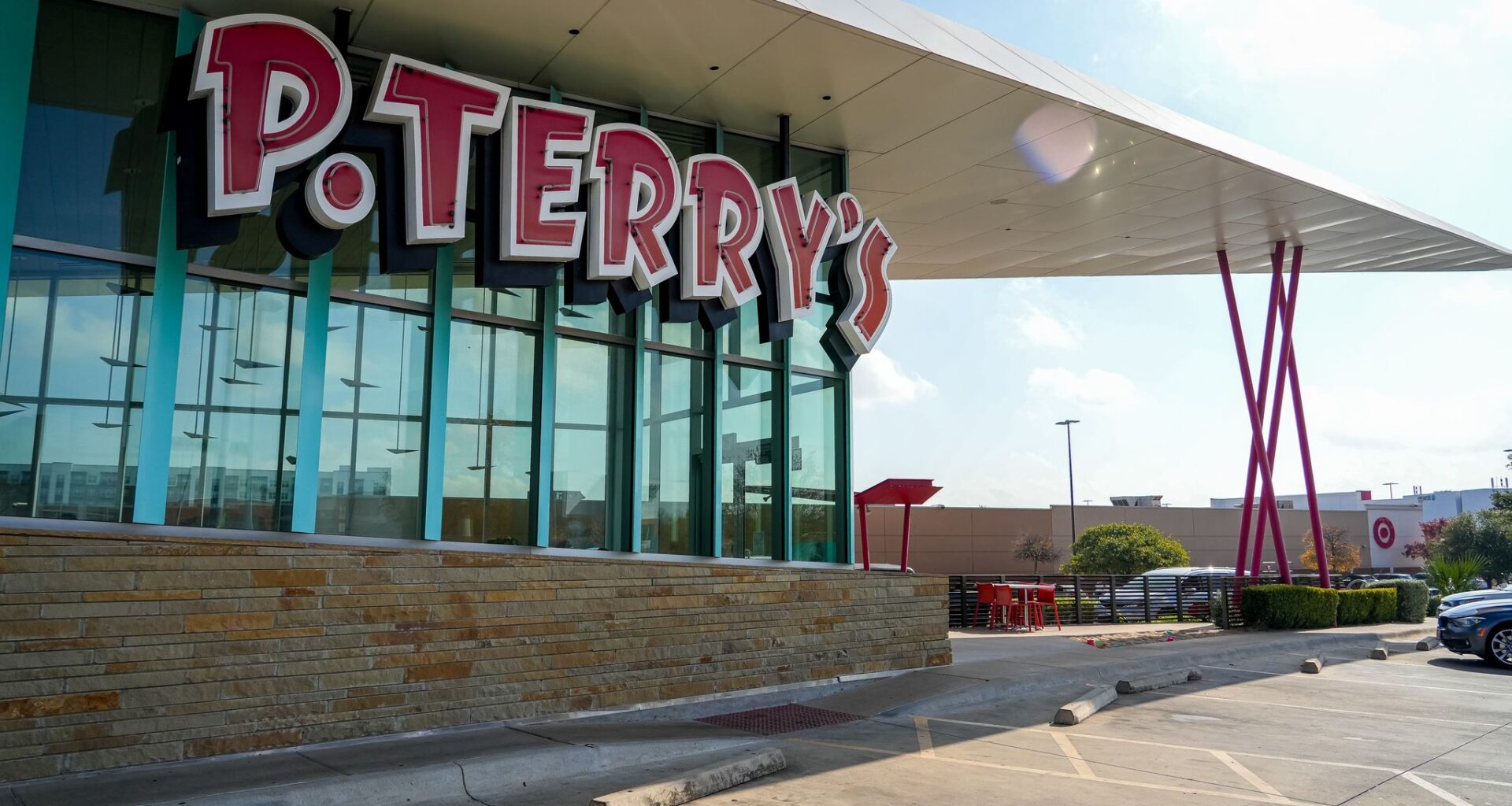
P. Terry’s Burger Stand’s location at 5701 North I-35 in North Austin, Texas on Saturday, Dec. 13, 2025.
Aaron E. Martinez/Austin American-Statesman
P. Terry’s Burger Stand, one of Austin’s largest homegrown restaurant chains, announced Tuesday that it is transitioning to employee ownership, a move co-founders Patrick and Kathy Terry said is intended to preserve the company’s values and reward its workforce.

In a video posted to social media, the founders said the company will open an Employee Ownership Trust, officially making employees beneficiaries of the business.
Article continues below this ad
The change will include profit-sharing with employees for the first time. Kathy Terry said the company is initially distributing 5% of its operating income to employees, but over time aims to increase that share to 20%. The benefit will be available to employees with more than two years of tenure.
P. Terry’s employs roughly 1,800 employees across the company’s restaurants and corporate operations, and about 400 of those will qualify for the benefit.
“From the very beginning, we’ve believed that taking care of people and building a great business are not competing ideas,” Kathy Terry said in the announcement. “This transition is the most honest expression of that belief we’ve ever made.”
Article continues below this ad
The change is a major shake-up for the company, which first opened as a single 527-square-foot burger stand at the corner of South Lamar Boulevard and Barton Springs Road in 2005. It has since grown to operate 38 locations across the Austin, San Antonio and Houston metro areas.
What is an Employee Ownership Trust?
An Employee Ownership Trust is a business structure in which a trust holds a controlling stake in a company’s shares on behalf of its employees, who then receive a share of the company’s profits as beneficiaries of the trust.
Article continues below this ad
The model has become a popular alternative for smaller companies that don’t want to sell their assets to private equity firms or large corporations because founders have the flexibility to transfer ownership without sacrificing the company’s existing culture.
The Terrys said the move was intended to “preserve the core values” of the burger chain after they step away from the company, but they reassured customers they have no plans to step away anytime soon.
Patrick and Kathy Terry, the co-founders of Austin burger chain P. Terry’s, announced Tuesday the company is transitioning to an employee ownership model.
Austin 360
An EOT differs from an Employee Stock Ownership Plan, which distributes shares and their cash values to employees through a defined contribution retirement plan.
Article continues below this ad
Kathy Terry said she considered transitioning to an ESOP, but instead chose to move forward with the EOT based on its straightforward bookkeeping requirements and compatibility with the chain’s slim margins.
“With an ESOP, every time an employee leaves, you have to buy them out,” Kathy Terry said. “We just aren’t sitting on that much cash.”
Plus, she said, workplaces with EOTs often see turnover rates plummet after a transition because employees become more personally invested in the company’s success.
Decision was decades in the making
Kathy Terry said she and her husband started the process of investigating options for succession planning back in 2016. At that time, they were considering selling the company but realized that handing off the reins would risk compromising the company’s core values.
Article continues below this ad
“We realized we don’t want to sell because the whole thought of selling — everything changes,” Kathy Terry said. “It’s going to be profit over people, and these are the people we love.”
They decided not to sell, but still had to figure out a way to protect the business in case something happened to them. Their children were young at the time, Kathy Terry said, and even if they were adults, she didn’t feel it would be fair to suddenly put them in charge over employees who had been there for decades.
Two years ago, the Terrys started working with Common Trust, a local business consulting group, to continue exploring their options for perpetual ownership plans. Kathy Terry said she latched onto the EOT right away because of its ironclad approach to protecting the company’s culture.
“It says we’re always going to provide high-quality food at a low price, the employees will always have financial benefit from working and building P. Terry’s,” Kathy Terry said. “These are basically the guardrails that protect the business in perpetuity.”
Article continues below this ad
A culture of giving
P. Terry’s has a history of altruism in its business practices.
A sign advertises the Statesman Season for Caring program at P. Terry’s Burger Stand’s location at 5701 North I-35 in North Austin, Texas on Saturday, Dec. 13, 2025.
Aaron E. Martinez/Austin American-Statesman
On four Saturdays per year, the company hosts “Giving Back Days,” donating 100% of profits to a select local charity or cause. P. Terry’s has donated nearly $3 million since the program began.
Article continues below this ad
The company also steps up during times of need in Central Texas. After catastrophic Hill Country flooding on July 4, 2025, at least one location hosted an emergency fundraiser to donate profits to Austin Disaster Relief.
The starting wage for P. Terry’s employees is $15 per hour — more than double the state and federal minimum wage of $7.25.
Kathy Terry said the transition to employee ownership is a natural extension of the company’s values.
Article continues below this ad
“For us, this transition is just doing what’s right,” she said. “These employees have worked alongside us and built this. Why should they not benefit from it? They deserve it.”
“We all come to our access in different ways, and I think a lot of us take for granted the access we were born into,” she continued. “My job is to share my access, not to hoard it. I think Patrick agrees with that. And it just feels good.”