
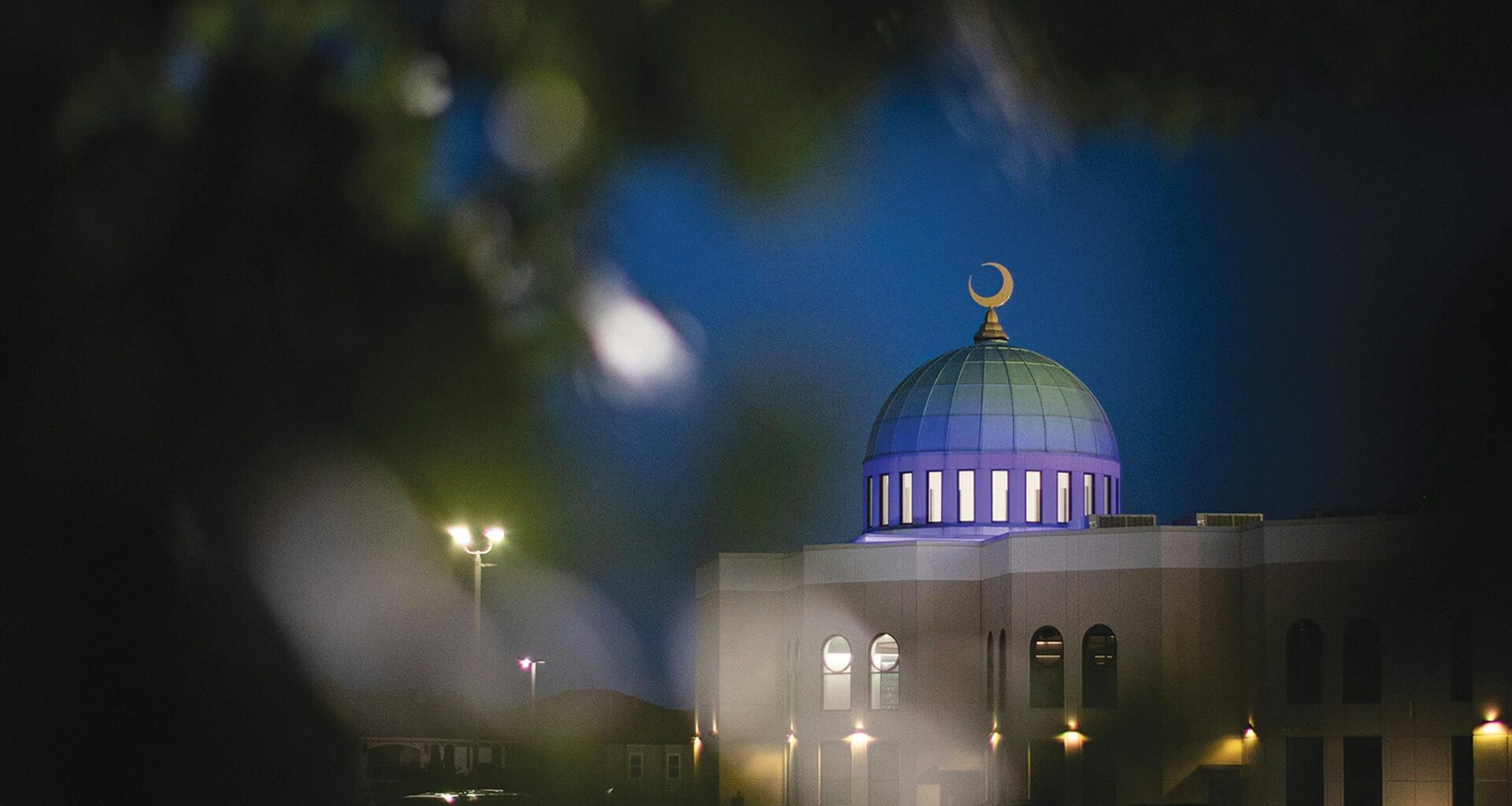
Sarah Sanders had spent the day in her small, windowless office drafting letters to funeral directors when her boss came in with a new request.
It was a late Monday afternoon in March 2025, and Scott Bingaman, the executive director of the Texas Funeral Service Commission, wanted her to put aside her other work and look into a year-old case. It concerned the East Plano Islamic Center, a mosque and Muslim community in North Texas known as EPIC. The soft-spoken 33-year-old Texas Tech University law school graduate had joined the commission, which regulates the funeral industry, only a few months earlier, after bouncing around law firms in Beaumont and briefly serving in another state agency. Most of her time in her new role in Austin had been dedicated to clearing a four-hundred-case backlog of complaints stretching back years. She figured the EPIC case would be just like the rest.
Sanders opened the agency’s file. A complainant alleged that the mosque was offering Islamic funeral services without a license. Other staffers had left several pages of analysis, in mismatched fonts and text sizes, summarizing evidence the commission had gathered. The file had been shelved for months, sidelined by other, more pressing ones.
Sanders took a few minutes to review one piece of the complainant’s evidence, a video that had appeared on EPIC’s YouTube page announcing a “one-stop shop” for funeral services. Families would call the mosque, and a funeral home it had contracted would transport the bodies to and from it for rites and burial—all for “around three thousand dollars.”
As a religious institution, EPIC was allowed under state law to perform funerals without regulatory oversight as long as it didn’t charge fees. But if it had done so, it would have needed a license, and its license had lapsed more than a year earlier. To Sanders, the video—which was posted before the lapse—did not provide definitive evidence that the mosque had been charging for services improperly. But that was the point of an investigation, she thought. She prepared to issue a cease and desist order: The facility would have to halt funeral services while investigators did their work. (EPIC would later argue that any money that changed hands was a voluntary donation and that it did not profit. The commission’s lawyers would counter that the definition of compensation was broader than profits.)
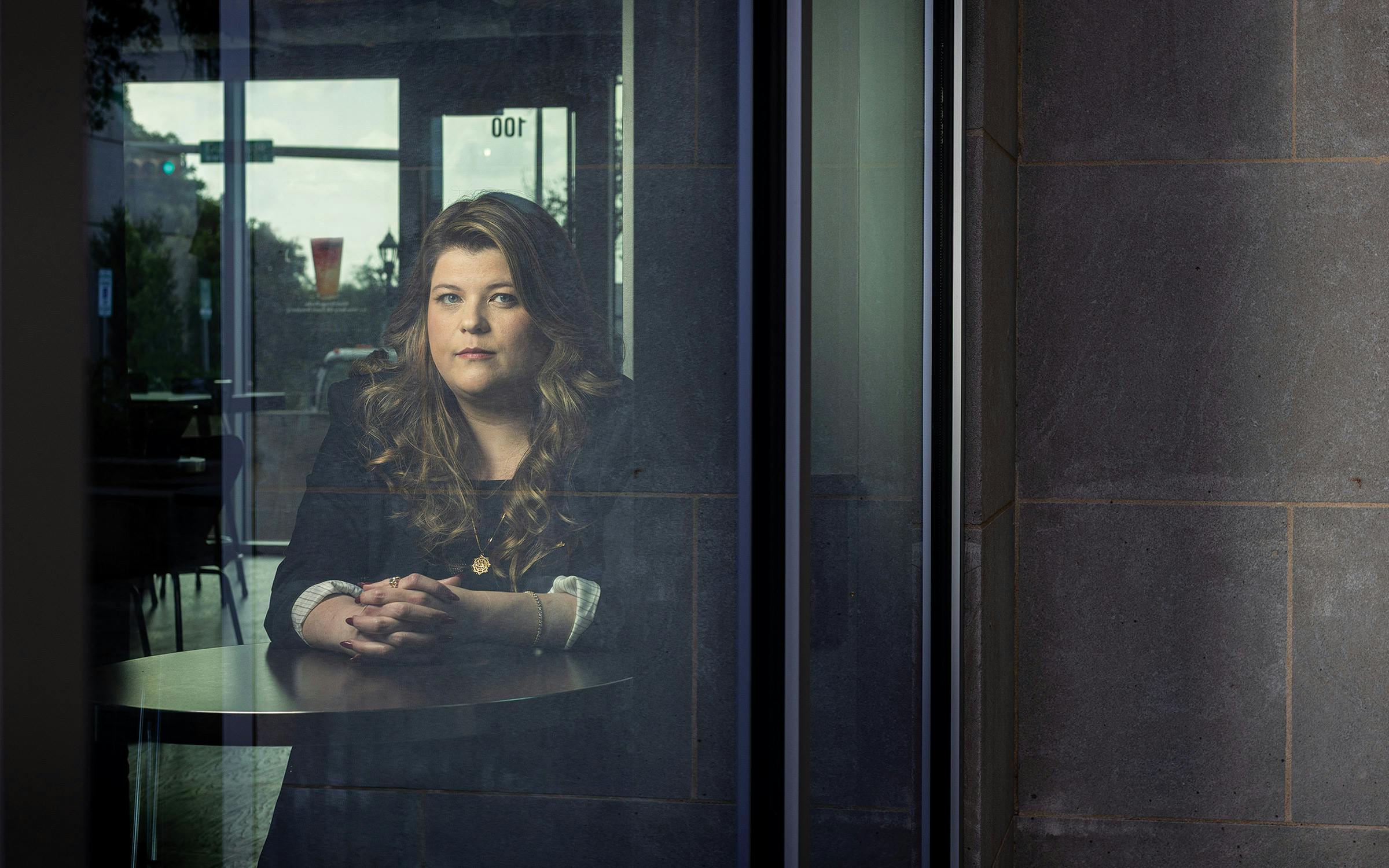 Sarah Sanders at Sweetwaters Coffee & Tea in Austin, where, she says, a meeting with the governor’s top lawyer left her unsettled about the EPIC case.Photograph by Tamir Kalifa
Sanders then turned to Bingaman’s second instruction, one that was far more unusual: Work on the case with Governor Greg Abbott’s general-
counsel division, a small group of lawyers in his inner circle. Sanders wasn’t sure why Abbott’s team was so interested in a routine regulatory matter; she had never discussed one with anyone from the governor’s office. But she trusted and admired Bingaman, who had wooed her to the agency with a pitch about building something together that would outlast them both. She forwarded the file to one of the governor’s lawyers.
The next morning, Trevor Ezell, the attorney leading Abbott’s general-counsel office, got on the phone with her. Sanders remembers Ezell, who had clerked twice for Supreme Court Justice Neil Gorsuch, emphasizing, over and over, how important the case against EPIC was to the governor. She didn’t ask why. She assumed he had explained it all to Bingaman.
In the evening, Sanders put together the usual enforcement documents, including a cease and desist order. At Bingaman’s request, she sent the draft to the governor’s office. Late that night, she and Bingaman got an email from Ezell. “Scott/Sarah, please see attached a suggestion,” he wrote. “Happy to discuss.” Attached was the draft of the order. She took note of the tracked changes to the document. (The Word file’s metadata indicates that Anthony Rodregous, another Abbott attorney, made the edits.) A boilerplate line, warning that if the mosque didn’t comply, the commission would “take legal action,” had been struck. In its place, the document now said the commission was “making a criminal referral” to the Collin County district attorney.
Sanders felt uneasy. During her short tenure at the commission, similar cases had been handled by the agency’s investigators, who worked to quickly bring potential offenders into compliance. Criminal referrals were usually issued only if the agency had completed an investigation and had findings that law enforcement could act upon, or if there was a serious threat to public safety, as in cases in which offenders were mutilating bodies or human remains were rotting in facilities.
But she’d recently been begging for a new legal assistant, or another attorney, and Bingaman had framed the governor’s general counsel’s office as a resource she should use. And it was late—after midnight—and Ezell and three other lawyers were waiting for her response. So Sanders accepted the changes. “Trevor,” she wrote back, “I greatly appreciate this. Wonderful edits.”
It would be months before she fully understood it, but Sanders’s reply helped set in motion what would become a yearlong campaign by the governor’s office against EPIC. That spring the funeral commission would handle many high-profile cases. The agency was investigating a University of North Texas program that had dissected more than eight hundred bodies and leased them to biotech companies and the U.S. Army, often without the consent of the deceased or their families; a Houston embalmer who allegedly cut off a dead sex offender’s genitals; and a Dallas funeral home that had reportedly accidentally shipped a stillborn baby to a Louisiana laundry facility. Abbott’s team would take an active role in none of those matters but weighed in often on the EPIC probe—requesting regular updates, coordinating public statements, and, at times, directing regulatory action.
Within twelve hours of Sanders’s accepting the edits, Abbott tweeted a press release announcing the funeral commission’s investigation of EPIC. Over the next seven days, he announced a host of other civil and criminal investigations into the community, including from the Texas State Securities Board, the Texas Workforce Commission, and even the Texas Rangers.
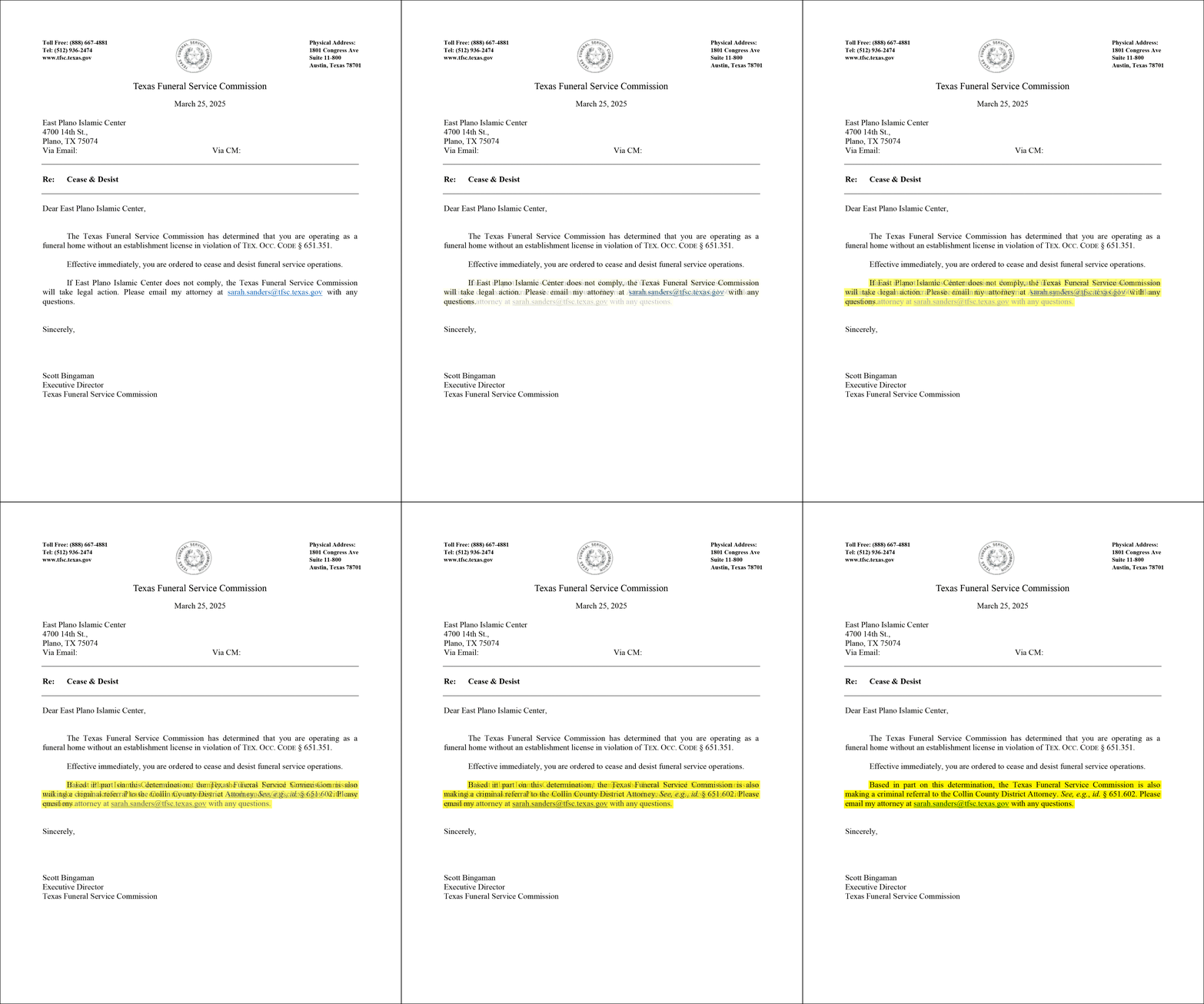 The modified cease and desist order for EPIC that Greg Abbott’s general counsel, Trevor Ezell, sent back to the funeral commission, reflecting edits the metadata suggests were made by Anthony Rodregous, a then deputy general counsel.Obtained by Texas Monthly
When asked about the role of the governor’s advisers in steering the funeral commission’s investigation into EPIC, Abbott’s press secretary, Andrew Mahaleris, sent Texas Monthly a statement saying that “entities seeking to impose Sharia law in our communities are not welcome in Texas.” Under Abbott’s “decisive leadership,” he continued, “efforts to create Muslim-only ‘no-go zones’ have been stopped in their tracks.” Mahaleris also defended the governor’s authority to direct state agencies and called the coordination “necessary and common.”
But interviews with multiple former funeral commission employees and Texas Monthly’s review of thousands of emails, texts, and documents tell a different story about the commission’s case against EPIC. It is the story of Abbott advisers’ use of a state agency as a weapon against a religious minority—placing a mosque and its congregants in the crosshairs of a GOP-led effort to combat what some Republican politicians have labeled the “Islamification” of Texas. It is the story of how the governor’s office continued its attacks against EPIC even as the underlying allegations against it collapsed.
When a handful of Muslim families in east Plano began holding informal prayers in private garages in 2003 to avoid the long drive to the nearest mosque, they didn’t foresee how large their community would become. By the next year, organizers, who had formed a nonprofit named the East Plano Islamic Center, realized they had enough practitioners to start a formal place of worship. They moved services to a small trailer, then rented a larger space at a local strip mall. By 2008, tens of thousands of Muslims had settled in the area, drawn to the Dallas suburbs by good schools and affordable housing, and EPIC built its first mosque. In 2014 around one thousand worshippers were attending prayer services, and leaders broke ground on a permanent place of worship and community center on land they had purchased ten minutes from the Plano municipal center.
For most of its existence, EPIC went largely unremarked upon by the powerful state GOP. But in February 2024 the Islamic center announced its largest project yet: a 402-acre development called EPIC City that would include one thousand homes, a school, and retail stores. By April of that year, EPIC shared mock-ups and renderings in a YouTube video: “It’s a way of life, a meticulously designed community that brings Islam to the forefront,” a voiceover declared.
When the right wing caught wind of the project, the backlash was swift. In February 2025 anti-Muslim activist Amy Mekelburg, the Nevada-based founder of an anti-Muslim website, posted about EPIC’s plans on X, calling the development an “Islamic stronghold.” Other Republicans soon piled on, calling it a “compound” and a “radical enclave.”
The outrage caught the attention of the governor. “To be clear, Sharia law is not allowed in Texas,” Abbott responded to one of Mekelburg’s posts. “Nor are Sharia cities.” A firestorm—leading to at least eight pieces of federal legislation and a congressional “Sharia Free America Caucus”—had been set off.
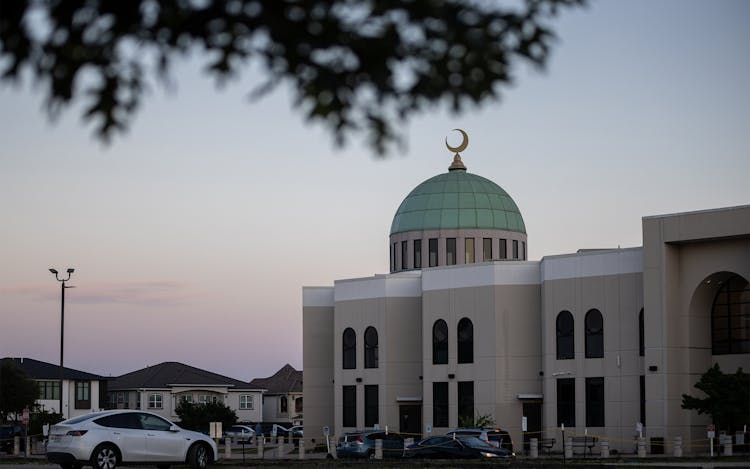 The sun sets over the East Plano Islamic Center on May 14, 2026. Photograph by Tamir Kalifa
 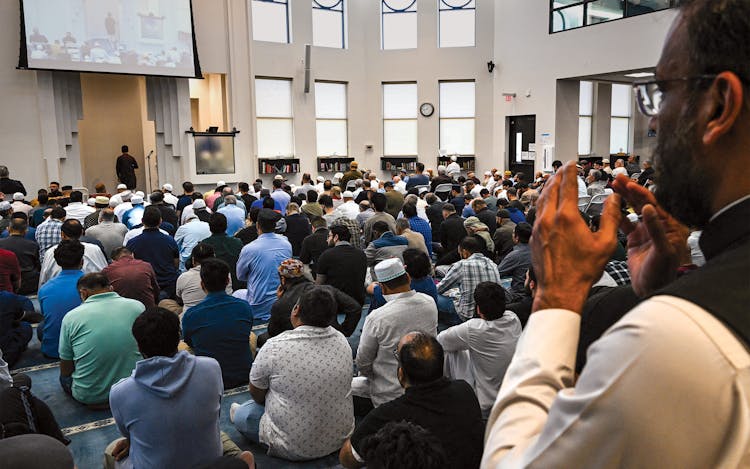 East Plano Islamic Center congregants praying in April 2025. Ronaldo Schemidt/AFP via Getty
In the year since the governor got involved, Republican candidates up and down the ballot have campaigned on opposition to sharia—Islamic moral prescriptions partly based on the Quran. Vinny Minchillo, a Republican strategist who runs a Plano-based advertising firm, told me that several legislative races he’d consulted on in the March GOP primary became referendums on which candidate more strongly opposed the “Islamification of Texas.” As the furor over immigration receded earlier this year, the party came to believe this could be a winning issue. “Not to put too fine a point on it,” Minchillo continued, “but it’s a very straight line from ‘Gee, the Muslims who are in my town’ to ‘Well, those Muslims over in the Middle East that are causing trouble and being terrorists.’ ”
A spokesperson for the planned development declined to answer questions, and the president of EPIC, Sameer Siddiqui, and other members of the board did not respond to multiple requests for an interview. Of the more than a dozen community members contacted—congregants, former and current officials—no one would agree to a chat. But according to one of EPIC’s lawyers, Dan Cogdell, what’s happened to the mosque has been “frightening.”
Cogdell has represented some of the most controversial defendants in Texas history—including Attorney General Ken Paxton during his impeachment and Clive Doyle, a survivor of the FBI’s deadly 1993 raid on the Branch Davidian sect’s compound near Waco. But the target on EPIC and its affiliates, he told me, was worse than anything he’d ever seen. His firm has received “certified hate mail,” he said. “I mean, I’ve represented people on death row and never received this much hostility.”
At first the invective aimed at EPIC was little more than online vitriol. Then in March 2025 came the state’s investigations and Sanders’s cease and desist letter. Suddenly there was force of law behind the attacks.
Muslim faith holds that the deceased should be buried as soon as possible, and prohibitions against embalming and cremation make prompt interment a practical concern as well. That’s why mosques encourage burials within 24 hours, accompanied by only modest rites for the bodies—cleansing, shrouding, prayer. For years, EPIC had offered those essential services to its congregants. When the Islamic center received the cease and desist order, however, its funerals came to a stop. As Muslims died in east Plano, grieving families were barred from performing some of their most sacred rites in their home mosque.
When former Confederates rewrote the Texas constitution in the 1870s, they sought to roll back the centralized government brought about by Reconstruction. Governors in Texas have had quite limited powers ever since. Lawmakers, not the top executive, create new state agencies. Much of the bureaucracy, including the funeral commission, is run by boards whose members serve staggered six-year terms. Though those members are appointed by the governor, they serve for longer than a governor’s four-year term, which theoretically insulates them from undue influence.
Months before Sanders drafted the cease and desist order against EPIC, however, Abbott’s team had begun a push to concentrate executive power. Ahead of the convening of the Eighty-Ninth Legislature, the governor’s chief of staff, Robert Black, a heavyset man with neatly parted brown hair, had summoned the executives leading Texas’s regulatory agencies for an in-person meeting with no announced agenda.
On January 8, 2025, Scott Bingaman walked into the governor’s press conference room in the Capitol for that meeting, eager to build a relationship with Abbott’s team. Four months into his job as the funeral commission’s director, Bingaman still had a lot of cleaning up to do. The agency had burned through five executives and interims in five years, and a scathing March 2023 report from the state auditor had found that unauthorized users had access to sensitive records, among other serious deficiencies. Bingaman, who had served as a mechanic in the Coast Guard and spent fifteen years in various positions across state government, including as a director in Governor Rick Perry’s criminal-justice division, believed he had the discipline to get things in order and the skills to get the commission what it needed from the state: more staff and increased funding.
Black (who did not respond to an interview request) delivered two directives, according to Bingaman. First, he ordered state agencies to remove all references to DEI from their websites. Second, he said officials must tell the governor’s office about anything “politically sensitive” inside their agencies. Don’t comply, Bingaman recalled the message suggesting, and you’ll lose your job.
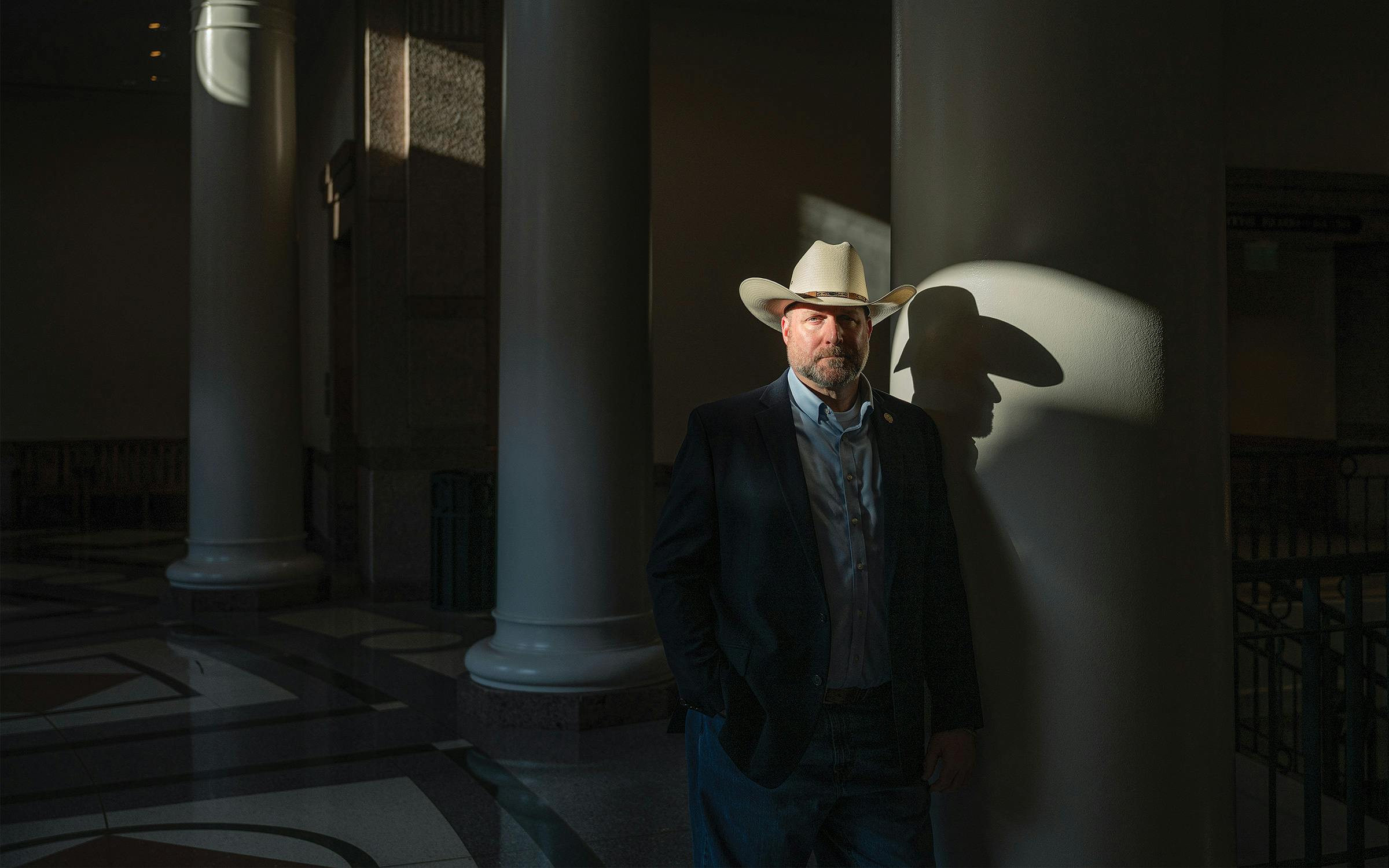 Scott Bingaman, former executive director of the Texas Funeral Service Commission, at the Texas State Capitol, where he was invited to an unprecedented meeting with the governor’s chief of staff in January 2025.Photograph by Tamir Kalifa
The directness unsettled Bingaman. He stopped to talk to a few other agency heads after the meeting and asked if this type of briefing was normal. “I got cut off pretty quickly,” he recalled, “and they said, ‘No, we’ve never done this before; this is a first.’ ”
But Bingaman still believed he could forge a good working relationship with the governor’s office. In the ensuing weeks he periodically sent drafts of press releases to Alex Aragon, the adviser in Abbott’s budget and policy division assigned to work with the funeral commission. He alerted Aragon (who declined an interview request) to cases that might make headlines. He blind copied Aragon when responding to media inquiries.
Then one weekend in late March 2025, as right-wing activists continued their campaign against the mosque, Bingaman caught wind of the uproar over EPIC. He recalled the commission’s shelved 2024 probe into the mosque and thought it was credibly founded. When Bingaman went to work that Monday, he called Aragon to tell him about the case. Bingaman told me that because this was a regulatory action, he “had a duty to inform” the governor’s office.
Aragon’s response, according to Bingaman, was “Holy s—.” The adviser excused himself. When they spoke the next day, Bingaman recalled, Aragon said he had received a text directly from Abbott saying the funeral commission was his new favorite agency.
The governor’s machine quickly went to work against EPIC. “They wanted to coordinate with us,” Bingaman said. “So I told Alex, ‘Yeah, we’ll get this taken care of.’ ”
Usually, the governor’s advisers confine their communications to agency heads and top officials. But this time, Bingaman told me, Aragon asked if the governor’s lawyers could work directly with the commission’s lawyer. Bingaman directed Sanders to draft the cease and desist order against EPIC.
This wasn’t the only enforcement action the governor’s team seems to have had in mind. Aragon, Bingaman told me, later called with a second request: See if there’s anything about EPIC you can report to the Texas Department of Banking, the state’s financial institution regulator, and its commissioner, Charles Cooper, so it, too, could kick-start a probe. Aragon told Bingaman to blind copy him on the email with the report so that Aragon could print it and share it. Then Aragon called multiple times, according to Bingaman, to check in on behalf of the “powers above.”
Bingaman wrote a report flagging that EPIC may have been illegally reselling burial spaces. According to a memo from the banking department, the official who oversees cemetery regulations reviewed the allegations and found that none of the six cemeteries Bingaman flagged were owned or operated by EPIC and determined that there was no course for action. Cooper, texts show, shared his department’s findings with the governor’s office.
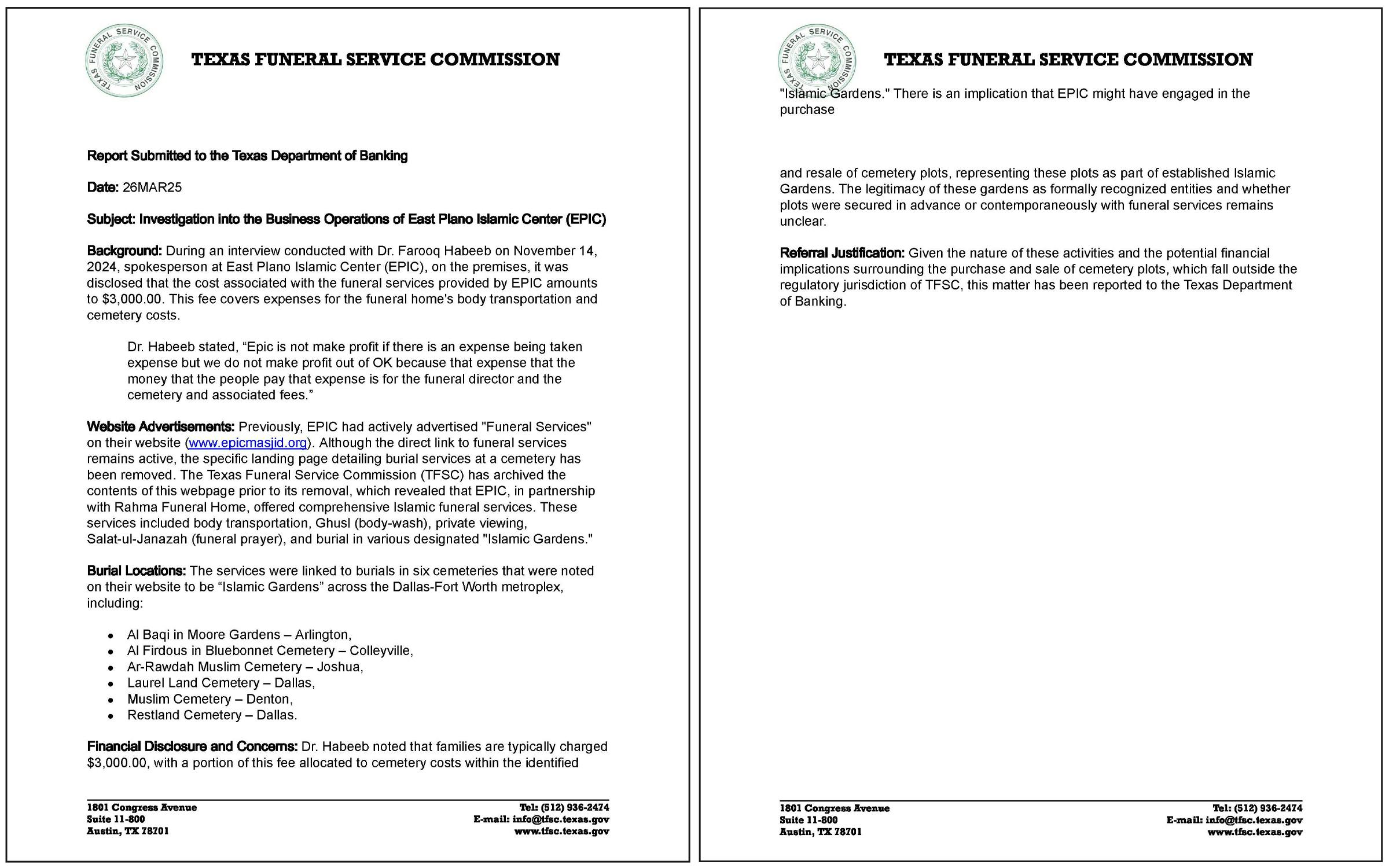 The report Scott Bingaman sent to the Texas Department of Banking, obtained via a public-information request.Obtained via public information request
Back in the funeral commission, the day she sent the cease and desist order, Sanders walked into Bingaman’s office to unload. They were friends, she thought—or at least close enough to be honest with each other. She was exhausted from the late-night work and confused about what she was being asked to do. Bingaman explained that the EPIC case had exposed a regulatory loophole that needed closing. He later told me that Abbott had offered an opportunity that he was glad to take, given the agency’s backlog: the chance to push an old case through using “the leverage in the strong arm of the governor’s office.”
When we spoke in May 2026, Bingaman told me he had been “on board” with what the governor was saying about EPIC and was alarmed by the proposed development of EPIC City. He insisted that he never let his opinions influence the commission’s investigation, but he, too, was concerned that the mosque was building an exclusionary compound in North Texas. “We had this case open before all this nonsense happened,” Bingaman said.
After Bingaman addressed Sanders’s confusion, he told her that the funeral commission was going to have to look into other mosques. Sanders pushed back: She believed the commission shouldn’t go out of its way to pursue houses of worship in one religion. Bingaman argued that it was their job to investigate whether facilities with lapsed licenses—in this case, mosques—were breaking the law. “We wanted to see what other mosques were doing, if they were doing the same thing or not,” Bingaman told me, adding, “It wasn’t just EPIC. We looked up every Islamic center we could find in the state of Texas.”
It was only a matter of hours before Sanders found another reason to be confused by Bingaman’s instructions. Aragon called Bingaman that afternoon, and, according to Bingaman, told him to delete the emails sent between the commission and the governor’s office. Bingaman was okay with the directive because he believed the emails were backed up elsewhere. He instructed Sanders to comply.
She hesitated. She had responded to public-records requests in a prior role at the Texas State Board of Pharmacy and believed that destroying emails from the governor’s office would violate records-retention laws.
Indeed, Bill Aleshire, an attorney focused on public transparency and a former Travis County judge, told me that such a directive could violate civil and criminal state law. Texas requires state agencies to certify the amount of time certain communications are maintained before deletion, and the funeral commission in turn requires that administrative correspondence, for one, must be maintained for four years. “Tampering with a government record, for example, under certain circumstances is a criminal offense,” Aleshire said. Anyone who had deleted the emails “could be prosecuted,” he added.
The next morning, the commission got a public information request concerning EPIC. Sanders asked the attorney general’s office to rule on whether the emails needed to be released at all, figuring they might be confidential because of the active investigation. The attorney general’s office would later rule that the funeral commission could withhold the records under attorney-client privilege. Sanders never deleted the emails, though, which got her in trouble. In her official personnel file, obtained via a records request, sits an unsigned draft of a memo—“a formal notification that insubordination will not be tolerated”—listing a series of issues she was to be disciplined for: “Scott Bingaman, Executive Director, directed you to delete a particular set of emails at the request of the Governor’s Office,” it begins. In requesting the outside opinion, Sanders had “caused issue [sic] with the Office of the Governor and placed the agency in a disparaging position.”
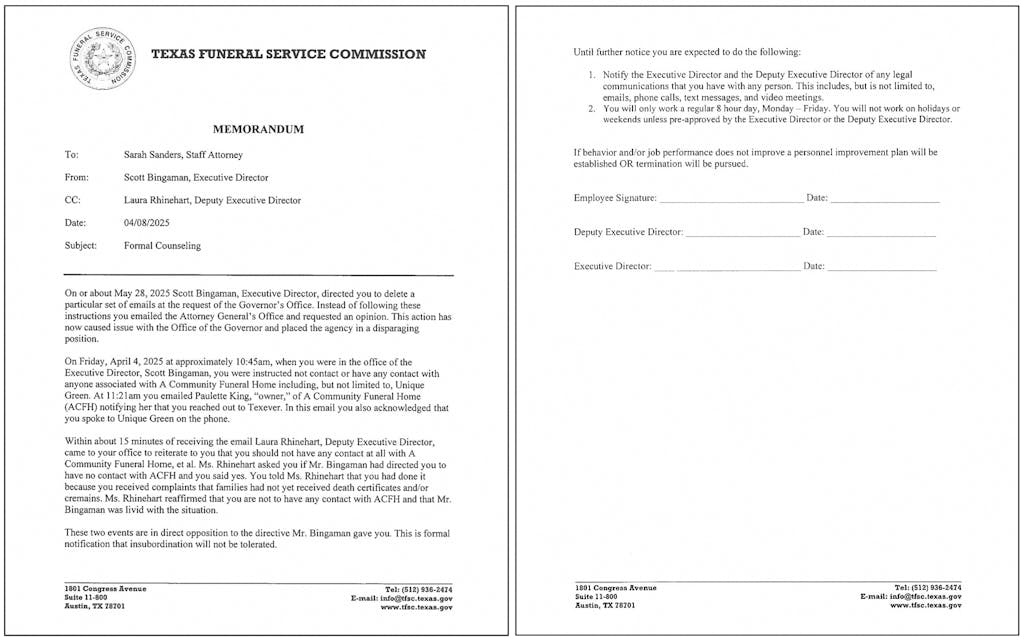
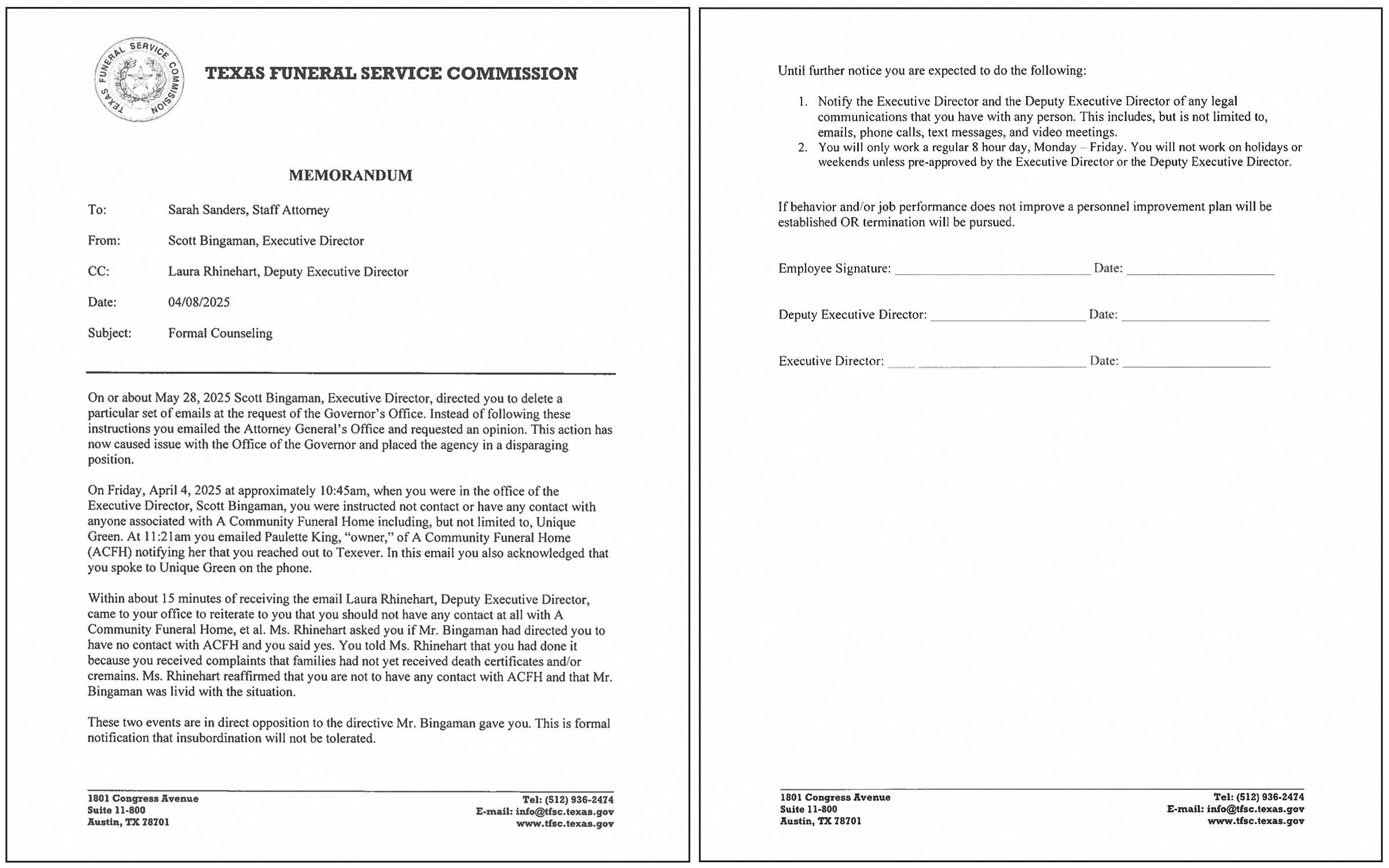 An unsigned draft memorandum in Sarah Sanders’s personnel file, obtained by Texas Monthly, in which she was reprimanded for not complying with a request from the governor’s office to delete emails. Obtained by Texas Monthly
Meanwhile, Bingaman continued searching for other possible offenders. The Monday after the EPIC probe was launched, he came across the Islamic Center of Greater Austin. No one had filed a complaint against it, but Bingaman said he was sure, after researching what it offered for funerals, that it was operating without a license. He told Sanders to write a “notice of complaint” to the Austin mosque requesting records of its funeral services.
Sanders told me she felt queasy about the demand, but that ultimately she had faith in the legal process; if the investigation were handled by the book, the commission would find no wrongdoing, and the Islamic center would be cleared. She wrote the notice. (The funeral commission did not respond to an inquiry about where the probe stands.)
Sanders emailed Bingaman the notice, and he forwarded it to Aragon. Bingaman felt great about the case. The funeral commission was finally doing what he had promised when he took over: cracking down.
Over the next month, Aragon would help the commission think through other ways to ensure that EPIC would not get relicensed, even if it came into compliance after the cease and desist order. On an April call, a recording of which was obtained by Texas Monthly, Aragon told Bingaman that the governor’s general-counsel division was “going to look into y’all’s code and see if there’s, like, other ways to not get a license, right.” He added, “The idea here is you don’t want them operating, period.”
“Yeah,” Bingaman responded. “I got it.”
Aragon then raised the possibility that the governor’s lawyers could find a way to use EPIC’s “moral and ethics code” as a legal basis for permanently denying it a license.
Maybe, Aragon added, Sanders could start looking into it.
Listen: Scott Bingaman, executive director of the Texas Funeral Service Commission, discussed an upcoming meeting with EPIC’s attorneys during an April 14, 2025, phone call with Alex Aragon, one of Greg Abbott’s budget and policy advisers. In this excerpt of the call, which was obtained by Texas Monthly, Bingaman outlines his strategy for that meeting, and Aragon responds that “GC,” or the governor’s general counsel, is going to review the funeral commission’s policies to try to find a way to prevent EPIC from becoming licensed again. “The idea here is, you don’t want them operating, period,” Aragon tells Bingaman.
They hung up. Bingaman began to have doubts about the direction of the case. He had been hopeful the commission could find a peaceful resolution with EPIC. But the governor’s advisers didn’t seem interested in a peaceful resolution.
Within a few weeks, Aragon would open a direct line with Sanders. In late April he asked if she’d be open to meeting over coffee. He didn’t say what he wanted to discuss. “I talked to my mom and my grandparents and everyone else,” she told me, “trying to figure out, ‘Why does this guy want to have coffee with me?’ ” Eventually she came to think that Abbott’s team wanted to recruit her. Sanders cleared the meeting with Bingaman, who was slightly annoyed that Aragon was talking to staff behind his back but told her to go nonetheless. Then, just before they met, Aragon called to say that Ezell, the governor’s general counsel, would be joining them.
Because this would be their first time meeting in person, Sanders restyled her long dark hair in her office, touched up her makeup, and put on a blazer she kept on a coat rack for trials. Then she headed to Sweetwaters, a coffee shop just a few blocks from the Capitol.
She arrived early and grabbed a large table by the entrance of the cafe. Aragon, a tall man with neat hair and an easy confidence, showed up right on time. He bought Sanders a small iced mocha; she was too nervous to have caffeine but appreciated the gesture.
Ezell walked in a few minutes later. With large, round glasses and buzzed hair, he had a nerdy, disarming look. For a few minutes, the trio’s conversation drifted across different topics—state funding, cases the agency was investigating, and a new attorney the funeral commission was hiring named Christopher Burnett.
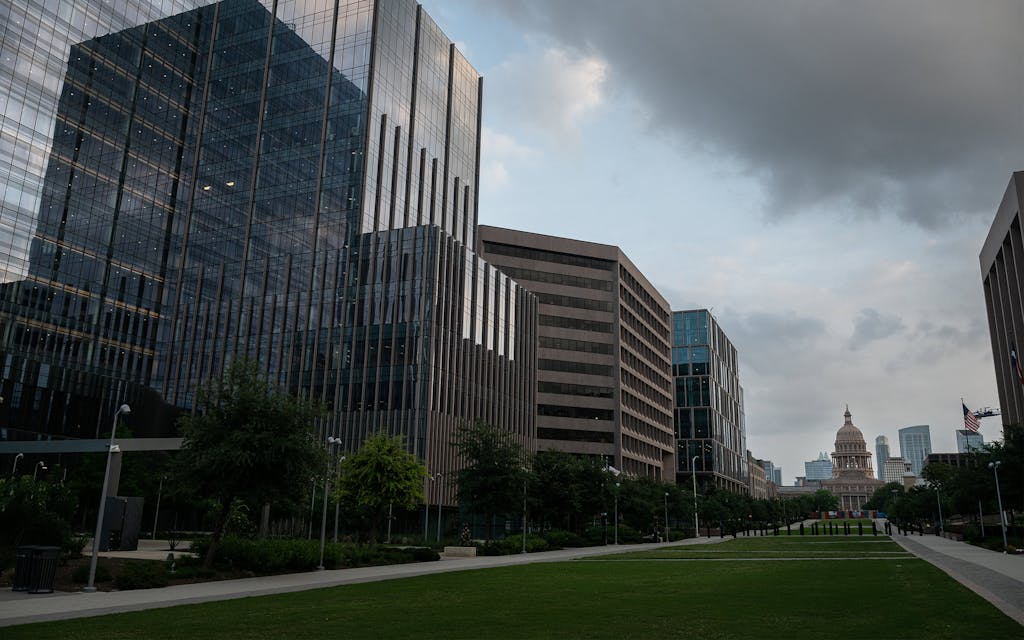 The George H. W. Bush State Office Building, in Austin, which houses the Texas Funeral Service Commission.Photograph by Tamir Kalifa
Halfway through the meeting, the talk turned to EPIC. Sanders had been growing increasingly uncomfortable with the case and had stopped attending her Episcopalian church out of shame. Her rationalization of her work had been that from a consumer-protection angle, it was sometimes important to investigate larger religious communities. She recalled telling the lawyers when EPIC came up that she always worried about the safety of little girls.
Ezell, she told me, replied that the prophet Muhammad had a child bride and then asked what else Muslims would permit. He kept a slow, calm monotone, she remembered, and they locked eyes. “It was just so matter-of-fact,” she told me. (Ezell didn’t respond to an interview request. Aragon directed questions to the governor’s press secretary, Mahaleris, who did not answer a list of emailed questions about the Sweetwaters meeting or Ezell’s comments.)
The table fell silent for a few seconds. Sanders was suddenly hyperaware of the customers that surrounded them—how close the tables were, how loudly her group had been talking. She stumbled for a reply. Eventually, she muttered that pedophilia was a concern with all religions, including Christianity.
Ezell changed the topic, Sanders said. According to her, he told her that she stood out among the bureaucrats the governor’s advisers had worked with on the EPIC case. The job of the governor’s general-counsel division, she remembered him saying, was simple: Abbott decides what he wants done, and the attorneys find a way to do it. Then, she said, Ezell launched into a job offer; the governor was looking for a new attorney—and even if Ezell didn’t like the idea of poaching one from the funeral commission, he was in a hurry.
After, when Sanders told a coworker about her skepticism about taking the job, her colleague was annoyed that she’d even consider passing it up. She wouldn’t really be affecting anything, the coworker told her. (Sanders later told me that wasn’t true. “Lawyers are not cogs in the machine!”) She applied the next Monday and was scheduled for an interview that Friday. “As odd as everything was, all the red flags that were going up, it’s like I didn’t want to believe it,” she later recalled. “I wanted to think that I was just being paranoid because the alternative was just too awful.”
The morning of the interview, she withdrew her application. In an email to the governor’s office explaining her decision, Sanders wrote that she had “prayed on it extensively.” There was more the funeral commission had to accomplish, she added. It would have trouble finding a replacement attorney. She wrote that she “must put Texas before myself.”
What Sanders didn’t put in writing was why she really withdrew. She frequently told me about her disagreements with the governor’s policies—the “people drowning in the river,” she’d say, referring to the migrants who died crossing the Rio Grande because of Texas’s border-enforcement efforts. She was prepared, though, to put those moral qualms aside for the job.
But Ezell’s comment at Sweetwaters had unsettled her in a way nothing before had. “I would rather stay somewhere that is stressful and on fire where I know I’m doing the right thing,” she told me, “where no one will ask me to do something I don’t believe in.”
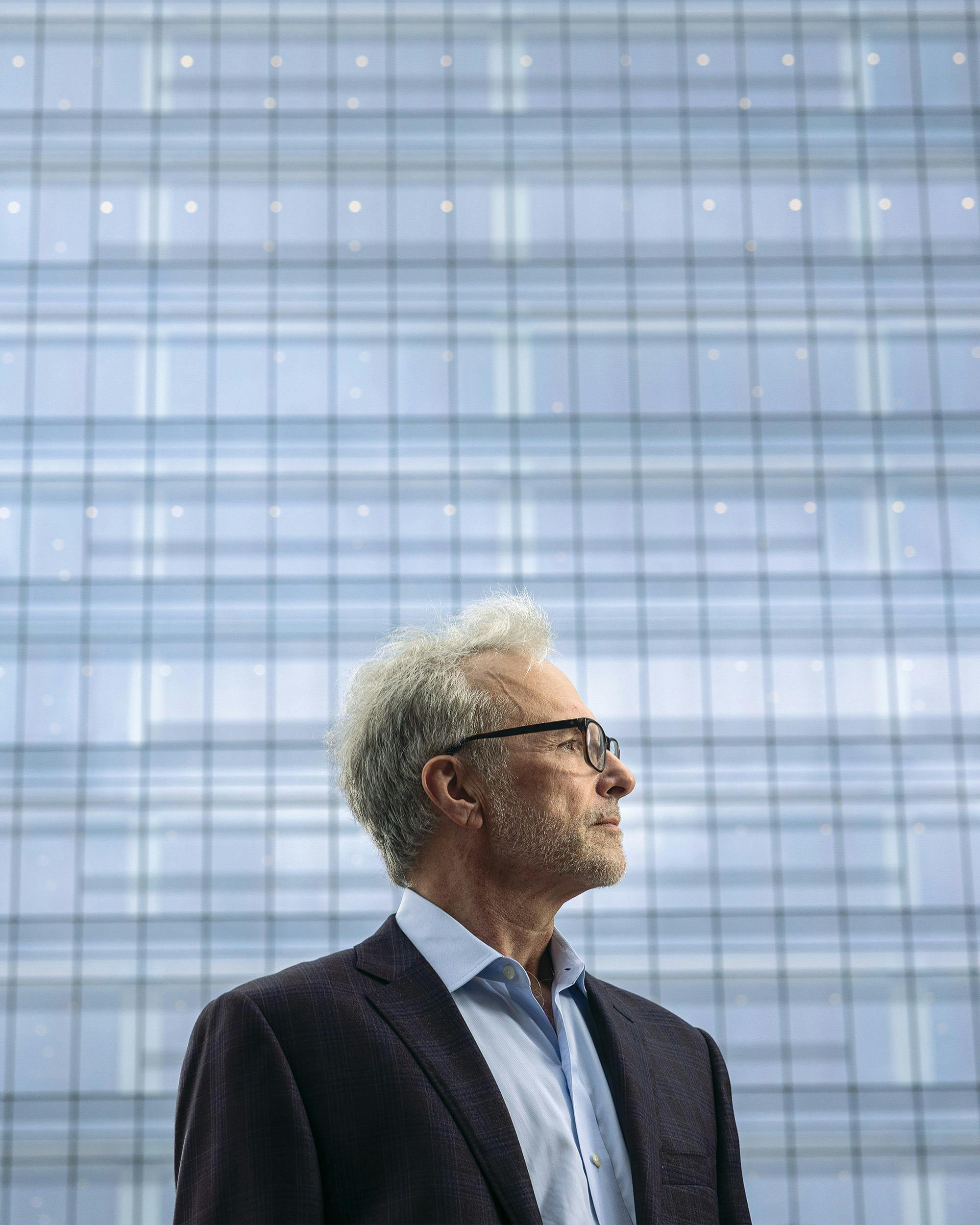 Christopher Burnett, a funeral commission attorney who was fired in July 2025, says he was taken aback by the governor’s advisers’ involvement in the EPIC case. Photograph by Tamir Kalifa
Christopher Burnett, the new hire Sanders had discussed with Abbott’s advisers, had just arrived at the funeral commission’s office when he began to sense something was off in the agency. The 65-year-old public servant, who keeps a light stubble and speaks bluntly in legalese, had served in state government for decades, working across nearly a dozen agencies, including Governor Rick Perry’s general-counsel division and the Texas Ethics Commission. As he made the rounds at the funeral commission on his first day, he said, Kristin Tips, the agency’s chairwoman, introduced herself to him with a question: “Are you MAGA?” Burnett responded that he was a three-time Trump voter. This, he said, seemed to satisfy Tips (who didn’t respond to an interview request).
Later, Bingaman pulled Burnett into a meeting with Cogdell and another EPIC attorney. The discussion was cordial, and the case seemed straightforward, but Burnett met with Sanders afterward to get a full picture of the probe. As Sanders explained her coordination with the governor’s team, Burnett was taken aback. Under Perry he had done work similar to that of Ezell and Aragon, managing a portfolio of agencies, pushing the governor’s interests. He knew what those jobs normally involved—and did not involve. “I’m like, ‘What the hell is going on here?’ ” Burnett remembered thinking, “This is bizarre! You know, this is not normal—not normal behavior, not regulatory.”
When we talked, Burnett wanted to be clear that he is skeptical about whether Islam “is compatible with Western democracy.” But he was steadfast that it wasn’t the government’s concern. “Whether you like them or not,” Burnett added, “EPIC’s due process rights were violated.”
Burnett and Sanders would commiserate about the case often in the weeks to come. He turned his official focus to cases he considered more germane to the commission’s work: an investigation into a Houston mortuary, where families of the deceased had posted videos online of bodies rotting on the floor, and a probe into the Dallas funeral home that had allegedly shipped the remains of the stillborn baby to a laundry facility. “I mean, [the agency] really was a s— show,” Burnett told me. He added, “Doing any big investigation—you know, snooping around trying to find out, ‘Oh, did they maybe, kind of, sort of, possibly, do something wrong with these mosques?’—probably was a low priority.”
By the end of his first month, Burnett had come to believe the funeral commission would implode. One evening, as the sun set, he called Sanders. She had just clocked out and was driving home in the Hill Country. “This is pretty bad,” he told her. “This is gonna be really bad when this comes out.”
Burnett didn’t mention EPIC by name. Sanders didn’t have to ask.
All the Governor’s Men
Trevor Ezell
General counsel
Served as an assistant attorney general
under Ken Paxton before being hired by the governor in 2023.
Alex Aragon
Budget and policy adviser
Worked for Marco Rubio and the casino lobby before joining the governor’s office in 2021.
Bingaman, too, was coming to believe that the agency would implode, but for different reasons. In April, the commission’s staff had grown concerned that Tips, the chairwoman, was lobbying the Legislature—pushing for tort reform in her official capacity as commissioner. When Bingaman reported her to the governor’s office, he said, Aragon told him to rein her in. Bingaman didn’t know how to control his boss, but he met Tips for a one-on-one meeting to discuss the allegations and advised her to avoid going to the Capitol. Tips seemed amenable to the counsel. (Tips has denied the lobbying allegations. She resigned abruptly from the commission in March 2026 without explanation.)
Then, in late May 2025, Bingaman pressed Tips about finalizing a plan they had discussed for months: promoting Burnett to be the agency’s top attorney. Tips accused him of overstepping his authority. In June, when they had another argument about the matter, he got the feeling he was about to be pushed out.
On a Saturday afternoon over text, Bingaman pleaded with Aragon, whom he felt he’d earned respect from, to intervene. Bingaman asked to meet. “I’ve been a stalwart Abbott supporter,” he texted, “and have done everything that Robert Black instructed me to do back in January.”
That Monday they got on the phone. Bingaman recalled Aragon assuring him that they’d figure something out. But he never heard from Aragon again, despite ringing him at least three times to follow up.
The commissioners, led by Tips, voted to fire Bingaman that Wednesday. They cited poor leadership and communication skills.
To this day, Bingaman is outraged that the governor’s team didn’t defend him. He listed to me all that he had done for them: He pursued the EPIC case, he looped in the general-counsel division, and he worked closely with Aragon. In one interview, after an hour of talking, his voice rose: “Is this what happens when you’re loyal?”
Not long after he was sacked, Bingaman sued the funeral commission, Tips, and the other commissioners. His petition alleges that he was fired in retaliation for reporting Tips’s alleged lobbying to the governor’s office. The case is still open, but Bingaman has been unable to find government work since.
The same day he was fired, the governor’s office distributed a press release: Abbott had appointed Tips’s husband to the Texas Historical Commission. Two weeks later, campaign-finance records show that the couple had donated $5,000 to Abbott’s reelection campaign.
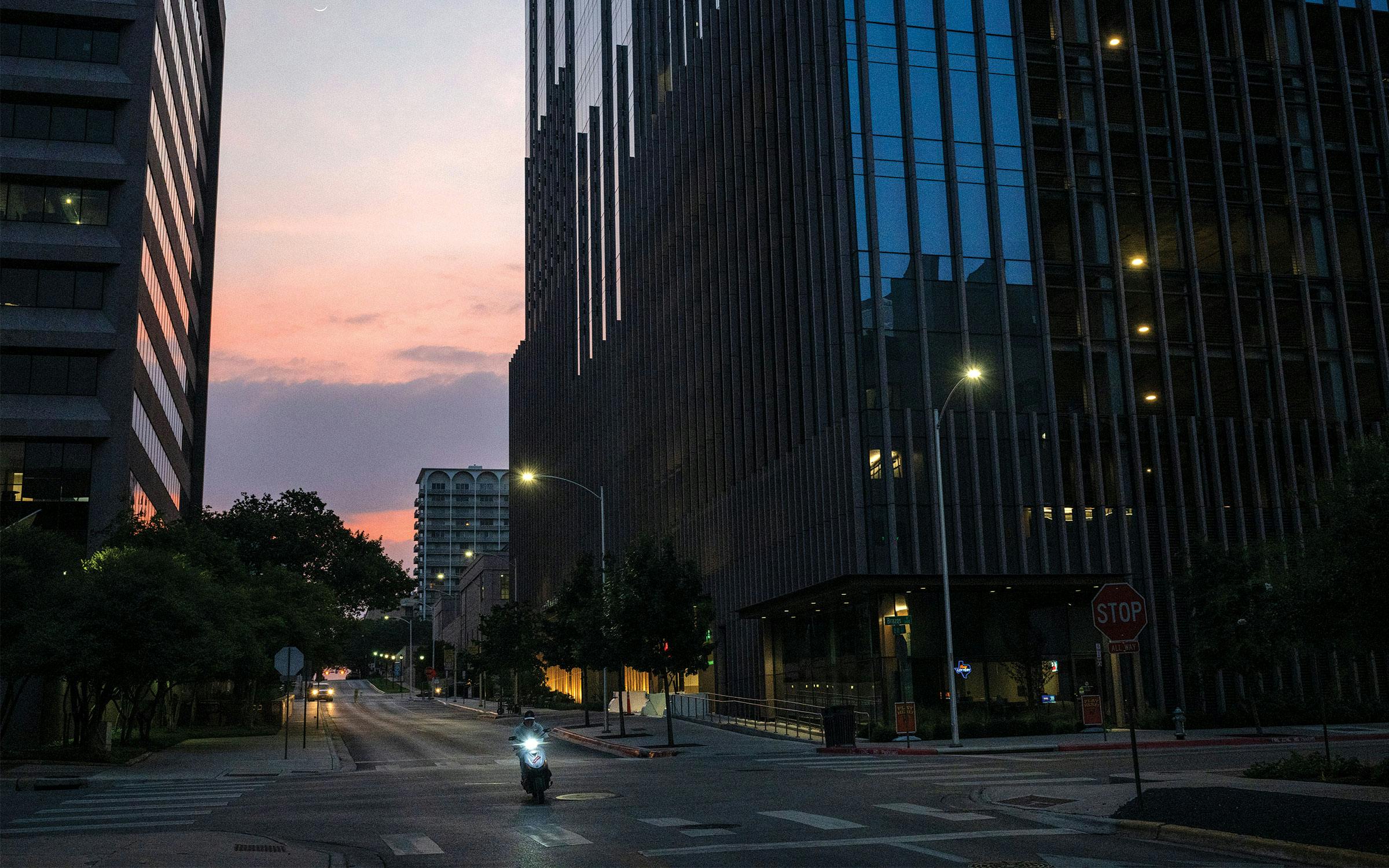 The Texas Funeral Service Commission has been mired in scandal and was the subject of a scathing 2023 state auditor’s report.Photograph by Tamir Kalifa
By the summer, the governor’s boasts of twelve investigations into EPIC quickly began collapsing, and he began referring to “about a half dozen” probes. By December, Abbott was flaunting “at least 4” active investigations. As of May 2026, not a single criminal charge has been levied against the mosque, and a federal probe into it—launched by the Department of Justice at Senator John Cornyn’s urging—was closed with no findings of wrongdoing.
In July 2025, EPIC sued the funeral commission, alleging that the state’s order unconstitutionally prohibited religious practices. EPIC’s lawyers argued that the commission’s abrupt shift in enforcement was overreach fueled by political hysteria.
The lawsuit, which remains ongoing, triggered the attorney general’s office to take over the commission’s defense in court. Within days Bingaman’s interim replacement sent a letter to EPIC, telling the mosque it could resume funerals; the commission’s policy had apparently allowed religious groups to perform funeral rites, and EPIC could do so provided it didn’t charge.
When news broke that EPIC could resume funerals, Sanders said, Aragon called her and patched in Ezell. The general counsel was “pissed,” she told me. Sanders recalled one of the last things she heard from Ezell before Abbott’s advisers hung up: The attorney general’s office had some explaining to do.
Sanders and Burnett both believed they would soon be axed. After Bingaman was ousted, Sanders had even gone to the Travis County district attorney’s public integrity unit with a trove of emails and texts about the EPIC case and Tips’s alleged lobbying in hopes that it might investigate the funeral commission and the governor’s office. Then, the Monday after the call, both attorneys were fired without cause. Sanders took a photo of her termination letter. She sent it to Aragon, but he never replied.
A few weeks later, Sanders and Burnett were served with a lawsuit. The commission was alleging that they divulged privileged and confidential information when they spoke to reporters about Bingaman’s firing and the commission’s dysfunction. The suits were dropped a few days later. Then the funeral commission, led by Tips, filed bar grievances against both, trying to strip them of their law licenses. The cases went nowhere.
Late last year, Burnett began looking for other work. He felt the governor’s office was exercising too much executive control, but he had devoted his whole life to public service and hoped that he’d just experienced one bad agency. In January 2026, he was hired as the Texas Veterans Commission’s new general counsel. A few weeks after he started, his boss told him to send a proposal for a new rule to the governor’s office for approval. The point of contact, Burnett learned, was Aragon.
Burnett reviewed the proposal, signed his name on it, and had a legal assistant email it. Aragon never responded. Then a few days later, Burnett said, his boss told him that they had “differing philosophies,” and he was given the choice to resign or be fired.
That night, when Burnett wrote his letter of resignation, he didn’t know what his boss had meant exactly. He’s still not sure. In the months since, Burnett hasn’t tried looking for government work. He doesn’t think there’s a place for him anymore.
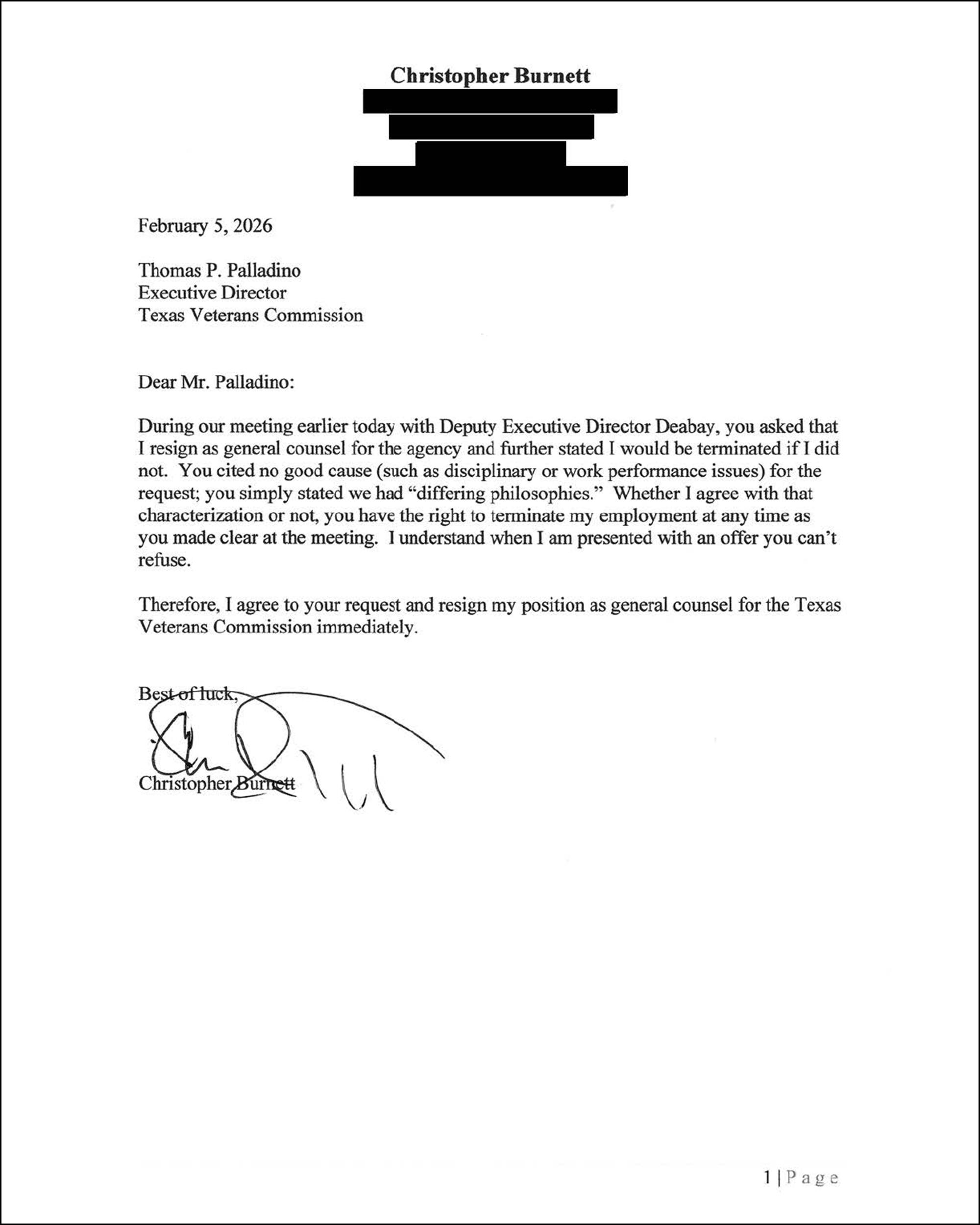 Christopher Burnett’s letter of resignation from the Texas Veterans Commission, obtained via a public-information request.Obtained via public information records request
Sanders also clung to the belief that the government could be a force for good and landed a job working for the Texas Real Estate Commission. At first she kept her head down, but she couldn’t shake her experience at the funeral commission. She spoke with the Houston Chronicle about the agency’s dysfunction. Two days before the Chronicle published its autopsy, Sanders resigned to avoid drawing a public spotlight to her new agency. She’s not sure when she’ll start looking for work again.
Most days now, Sanders replays the sequence of events with the EPIC probe, considering where she might have made different choices. She thinks back to her college years, when she served in student government, and how idealistic she’d been. She recalls her interview with Bingaman for the job at the funeral commission, when he’d dazzled her with his talk of an agency-wide revival.
When we spoke in March, she told me, tearfully, that she had been naive. “I didn’t realize how significant that change was,” she said, referring to the edits she accepted on the cease and desist order. “I should have pushed back. There’s a lot of things in this I wish I had pushed back more on.”
She has repeated that line of regret often in recent months—to friends, to family, and especially to herself. The same shame over the EPIC case that drove her to stop attending church in the spring ultimately pushed her to start attending again in the late summer.
“I went in [to the commission] thinking, this is just gonna be so—this is gonna be hard work, but I’m finally gonna get to do something I’ve always dreamed of doing, and it just, it just, it . . .” she trailed off. She took a deep breath. “I don’t think I’ll ever recover from that heartbreak, of it just turning out to be what it was.”
Since the firings of Sanders, Burnett, and Bingaman, the state’s pursuit of EPIC has persisted. On March 25, exactly one year after the governor’s office edited the cease and desist order, the commission’s interim director issued a broad subpoena to EPIC seeking records of funeral services and how much money had been collected.
The agency wanted to know, once again, if the mosque was charging to perform funerals.
This article will appear in the July 2026 issue of Texas Monthly with the headline “The Death Penalties.” Subscribe today.
Read Next