
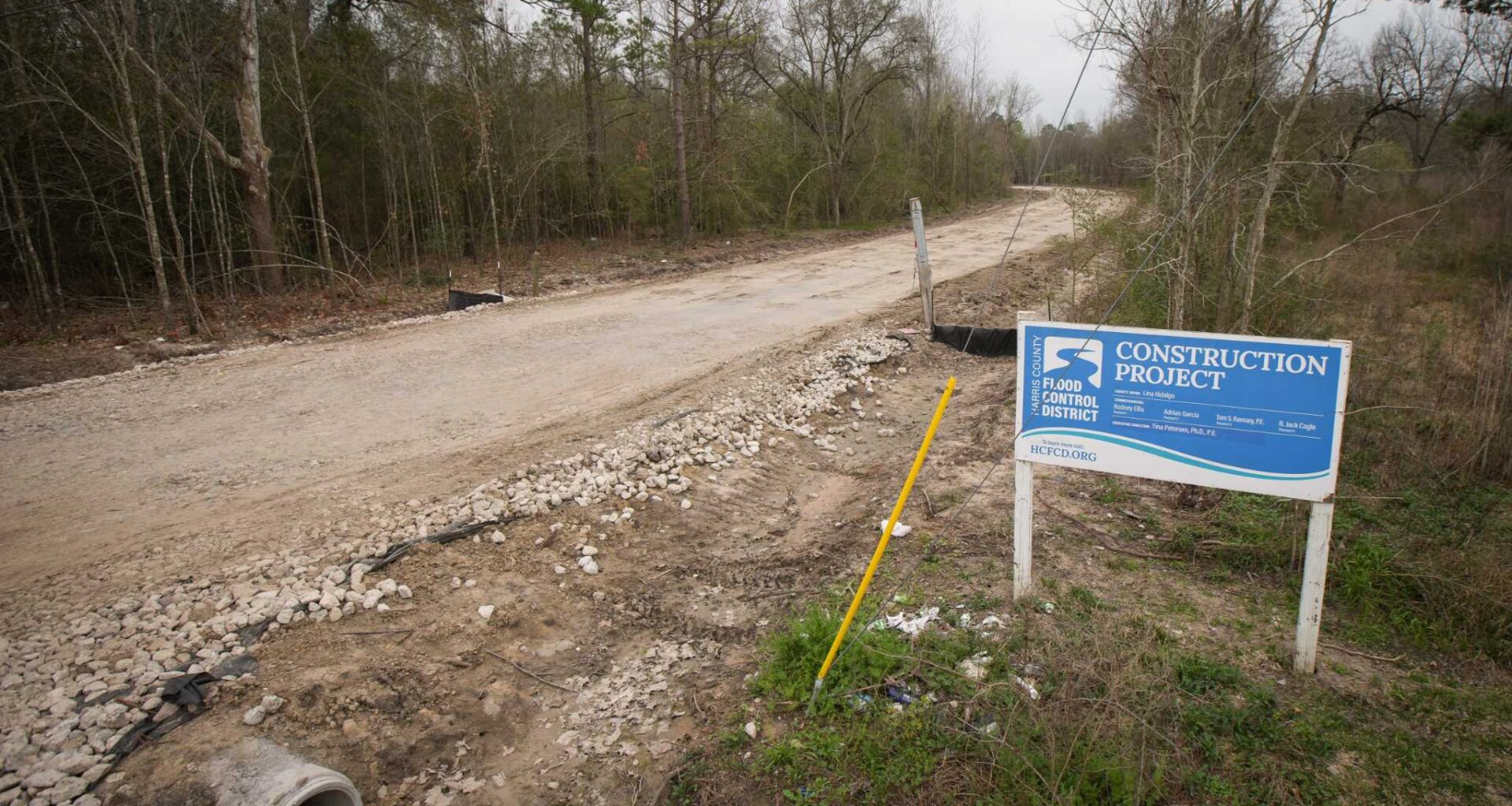
A Harris County Flood Control District project, photographed Wednesday, Feb. 15, 2023, in Houston.
Jon Shapley/Staff photographer
Many residents living along White Oak Bayou are expressing frustration over their neighborhood becoming a dumping ground for Harris County Flood Control’s halted construction on Tuesday November 23, 2022.
Raquel Natalicchio/Staff Photographer
Tina Petersen, Harris County Flood Control District director, is shown at the Hill at Sims in Houston Thursday, May 28, 2026.
Melissa Phillip/Houston Chronicle
Harris County officials are pursuing a last-minute funding swap they say could preserve $322 million in federal Hurricane Harvey aid for flood control projects at risk of missing a 2027 spending deadline.
The county Flood Control District plans to take a “phased approach” to managing more than $800 million in federal projects, according to a Friday news release, allowing it to meet the deadlines and avoid having to repay funds to the federal government.
The issue has rankled Commissioners Court in recent months, with court members demanding detailed project timelines and alleging Executive Director Tina Petersen had not done enough to keep them informed. The court, for a second time, is scheduled to discuss Petersen’s performance at its meeting this Thursday.
Article continues below this ad
Texas Land Commissioner Dawn Buckingham, whose General Land Office is in charge of distributing the federal funds, said she believed the flood control district’s plan is viable.
PREVIOUS: Harris County commissioners could consider replacing flood control director amid deadline concerns
“We have worked with HCFCD to determine a new path forward to expedite expenditures in order to meet the required disaster recovery grant deadlines,” Buckingham wrote in a Monday letter to County Judge Lina Hidalgo.
Buckingham criticized Hidalgo, who has been vocal about her concerns with Petersen’s handling of the Hurricane Harvey projects.
Article continues below this ad
“Harris County needs shovels, not scapegoats,” the Republican Land Commissioner wrote. “We have grave concerns about the Harris County Flood Control District not reaching its benchmarks partially due to the arbitrary procedures imposed by the Harris County Commissioners Court.”
But Hidalgo, a Democrat, is not Petersen’s sole critic. Republican Commissioner Tom Ramsey previously blasted Petersen for what he said was a failure to adequately communicate with the GLO.
“I shouldn’t have to come to Commissioners Court to get support from this court to ask you to provide information to the GLO,” Ramsey told Petersen at a May 14 meeting. “That should have been something that would be fairly obvious.”
Buckingham’s letter also highlighted several “observed failures” the GLO identified while working with the flood control district, including high turnover and issues related to grant documentation and compliance.
Hidalgo’s office did not respond to a request for comment on the letter.
Article continues below this ad
A ‘phased approach’
The flood control district is pursuing 28 Harvey recovery projects funded by the U.S. Department of Housing and Urban Development, which routed two types of grants through the GLO.
Eleven “disaster recovery” projects face a February deadline, while 17 “mitigation” projects must be completed by April 2028. The two buckets of money come with different rules, but county officials believe some stages of each of the projects can qualify under one grant or the other.
The plan, according to an internal presentation obtained by the Houston Chronicle, is to move eligible disaster recovery projects — including six that are expected to miss the deadline — to the mitigation program, which has the later of the two deadlines.
The disaster recovery funds would not go unspent, however. Those dollars would instead cover subdivision drainage improvements and an update to the county’s flood warning system, which were assigned to the program with the later of the two deadlines but are estimated to finish before February. Those projects are being managed by county housing officials but would, under the plan, be funded using the flood control district’s grant funds.
Article continues below this ad
The district would then move about $90 million in flood control projects now slated to miss that February deadline to the later mitigation program.
Although the flood control district’s total Harvey recovery project list is growing from 28 to 36 with no new funding, a spokesperson said there are no plans to alter the scope of any projects. Flood control district spokesperson Emily Woodell said the district overestimated the cost of its disaster recovery projects by about $100 million.
EDITORIAL: Red tape and politics are putting Harris County flood protection at risk
The more than 30% underrun is thanks in part to falling construction costs driven by project cancellations at the state level and other considerations, Woodell said.
A firm deadline
While the GLO is tasked with distributing HUD’s money across Texas, the two agencies have separate timelines, with roughly a one-year gap between the state’s February deadline and HUD’s close-out date.
Article continues below this ad
The state’s current deadline for the remaining 17 mitigation projects is March 2028, but HUD’s is January 2033 — leaving several years for local officials to seek an extension.
The GLO has previously twice extended the looming disaster recovery deadline and secured a federal extension in 2024, but a fourth is out of the question, Buckingham said in the letter. HUD has signalled its opposition to any additional federal extensions, and the GLO must complete the grant close-out process before the federal deadline.
“The GLO is responsible for following the rules and regulations mandated by HUD, and from the beginning, we have maintained that the February 28, 2027, deadline is firm,” Buckingham wrote.
Should any government organization in Texas miss the deadline, HUD could demand the return of any grant money it provided the GLO. That could spark a lengthy reconciliation process that would force the GLO to recoup the money it gave to any subrecipients deemed noncompliant.