
As triple-digit temperatures arrive in El Paso, fire officials are warning that a parked car can become dangerously hot in a matter of minutes — putting children and pets at serious risk even if the stop feels brief.
El Paso Fire Department Battalion Chief Miguel Garcia said that “on a day that’s 100 degrees outside, temperatures can get as high as 130, 150 degrees Fahrenheit.”
He added that “most of the temperature increase happens within the first 10 or 20 minutes.”
Garcia said that in 2025, the El Paso Fire Department received about 100 calls related to people or pets trapped in hot cars, and that this year the department is on track to reach a similar number.
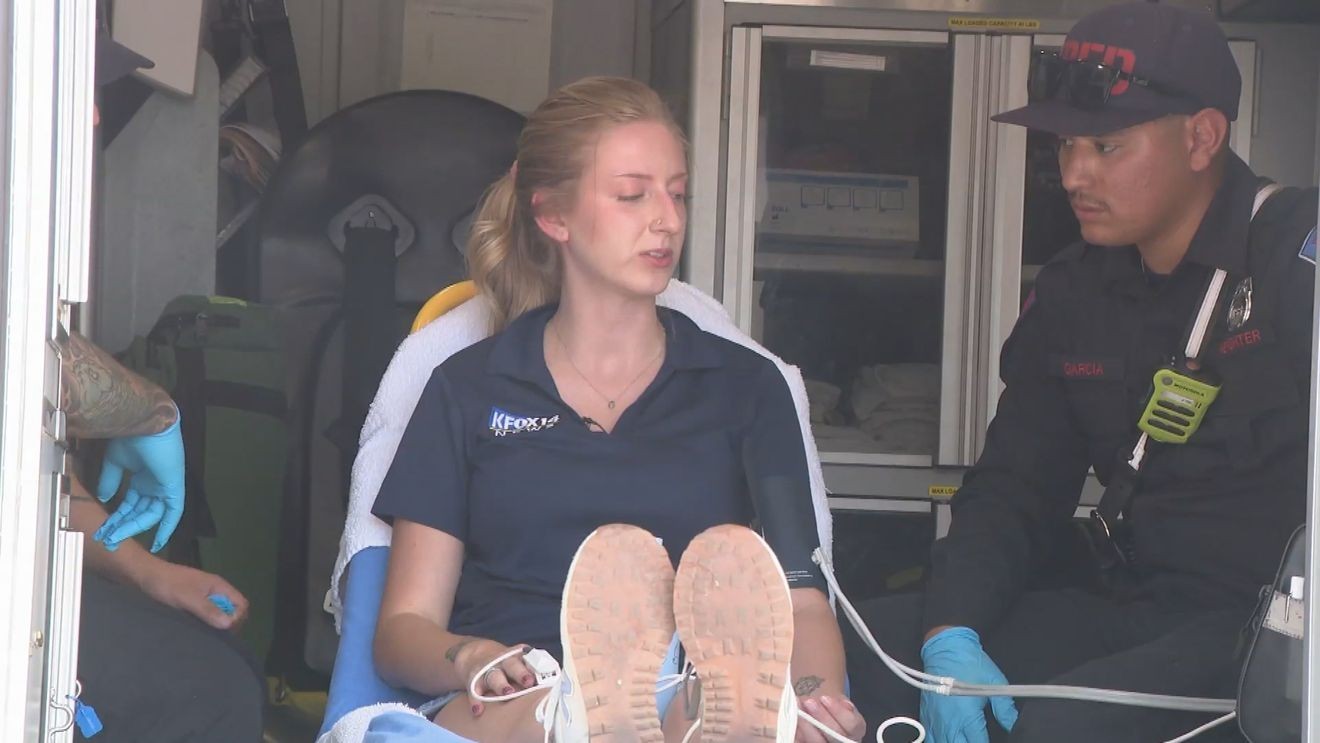
Emily Schmalz reports on the dangers of hot cars during triple digit heat. (Credit: KFOX14)
RECOMMENDED: El Paso hits triple-digit temperatures for first time this year
To demonstrate how quickly conditions can change, KFOX14’s Emily Schmalz sat inside a parked car with the windows up, no water and the air conditioning turned off for 30 minutes.
At the start of the test, Schmalz said, “We’re at zero seconds right now. I’m going to try to go to 20 minutes.”
About 10 minutes into the test, Schmalz said, “Ten minutes and 30 seconds right now. I do have a little bit of sweat, but it’s really, it’s not terrible right now. Obviously for a child or a pet, this affects them way more.”
Garcia emphasized that there is no safe window of time to leave a child or pet in a vehicle during the summer.
“In the El Paso summer heat there is no right amount of time that you can leave or should leave a child or a pet inside of a vehicle,” he said.
He urged people who see a child or pet alone in a hot vehicle to call for help immediately.
“Don’t assume that somebody has already called 911,” Garcia said.
If you see a pet or a child inside of a hot vehicle especially with the vehicle turned off make sure that you call 911, with these types of calls minutes and even seconds matter.
As the test continued, Schmalz said at 15 minutes, “At the 15 minute mark, again my only symptom right now, is sweating. You can see it beading and dripping down my face.”
At 18 minutes, she said, “At the 18 minute mark right now, it is getting fairly hot. I am sweating a lot. It is like being in a sauna,” adding she was “starting to feel my heart rate is raising a bit.”
After 30 minutes, Schmalz said her heart rate had increased and warned that the danger escalates for vulnerable people.
“My heart rate did go up slightly, but animals, children, anyone with health complications, that’s when the issue gets real,” she said.
Even for a healthy person sitting in that car for an hour, you are likely to get sick.
She said she felt symptoms after leaving the vehicle. “I’m feeling it after the fact, I’m definitely feeling lightheaded,” Schmalz said.
She also shared her readings: “So my heart rate before it was around 100 ish. We’re looking 121 right now. My oxygen saturation was at 97%. It’s 95 right now. And then my blood pressure is 113 over 73.”
Fire officials told Schmalz the textbook blood sugar levels are 120 over 80.
RECOMMENDED: El Paso, Las Cruces open cooling centers citywide as summer heat builds across the region
Garcia said extreme heat inside a vehicle can quickly lead to medical emergencies.
“So the body could potentially endure severe dehydration, heat exhaustion, which could potentially put the body into organ failure or could potentially lead to death in severe cases,” he said.
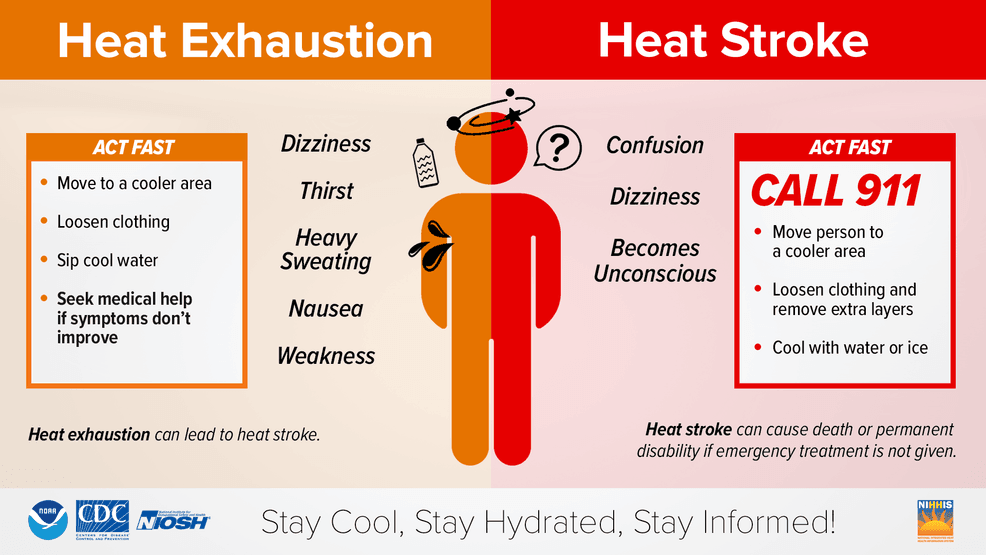
National Weather Service signs of heat exhaustion versus heat stroke. (CREDIT: NWS)
The National Weather Service says signs of heat exhaustion include heavy sweating; weakness or tiredness; cool, pale, clammy skin; a fast, weak pulse; muscle cramps; dizziness; nausea or vomiting; headache; and fainting.
For heat exhaustion first aid, the National Weather Service recommends moving the person to a cooler environment, preferably a well-air-conditioned room. Loosen clothing. Apply cool, wet cloths or have the person sit in a cool bath. Offer sips of water.
Heat stroke is more severe.
The National Weather Service lists symptoms as a throbbing headache; confusion; slurred speech; nausea; dizziness; a body temperature above 103 degrees; hot, red, dry or damp skin; a rapid and strong pulse; fainting; and loss of consciousness.
For heat stroke first aid, the National Weather Service says to call 911 or get the victim to a hospital immediately.
Heat stroke is a severe medical emergency. Delay can be fatal.
The agency recommends moving the victim to a cooler, preferably air-conditioned, environment and reducing body temperature with cool cloths or a bath.
It says to use a fan if heat index temperatures are below the high 90s, noting that “a fan can make you hotter at higher temperatures.”
The National Weather Service also warns: Do not give fluids.
For those looking to escape the heat, cooling centers are available across El Paso and Las Cruces. A full list of locations and hours here.
Sign up to receive the top interesting stories from in and around our community once daily in your inbox.