
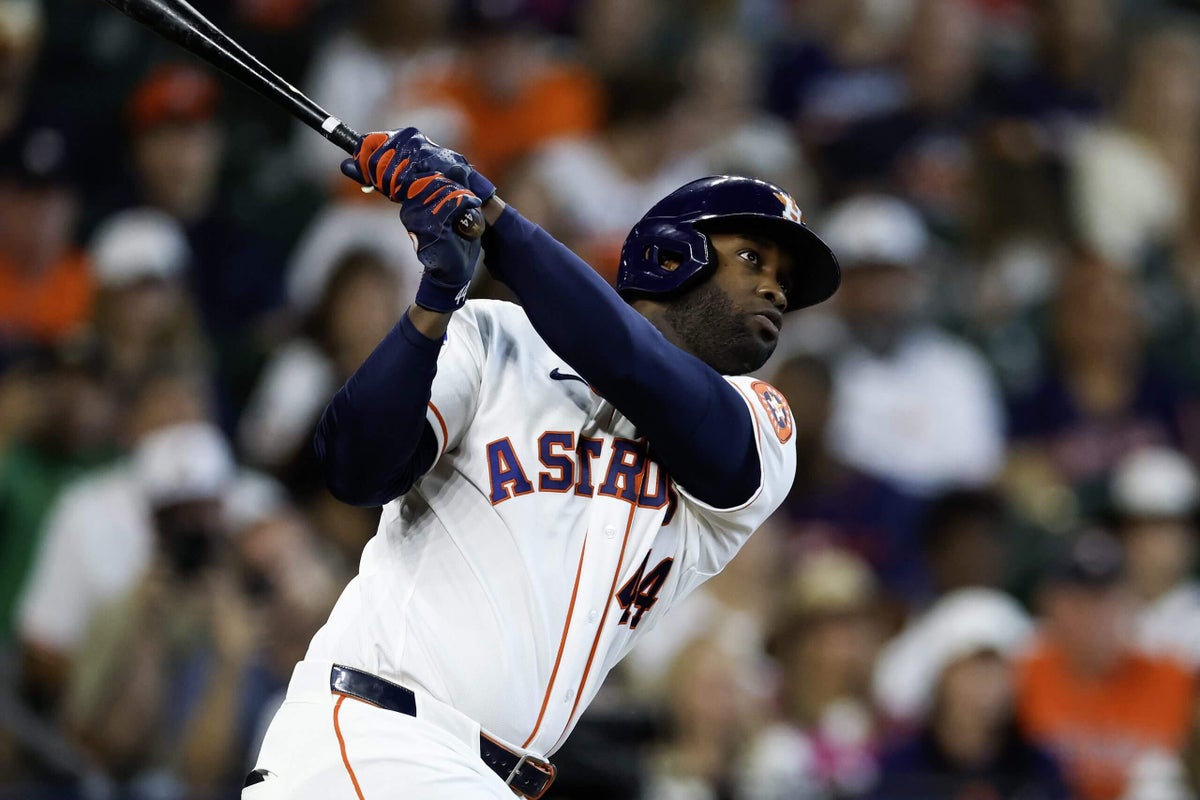
HOUSTON — Misery loves company, a cliche the Houston Astros can cling to during this upcoming nine-game stretch. All of their opponents are American League teams who entered Monday with a worse record than Houston’s 30-37 mark.
No better time exists for this injury-ravaged team to build and sustain serious momentum. Since falling 11 games below .500 on May 20, the Astros have won 10 of 16 games. Getting to .500 by the All-Star break may feel far-fetched, but should be an attainable goal.
Jose Altuve’s remarkable recovery from a Grade 2 oblique strain has their lineup as close to full strength as it can be. Yordan Alvarez is atop the American League MVP leaderboard and conjuring Triple Crown conversations. The pitching staff has stabilized. So has chatter around the job statuses of both general manager Dana Brown and manager Joe Espada.
As this soft portion of the schedule begins, here are six things I think about the Astros and their path forward.
1. I think the Astros will tout themselves as trade deadline buyers until the bitter end. Even if standings and season-long trends suggest otherwise, this is the only answer that will keep a clubhouse intact and invigorated. Expecting Dana Brown, a general manager in the final year of his contract, to publicly concede defeat during a tenure-defining season is delusional.
Playing in a pedestrian American League affords Brown and the Astros that luxury. So does the impending return of ace Hunter Brown, who will make his fourth minor-league rehab start on Wednesday night for Triple-A Sugar Land. It should be his last before reassuming his role atop the Astros’ rotation.
Presuming Hunter Brown returns sometime during next week’s series against his hometown Detroit Tigers, which begins on June 15, it will give the Astros around 38 games at almost full-strength before the trade deadline.
That stretch could determine myriad things: the extent to which Houston will buy, whether buying is prudent at all or which pieces to dangle in potential selling scenarios. Through it all, the public refrain will remain the same.
2. If the Astros are buyers, I think their biggest need is obvious. The Astros’ outfield began this six-game road trip with a .301 on-base percentage. Only three outfields in franchise history have finished with a lower one: the 1964 Colt .45’s, along with the 2012 and 2013 Astros — two teams that combined to lose 218 games.
Entering Monday, only three outfields in baseball had produced a lower OPS than Houston’s. Just one, the Miami Marlins, has a higher strikeout rate. Brown has already optioned his one offseason outfield addition, Joey Loperfido, to the minor leagues while cycling through a never-ending carousel of names.
Nine players have started in left field across the Astros’ first 67 games. Six different center fielders have played during that stretch. Cam Smith is a constant in right, but he boasts a .670 OPS after his first 252 plate appearances. Smith’s superb defense is the sole reason Houston’s outfield isn’t lower in wins above replacement leaderboards.
Finding more stability around Smith — preferably from someone who hits left-handed — will be Brown’s foremost goal before Aug. 3. It is the same one he broadcast throughout the winter. Not accomplishing it feels like the biggest blemish on an offseason Brown needed to nail.
3. I don’t think Yordan Alvarez will be traded. But, when other teams inquire, it would be malpractice for the Astros not to listen — even if they maintain their position as buyers.
Alvarez is baseball’s best hitter and is becoming a favorite to win the American League MVP. The prospect haul Houston would receive for him could revitalize its fallow farm system. It would also signal the beginning of a rebuild that owner Jim Crane has vowed will never happen under his watch.
Crane has long maintained that the Astros’ championship window “will always be open” during his ownership tenure. Trading Alvarez would run counter to this claim. Bear in mind, too, that Alvarez is playing on the second-biggest contract Crane has ever given out.
That fact alone makes any potential trade of Alvarez an ownership-level decision. It’s difficult to envision Crane doing an about-face on the declaration that has come to define his tenure.
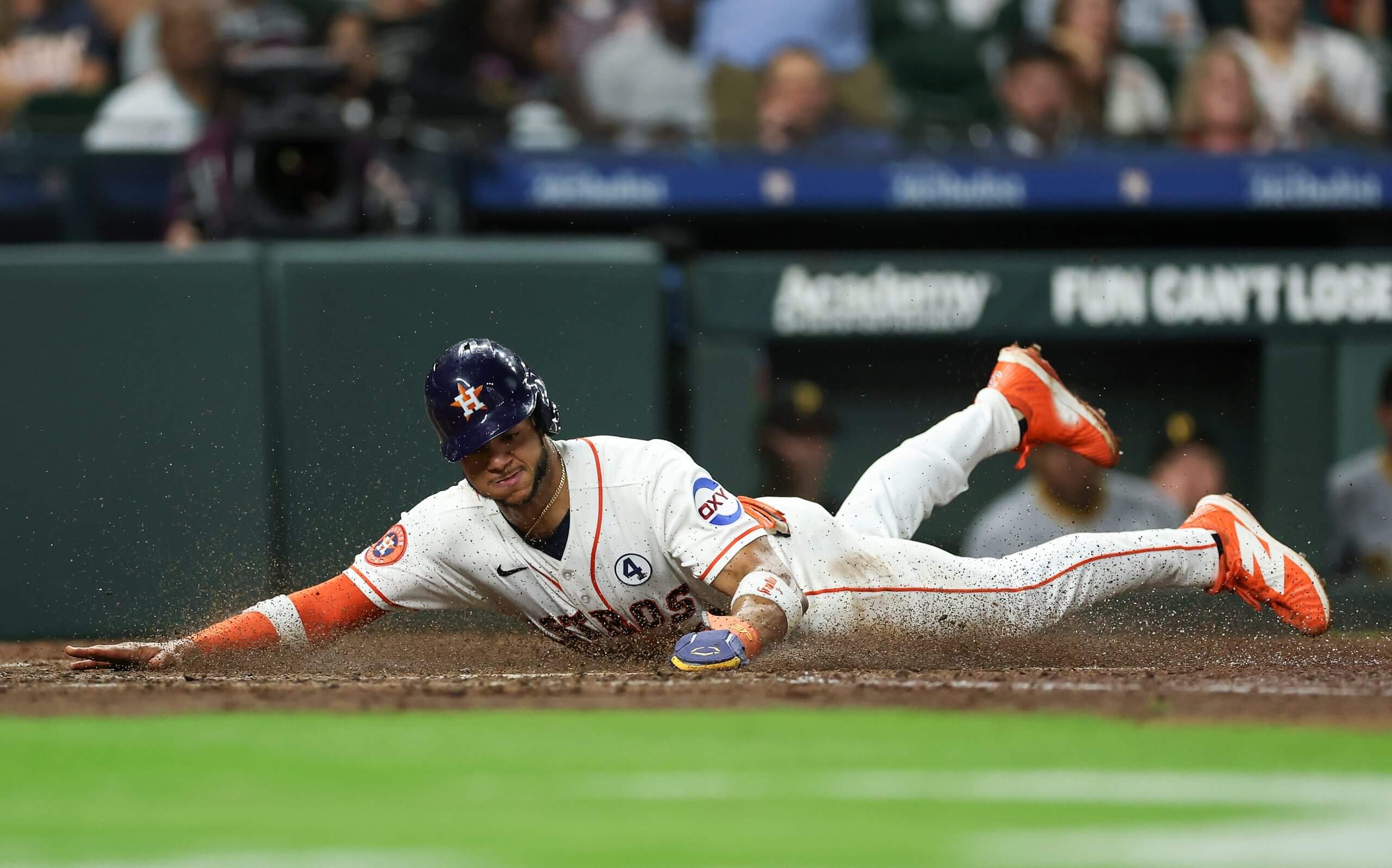
Jeremy Peña is eligible to become a free agent after the 2027 season. (Tim Warner / Getty Images)
4. I think Jeremy Peña’s future as an Astro is far more cloudy. And, no, it’s not just because this scenario appeared in a bold predictions piece written before the season.
Peña is perhaps the Astros’ most attractive, realistic trade chip, be it at the Aug. 3 deadline or during the offseason. Houston tried and failed to extend Peña last season. He hired Scott Boras to represent him after negotiations ended.
Boras’ preference is for his players to reach free agency, but both Jose Altuve and Lance McCullers Jr. are proof that Boras’ Astros clients can receive long-term extensions.
In the absence of one for Peña, he will enter this offseason one year away from free agency and in the exact position Kyle Tucker occupied in 2024. Team officials knew they had no chance of re-signing Tucker, so instead of receiving just a compensatory draft pick when he went elsewhere, they traded him to the Chicago Cubs for a prospect and two major-league players.
That same precedent could apply to Peña, who has been worth at least 3.9 wins above replacement according to Baseball Reference in each of his first four major-league seasons.
An Astros freefall before Aug. 3 would make Peña an obvious target for contending teams. Though, given Crane’s resistance to a rebuild, might it behoove Houston to wait until the offseason and expand the market?
Receiving major-league talent in exchange for Peña, as the Astros did for Tucker, is the only obvious way to stave off a teardown. It is doubtful any contender would trade off its active roster in August to acquire Peña. Doing so during the winter is a more realistic possibility.
5. I think Christian Vázquez has played a pivotal role in Houston’s pitching improvement. His experience, all of it within the American League, has allowed him to adjust plans in-game and guide a teetering pitching staff back to stability.
In 33 games since starter Yainer Diaz injured his oblique and Vázquez became the primary catcher, Houston’s pitching staff has a 3.99 ERA. It had a 5.75 ERA over the Astros’ first 35 games.
Catchers don’t execute pitches, so heaping all of the credit on Vázquez is disingenuous. So is using all of this as an indictment on Diaz, who defines the term bat-first catcher, but does not have anything near Vázquez’s experience. There is a happy medium to be found, even if the disparity between the two catchers seems drastic.
Astros Catching Splits
CatcherInnings CaughtPitcher ERAOpponent OPS
192.1
5.66
.880
327
4.16
.701
Vázquez has earned a more prominent role upon Diaz’s return, but the answer won’t be to make Vázquez the starter and Diaz his backup. Vázquez is 35 years old and must be monitored as such. He hasn’t started more than 81 games in a season since 2023. He has already started 38 of Houston’s first 68 games.
The risk of overwork — and diminishing returns — is real. Diaz is 26 and lacks Vázquez’s defensive capabilities or veteran presence. But, for a top-heavy lineup in need of length, Diaz offers a more dynamic offensive upside than Vázquez ever could.
Vázquez began this road trip with a 91 OPS+ — 11 points above his career average. Consider, though, the 41-point disparity in his batting average (.244) and expected batting average (.203), his 22.9 percent hard-hit rate and a .278 expected slugging percentage paired against the .382 mark he actually has.
Upon Diaz’s return, the Astros should — and will — divide the playing time more evenly. Seeing how is straightforward. Manager Joe Espada already anointed Vázquez as the personal catcher for Tatsuya Imai. It’s difficult to envision Espada interrupting the rhythm Vázquez has with Spencer Arrighetti, who won American League Pitcher of the Month in May while throwing to him.
Last season, Diaz caught all but four of Hunter Brown’s starts en route to Brown’s third-place finish in Cy Young Award voting. Expect that pairing to continue, too. Who to catch on the other two days — or three, depending on the state of the rotation — will be a fascinating decision for Espada.
6. I think Mike Burrows’ runway remains lengthy. Hard to comprehend for someone with the highest ERA of any qualified starter in baseball, but circumstances may keep him cemented in Houston’s rotation.
After Thursday’s off day, the Astros play 26 games in 28 days, the sort of stretch in which both Dana Brown and Espada prefer to deploy a six-man rotation. If, as expected, Hunter Brown returns near the beginning of this gauntlet, he would slot in as the sixth starter.
Six-man rotations leave bullpens shorthanded, meaning length from starters is mandatory. And, if nothing else, Burrows has provided that. He is the only member of Houston’s season-opening rotation to make every one of his 13 scheduled starts. Burrows has thrown a pitch in the sixth inning during eight of them.
Burrows leads the team with 73 1/3 innings, the 15th-most in the American League. This does not excuse or diminish his 5.77 ERA, but it is something. For a pitching staff that allowed workhorse Framber Valdez to walk in free agency and has missed Brown since early April, the length is welcomed, even if it gets minimized by Burrows’ performances. It is also not guaranteed if Burrows is replaced in the rotation by prospects like Ethan Pecko or Bryce Mayer.
Still, Dana Brown did not trade two touted prospects for someone to slog through five or six shaky innings. That Burrows is here because of that trade — Brown’s biggest one of the offseason — may be what is bolstering his security in the starting rotation.
Burrows has allowed a major-league high 17 home runs and has one of the sport’s worst-performing four-seam fastballs. Eleven of the homers have come against it. Hitters are slugging .781 against Burrows’ four-seamer and are averaging a 92.5 mph exit velocity when putting it in play.
Burrows is throwing the four-seamer less than he did last season in Pittsburgh, but it’s clear Houston must further reimagine everything about his arsenal and how he sequences it. Pitching backwards — using spin or off-speed early in counts before finishing with fastballs — led to some success last month.
Perhaps relying more on Burrows’ changeup, his best pitch, could produce better results. He threw more changeups than four-seamers on Sunday against the A’s, but still surrendered two home runs on the fastball. Varying the locations of his four-seamer may help, as would throwing the two-seam fastball he’s shown 13.8 percent of the time this season.
It is a lot to undertake. Burrows should have the time to tackle it.