
 Until Saturday Newsletter 🏈 | This is The Athletic’s college football newsletter. Sign up here to receive Until Saturday directly in your inbox.
In a week when so many other sports have thrilling championships going on, college football is the talk of the town thanks to paperwork. As usual.
Bad Beat: The NCAA created its own Wild West
Compare these three news items:
Two years ago, the NBA banned Raptors forward Jontay Porter for life, saying he’d bet on games and relayed inside information. The ruling stuck. He’s not back in the NBA. He’s in a tiny league that was founded just a few months ago.
Also two years ago, MLB lifetime-banned Padres infielder Tucupita Marcano after it found he’d placed 25 bets on the Pirates while playing for them. This also stuck. He’s playing for a North Dakota indie, not an MLB team.
Two weeks ago, the NCAA declared Texas Tech quarterback Brendan Sorsby permanently ineligible. He admitted to betting at least $90,000, including at least 40 bets on Indiana games during his time as a Hoosier.
That latter ruling … did not stick. Yet, at least.
Yesterday, a judge in a Lubbock court decided Sorsby must not be pulled away from his new teammates. Other than for a two-game suspension offered by Sorsby’s lawyers, because apparently judges handle suspensions? Pending an anticipated appeal, the NCAA’s ruling doesn’t matter. Poof.
There’s an obvious question here. If every other association is able to enforce the only universally agreed-upon rule, the one meant to assure competitions aren’t rigged, why can’t the NCAA?
The answer is maddeningly simple, the same as always: Nobody’s ever actually been in charge of college sports. The NCAA, a creation of the 1,075 schools it governs, only exists to the extent all of its members (and their players and/or lawyers) agree it exists.
Leagues like MLB and the NBA have collective bargaining agreements with their players. To play for those teams, you have to abide by the employee handbook, so to speak.
Because the NCAA has no CBA, and in fact has long worked to avoid one, no athletes actually work there. The NCAA’s rulings are only binding if a lawyer can’t get a local judge to say otherwise.
If it feels like it’s all falling apart at once, there are reasons. Follow the money. Four decades ago, a few powerful schools beat their own governing body in court over TV rights. What might players themselves have sued the NCAA over in those decades, if they’d had enough money to afford lawyers of their own?
Well, in the 2020s, players have money, thanks to the NCAA’s inability to argue in court against that. Players are suing for more time to keep making more money, sometimes successfully and sometimes not, depending on the enigmatic wisdom of those local judges.
Add in the widespread availability of gambling ever since a Supreme Court ruling in 2018, and in hindsight, I’m kinda surprised this week’s story didn’t happen a year or two earlier. (Perhaps in a situation like 2023, when the NCAA banned athletes like Iowa lineman Noah Shannon, who placed one small bet on Caitlin Clark’s Final Four run.)
Sure, it’s possible the NCAA still wins this one, prevailing before kickoff in an appeals court where all four judges happen to have Texas Tech law degrees. And maybe this is what finally convinces Congress to step in, which NCAA president Charlie Baker pleaded for yesterday, lamenting “deep-pocketed supporters willing to look the other way on the glaring integrity threat of betting on your own team.”
But for now, that just leads us to this punchline: Texas Tech megabooster Cody Campbell — both the guy most invested in Sorsby suiting up and the guy in the “save college sports” commercials — saying in a statement yesterday, “This unfortunate situation is the outcome of a broken system. I’m doing everything I can to fix it.”
Oh, my hero, thank you for your service. Like Baker, Campbell is referring to hoping Congress will solve the NCAA’s problems. Hey, if you want Congress to act, why not help fund the outrage that maybe makes it happen? Be the change you want to see.
More:
“What does the NCAA have left?” Matt Baker on why this really might be as big as it feels.
Coaches are now worried about a lot of things, including the door flying open for players to get more money from bettors than from boosters. (The list of figures stunned by yesterday’s news includes even lawyer Tom Mars, one of the NCAA’s courtroom nemeses.)
A judge playing temporary commissioner? Yep, a whole history of them.
A Big Ten ban on playing the Red Raiders in all sports is up for discussion. What is this, 1910s Notre Dame? (Georgia and Nebraska have separately banned Tech.)
Big 12 ADs have a call with commissioner Brett Yormark today to “explore options” for sanctions on Tech and Sorsby.
“Just how egregious is this decision? It may be the first time in college sports history in which 99.9 percent of the country sides with the NCAA.” Read Stewart Mandel.
Spinning off the Sorsby reaction episode by “The Audible,” I’m wondering … is Tech really prepared to become a pariah and scapegoat in exchange for a few months of a quarterback whose Bearcats went 0-9 across their last two stretch runs?
Quick Snaps
📬 More Mandel, from an answer in last week’s mailbag on all that SEC-breakaway talk: “If it’s the SEC’s rules, not the NCAA’s or CSC’s, I’m sure everyone would suddenly be on their best behavior.” Sarcasm, yes.
🧢 No. 1 in recruiting, with a class that includes five five-star commits: Texas A&M. What to know nationwide about official-visit season.
📰 Other news since last Wednesday:
ESPN could soon pay Pat McAfee $60 million per year (???), our Andrew Marchand reported this morning.
“Ohio State reached a $100 million settlement with hundreds of former student athletes who said university doctor Richard Strauss sexually abused them.” Details.
“Jordyn Adams intends to give football another shot. The 26-year-old ex-MLB first-round pick plans to play this fall for SMU.” Four-star UNC signee in 2018.
We have a TV schedule for the 32 non-Playoff bowl games. Pop-Tarts Bowl on Dec. 29.
“NC State and Virginia are moving their Week 0 opener from Brazil to the Cavaliers’ Scott Stadium.” Weird idea to begin with.
💎 It’s still diamond season:
The Video Game: CFB 27 debuts NIL system
Since the return of college football video games two years ago, EA Sports hasn’t yet published a game that attempts to simulate NIL, something that didn’t exist during the series’ previous era.
That will change on July 9.
Last week, EA revealed a long list of changes for this year’s edition, including the headliner in Dynasty mode: NIL credits as a roster-management resource. Successful players will expect raises, but that money might already be needed elsewhere in your athletic department’s budget, perhaps to repair your locker room’s dilapidated misting fans. Not joking, though I am looking forward to testing it all.
The game also finally includes a more thorough record-keeping system, meaning some of us might be done with manually tracking basic information about our multi-season campaigns in offline spreadsheets.
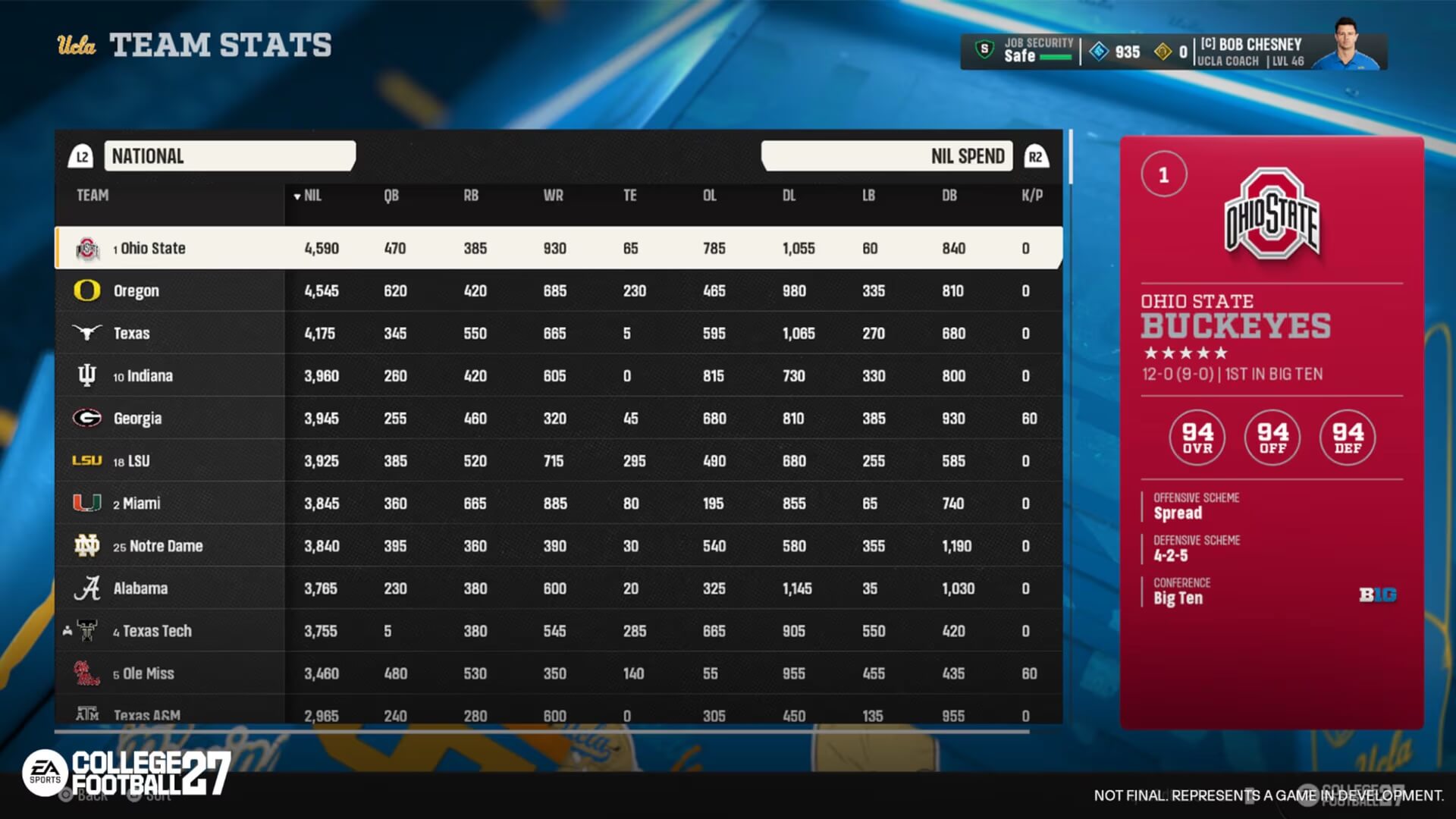
Expanded info includes being able to spy the NIL allocations of enemy schools, in fact. This EA screenshot from last week even seems to include Sorsby’s once-presumed absence:
There are also lots of new features that don’t revolve around Dynasty Mode, but that’s the only mode I use. Two of my current Dynasty rivals, David Ubben and Chris Vannini, have more here on the return of mascot mode, and what have you.
That’s a wrap. Email me at untilsaturday@theathletic.com about whatever.
Last week’s most-clicked: Stew’s revised Top 25, now led by Indiana.
Love Until Saturday? Check out The Athletic’s other newsletters, too.