
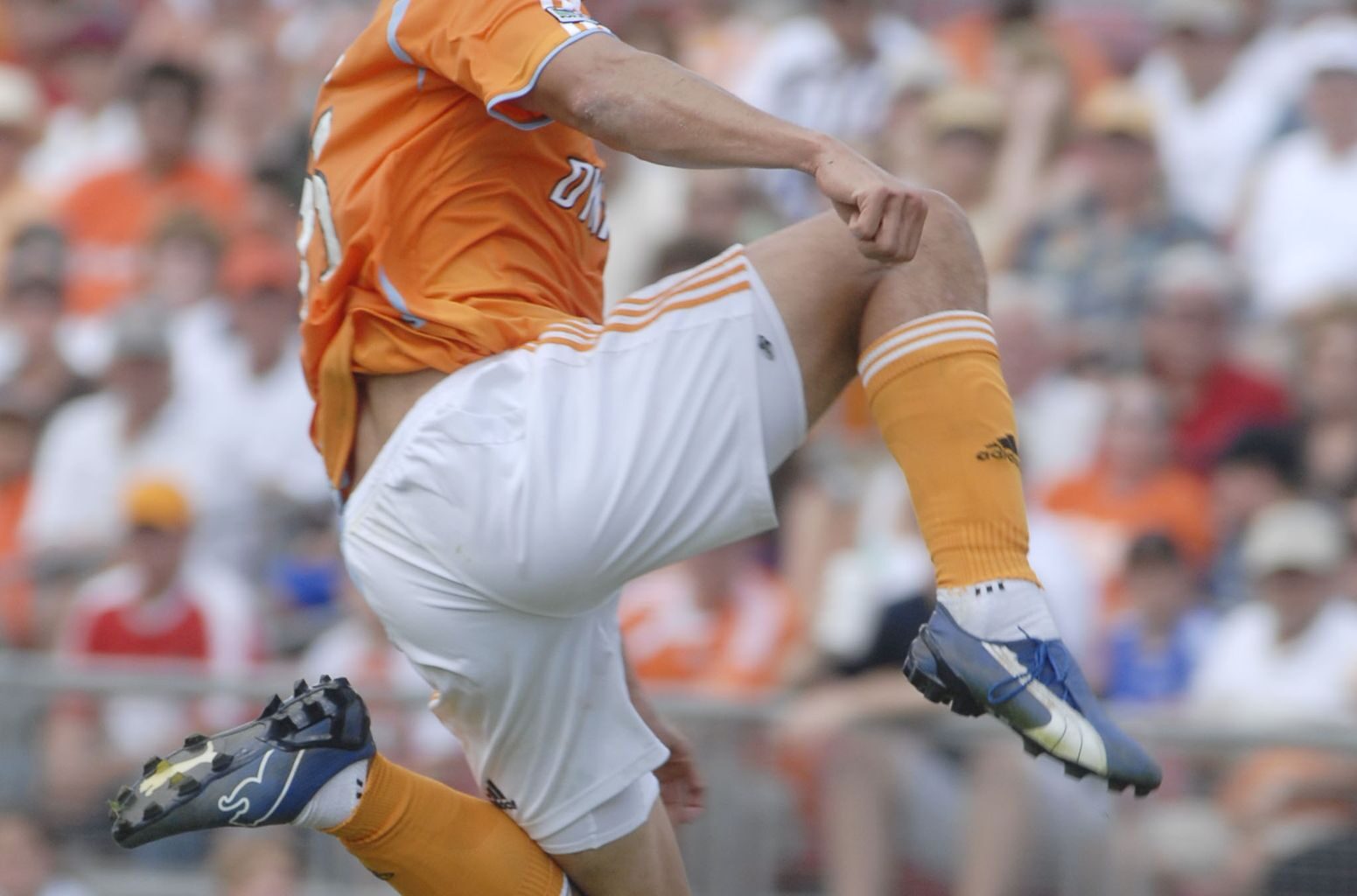
Houston Dynamo’s Brian Ching (25) jumps up for the ball in a 2007 MLS soccer game against FC Dallas, at Roberson Stadium.
Tim Johnson/AP
Brian Ching (25) of the Houston Dynamo stops a ball from advancing during a 2012 MLS playoff game against D.C. United in BBVA Compass Stadium.
Nick de la Torre/Houston Chronicle
Houston Dash forward Ella Masar, left, (30) and Houston Dash defender Ellie Brush (24) congratulate Houston Dash midfielder Carli Lloyd, center, (10) after Lloyd scored a goal against FC Kansas City in 2015.
Marie D. De Jesús/Houston Chronicle
Players show off their new “Houston Chronicles” kit for the 2026 season.
Elizabeth Conley/Houston Chronicle
Houston Dash midfielder Carli Lloyd chases the ball during 2015 National Women’s Soccer League game action at BBVA Compass Stadium.
James Nielsen/Houston Chronicle
Pro soccer in Houston, despite a colorful history that included the Houston Stars competing in the Astrodome in the late 1960s, kicked into overdrive with the addition of the Dynamo in 2006.
The Anschutz Entertainment Group uprooted the San Jose Earthquakes from the West Coast and planted them at the University of Houston’s Robertson Stadium for the franchise’s first six seasons. One thing was apparent from the start along the marshy Texas Gulf Coast: the team needed a new name. Earthquakes aren’t a Houston thing.
Houston Stars: (USA/NASL, 1967-1968) Houston’s first short-lived pro soccer team played its games at the Astrodome.
Houston Hurricane: (NASL, 1978-1980) During the Pele era, the Hurricane was the sixth and final expansion team granted for the 1978 NASL season. It finished in last place in ’78, but turned around in 1979 under Coach of the Year Timo Liekoski, winning the American Conference Central Division with a 22-8 record. The team struggled with attendance and folded in 1980.
Houston Hotshots: (CISL/WISL, 1994-2000) Professional indoor team.
Houston Hurricanes: (USISL, 1996-2000): Second iteration of the outdoor team.
Houston Bolt: (MASL3, 2024-2025): The professional indoor soccer organization featured both men’s and women’s teams.
“Dynamo is a word to describe someone who never fatigues, never gives up,” then-team president Oliver Luck said. “The name is symbolic of Houston as an energetic, hardworking, risk-taking kind of town.”
Article continues below this ad
The team name “Dynamo” did not actually replace the name Earthquakes, it replaced “Houston 1836,” which was the winning name from an online poll after the franchise moved from San Jose. The name 1836 was meant to recognize the year the city of Houston was founded, but the moniker received backlash from the Hispanic community because that also was the year of the Texas Revolution against Mexico. The name was changed prior to the start of the 2006 season.
Based on the success of the Dynamo over its first eight seasons, the team owners in 2014 added the Houston Dash, which joined the National Women’s Soccer League’s other eight teams.
The Dynamo had incredible success early in its Houston run, with two MLS titles in its first two years in the Bayou City.
The Dash for the most part struggled over its first decade or so. The team made the NWSL playoffs only one time from 2014-2025, and that was a first-round exit.
Article continues below this ad
The Dynamo burst on the scene in 2006 with a MLS championship –- a 4-3 victory over the New England Revolution in a shootout in Frisco –- and followed with a consecutive title in 2007, a 2-1 edging of the Revolution in RFK Stadium in Washington, D.C.
“I don’t want to leave,” said Dynamo midfielder Richard Mulrooney, as he lingered on the pitch with his teammates and family, soaking in a second straight title for Houston’s still-new MLS franchise.
Six years after the team moved to Houston, the city that had been starved for pro soccer added a diamond for the Dynamo in East Downtown. The team’s rapid success helped lead to the shiny new stadium across Interstate 69 from the Astros’ downtown home of Daikin Park.
The sleek Shell Energy Stadium (originally called BBVA Compass Stadium) was built on a six-acre industrial site of old warehouses and parking lots in 2012, giving Houston’s successful Major League Soccer team a pitch it could proudly call home.
“This stadium is going to be a great attribute to Houston,” Dynamo superfan Pedro Benitez said the day the stadium opened in May 2012. “It’s a great advertisement for the city.”
Article continues below this ad
Soccer fans celebrated with what was headlined a giant “group hug” on May 12, 2012.
“Every time we were at Robertson it was a home game, but we were always tenants,” Dynamo superfan James Hromadka said the day the new digs opened. “Now you feel like it’s yours. We were at our tailgate today, and it felt like we were on our property.”
That feeling from fans has continued through the years, although Shell Energy Stadium as of 2026 also is home to the Houston Gamblers of the United Football League.
Star players through the decades for the Dynamo have included Brian Ching, the franchise’s all-time leading scorer and 2006 MLS Cup Most Valuable Player, and Brad Davis, a midfielder who holds the club’s all-time assists record.
“We are going to look at the players and coaches who set the standard, and Brian Ching will be at the forefront of those who played a major role in setting the tone,” then-Dynamo president Chris Canetti said when Ching retired in 2013, after playing two seasons in the new place. “He will always be a Dynamo legend.”
Article continues below this ad
The Dash are best known for standouts Rachel Daly and Jane Campbell, while nationally acclaimed soccer star Carli Lloyd also competed in Houston from 2015-17. During Lloyd’s three seasons, the Dash failed to qualify for the playoffs.
The launch of the Dash led to at least one fan favorite fairytale, however, involving Houston football and futbol: Houston Texans star defender J.J. Watt was introduced to Dash midfielder Kealia Ohai through Watt’s Texans teammate Brian Cushing, who is Ohai’s brother-in-law. The star athletes are married and have two children.
While the Astros across the freeway have won two World Series in baseball in 2017 and 2022, including a championship won on their home field with the latter, Houston soccer fans are still waiting for an MLS or NWSL title in Shell Energy Stadium.
“I enjoy this more when we win than when we lose,” said Ted Segal, a real estate developer who bought the Dynamo and Dash in 2021. “I actually don’t enjoy it when we lose. That stays with you every single week when we’re not winning. … (But) the community impact, and the way that we as an organization have a unique platform to involve the community, that is very, very gratifying.
Article continues below this ad
“That’s something that has been a point of pride for me. … When you’re a competitive person, you hope that you can succeed as a business and a club, and every day that’s how we lead.”
He has hopes of emulating the Dynamo’s championship success during its Houston honeymoon.