
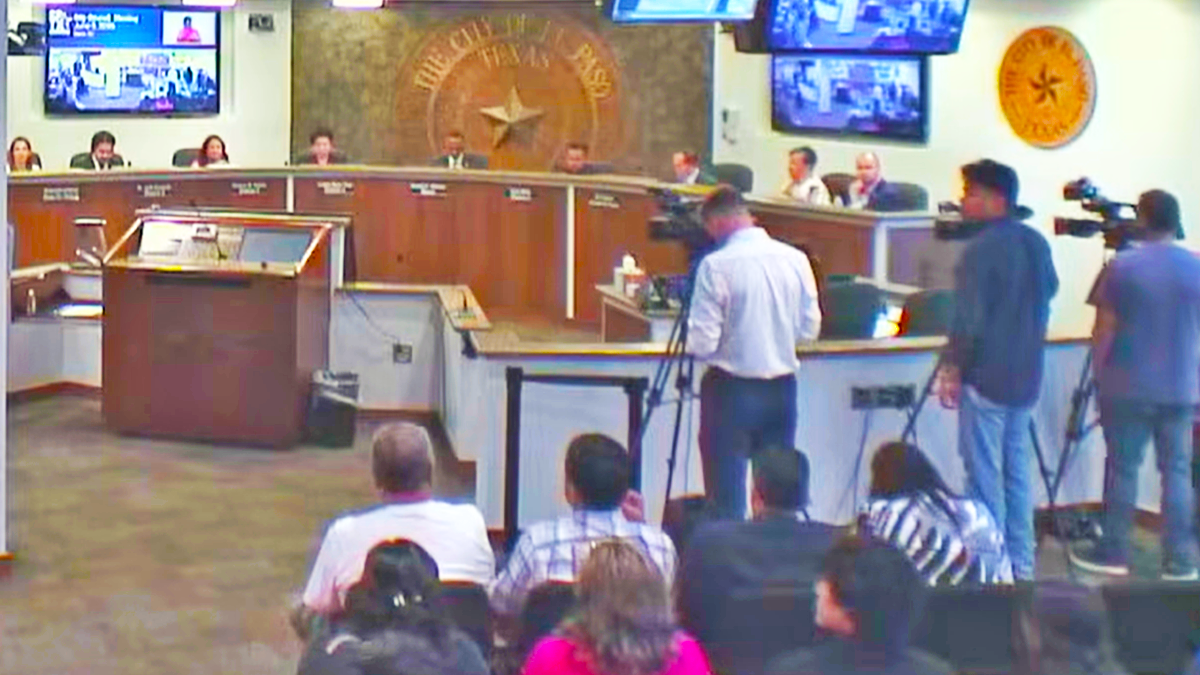
EL PASO, Tx., June 10, 2026: After listening to 193 speakers, members of the business community and two unions, an expert lawyer on government affairs, the city council voted against the measure to start negotiating with META to end the Northeast datacenter project.

Voting for negotiating with META to end the Northeast datacenter were Josh Acevedo and Lily Limón, who were the authors of the measure. They were joined by Chris Canales who previously said that although he voted for the 380 Agreement, he no longer supports it after learning more about the problems associated with datacenters.
City representatives Alejandra Chávez, Deanna Maldonado-Rocha, Cynthia Boyer Trejo, Ivan Niño, and Art Fierro voted to leave the contract in place. Canales, who supported the measure, is up for reelection in November. Although the window for announcing to run for the seat does not open until July 18th, Canales already faces two announced opponents, restauranteur Arturo R. Alluin and Mathew Guzman. Likewise, Chávez, who also opposed the measure, faces Sam Armijo, who ran against her in 2024. Art Fierro and Ivan Niño, two other city representatives who both also voted against the measure are also up for reelection.
Discussion about the city council measure to open negotiations with META began shortly before 11:00am. Over 193 speakers signed up to speak about it, forcing city officials to open an overflow area where the speakers could wait until their turn to speak on the motion.
Acevedo, a co-author of the measure, opened the discussion by informing the audience that he has reached out to META asking for them to hold public meetings about the datacenter they are building in the Northeast. According to Acevedo, META has refused to hold public meetings because of “security concerns.” After the measure’s other co-author, Limón finished her opening statement, the city’s outside legal counsel, Sandy Gomez, outlined the city’s liabilities should they move to cancel the 380 Agreement with META.
According to Gomez, there are three agreements in place with META. They are a purchase agreement with the city for the 1,000 acres of land the city sold to META, the 312 Agreement which provides META with an 80% city tax abatement for 10-years and the 380 Agreement that reimburses META with 80% of the city property taxes it pays for 15 years.
Gomez said that the city has not identified any causes to end the contract saying that META is in compliance with the contract agreements. She added that META has seven years to complete the project.
Regarding the possible liabilities the city faces should they move to cancel the contract, Gomez said that they include $8.5 million to repurchase the land, $370 to $760 million in damages. Additionally, she said that city faces unknown amounts in consequential damages, tort damages, attorney fees, lost tax revenues, and third-party complaints. Third party complaints can be filed by other companies who lose business because their META contracts were cancelled.
Conservatively, Gomez estimated that the city faced an “exposure is $800 million,” more than the $650 million the city budgets for annual expenses.
During questioning by Limón, Gomez called the agreement a “fairly standard” agreement. She denied that there was a clause in the contract where the city waived sovereign immunity. As previously reported, Clause 13 of the META 380 Agreement includes a “Limited Waiver of Immunity,” that is not found in other 380 Agreements that the El Paso Herald Post has reviewed.
After denying that the immunity clause waiver was in META’s agreement, Limón pointing it out to Gomez. Acevedo later added that he was concerned that outside counsel “directly contradicted themselves by saying that immunity was not waived in the agreement, then later saying that it was” in his closing remarks before the vote.
Three of the city representatives who later voted against the measure, Chávez, Niño and Trejo focused their public comments on the liability the city would face should they move forward in canceling the contract. Chávez added that even if the city were to cancel the contract, “the environmental concerns would continue” because META owned the land and had the funding to continue the project even if the city canceled its contracts with them.
Public Speakers For and Against the Measure
Many of the close to 200 speakers were members of two community groups, Amanecer People’s Project and Sembrando Esperanza. Both community groups have been actively opposed to the META project due to concerns about electricity and water. Many of the community group speakers said that the city representatives voting against the measure would be voted out of office. Another group of speakers included private business officials and members of two trades unions.
Trades union leader Eddie Treviso argued that canceling the contract would “hurt the working-class people.” Business owner architect Eugenio Meza argued that canceling the agreement would have a “ripple effect” leading to discouraging future investments in the city.
The Vote
About seven hours after the city council opened the measure for discussion, they voted to leave the agreement in place. Canales opened the closing comments period saying that although he supported the measure to begin negotiating with META, that there was no “guarantee that META” would negotiate and that it was important “to not underestimate the cost to the city” that ending the contract would entail.
Trejo, who represents that area where the datacenter is being built, said that she was not on council when META’s 380 Agreement was voted on, but that she heard the “real concerns” people have about it. Trejo added that because of the concerns, she drafted a draft policy on future datacenters which the city council will take on later in the month. She added that council cannot “legally” break the contract with META, but that the city can adopt measures to force META to make the datacenter beneficial to El Paso, including ensuring resource management and having the promised jobs benefit El Pasoans. “We must hold META accountable but legally,” she said, adding that she did not support the measure before them.
Acevedo said that “datacenters are bringing people together across the nation.” He reminded everyone that the outside counsel “directly contradicted themselves by saying that immunity has not waived in the agreement, then later saying that it has.” Acevedo added that city officials should consider looking at how effectively the outside legal counsel advocated for the city, suggesting that the city’s counsel did not properly advise the city council about the contract. “This is a really bad contract,” Acevedo stated.
Rocha-Maldonado said that “I have worked with datacenters for the last 30-years.” She added that “the fight for DSL was messy…we are in the same situation.” Digital Subscriber Line (DSL) was one of the first high-speed internet connections that was adopted in the late 1990’s and early 2000’s. It used the telephone lines connecting homes to the telephone network to transmit data through the copper wires, replacing dial-up modems.
DSL was controversial because it threatened the telephone company’s monopolies and started the idea that access to the internet should be neutral. Because of the controversy, the telephone companies rolled out the service slowly, made it costly and preferred to deploy it in profitable urban centers instead of equally across the nation. Today, most internet connections use fiber optic cables.
Rocha-Maldonado went on to add that during the DSL controversies what was missing then was the “organized” groups, which were before them yesterday. She, however, added that “fiscal responsibility is one of the most important responsibilities” for the city council. She was concerned that “exposing taxpayers” to liability is not responsible. Rocha-Maldonado said that many people she heard from were “afraid” to come speak before them but told her that canceling the contract would expose the taxpayers to tax increases. In voting against the measure, Rocha-Maldonado said that she did not support the measure because “fiscal responsibility requires us to protect taxpayers,” and that an attempt to end the agreement “exposes taxpayers to unknown financial” burdens.
In her closing comments, Limón quoted several comments made during the public speaking portion of the meeting, including that “complacency kills, we have become complacent” and that “juries hate META,” suggesting that a legal fight can end in the city’s favor. Limón reminded her city council colleagues that the item called for the council “to initiate discussions,” not to cancel the contract, asking them to join her in voting for the measure.
Mayor Renard Johnson said that “the passion we heard today comes from a shared love for our community,” adding that “we all want what is best for El Paso.”
At around 8:30pm, the city council voted orally on the measure by suspending the rules of order for the vote after Limón moved to force an oral vote instead of the use of the electronic voting usually used by the city council.
Like Us and Follow Us On Our Social Media!