
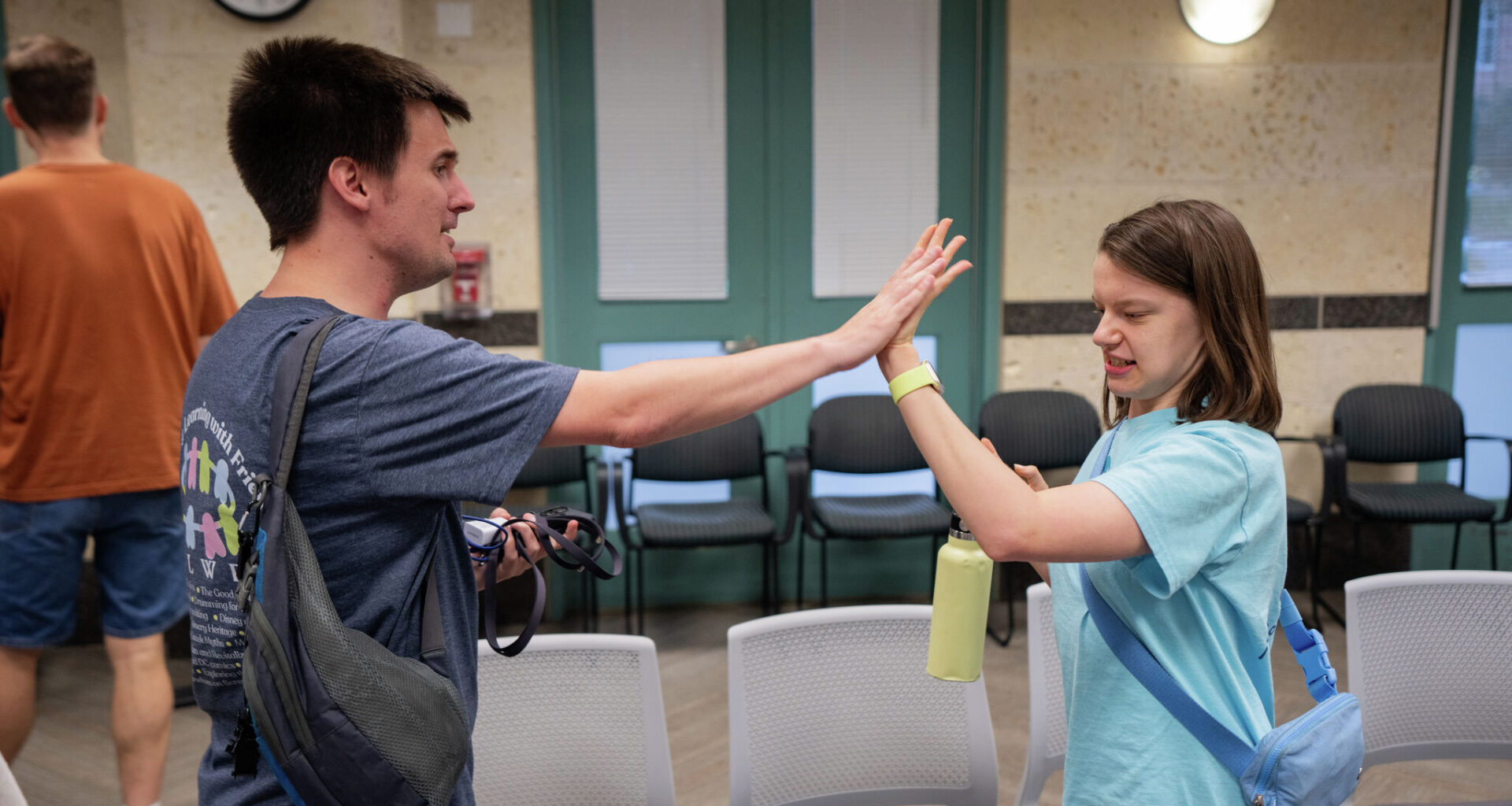
Students attend the “Love on the Spectrum” class at the University of Texas at Austin, Sunday, May 31, 2026. The class teaches social and dating skills, and is provided through the Lifelong Learning with Friends program, which offers a variety of classes to adults with intellectual and developmental disabilities.
Mikala Compton/Austin American-Statesman
On a Sunday evening at the University of Texas, a gaggle of students discussed their dating goals.

Ocean Pierce-Shimomura wanted someone “to love things with them.” Marielle Abrams envisioned someone who is patient — and tall. Carter Cawley hoped for “someone who wears a Texas tee,” he said. “Not A&M.”
Article continues below this ad
Matthew Thompson, who is non-verbal, helps instructor Kaelin Rubenzer-Kassam read a slide by tracing the words on the screen during the “Love on the Spectrum” class at the University of Texas at Austin, Sunday, May 31, 2026. The class teaches social and dating skills, and is provided through the Lifelong Learning with Friends program, which offers a variety of classes to adults with intellectual and developmental disabilities.
Mikala Compton/Austin American-Statesman
Executive director Kaelin Rubenzer-Kassam teaches the “Love on the Spectrum” class at the University of Texas at Austin, Sunday, May 31, 2026. The class teaches social and dating skills, and is provided through the Lifelong Learning with Friends program, which offers a variety of classes to adults with intellectual and developmental disabilities.
Mikala Compton/Austin American-Statesman
A list of dating priorities is displayed on screen during the “Love on the Spectrum” class at the University of Texas at Austin, Sunday, May 31, 2026. The class teaches social and dating skills, and is provided through the Lifelong Learning with Friends program, which offers a variety of classes to adults with intellectual and developmental disabilities.
Mikala Compton/Austin American-Statesman
The students are enrolled in a dating class offered by Lifelong Learning with Friends, a nonprofit that gives students with intellectual and developmental disabilities access to classes at UT infused with rigor, accessibility and fun.
The Sunday course — based on the popular Netflix show “Love on the Spectrum” — equips students with skills to achieve their dating goals. Like the show, the course walks through the often unspoken social rules of dating and helps students learn how to spot a good romantic match.
Before the second lesson, the room hummed with an excited energy. Everyone in the course, regardless of ability or age, wants love.
Article continues below this ad
“It’s just this really human interaction,” Kaelin Rubenzer-Kassam, the instructor and Lifelong’s executive director, said about the class. “It’s all founded on this underlying need for connection.”
The course — and the program — fill a too-common gap in support for adults with intellectual and development disabilities, or IDDs. It challenges perceived limitations about what people with IDDs such as autism and Down syndrome are capable of learning, wanting and pursuing, Rubenzer-Kassam said.
Students have been asking for a “Love on the Spectrum” course for a while. Though students with IDDs interact with the world differently, many seek the same things others do — a partner, an education and a family.
Article continues below this ad
“I knew wanting to date someone wouldn’t be very easy,” said Cawley, a 20-year-old Buda resident who has autism. But “there’s a lot of ways about dating that you can learn about.”
In one lesson, students analyzed scenes from the Netflix show, shared first date anxieties and identified qualities they want in a partner. Cawley sat in the classroom’s front row, eager to share that he wants a girlfriend who is caring, patient — and a Texas cheerleader.
After, Abrams said she wants to learn how to better talk to a romantic interest. Molly Dean-Polacheck shared a picture of her own boyfriend, whom she met in a Lifelong art class, saying she likes him because he is kind.
“It’s just such a fun class, because everyone is so earnest, and everyone is so sincere in these things, and they’re open to feedback,” Rubenzer-Kassam said.
Article continues below this ad
“Love on the Spectrum” spent 12 weeks on Netflix’s top-10 list, beloved by fans for its raw and earnest depiction of dating on the spectrum. But long before the show first aired in 2022, Lifelong Learning with Friends has offered students with disabilities access to a rich education and community.
Jonathan Pierce, a UT professor, founded Lifelong in 2010 to allow students with IDDs like his son, Ocean Pierce-Shimomura, access to higher learning. The program has no age, term or ability restrictions. Students pay $150 a course for a rare opportunity in special education, where classes typically focus on vocational or life-based skills or have strict age caps on enrollment.
“I don’t think what we’re doing is complicated. It’s really simple,” Pierce said. “The hard part is just believing that it’s worthwhile and can happen.”
Challenging expectations
Students Bryce Palmer and Macy Bouchard high-five during the “Love on the Spectrum” class at the University of Texas at Austin, Sunday, May 31, 2026. The class teaches social and dating skills, and is provided through the Lifelong Learning with Friends program, which offers a variety of classes to adults with intellectual and developmental disabilities.
Mikala Compton/Austin American-Statesman
Since 2010, more than 700 students have enrolled in Lifelong classes, and 1,600 UT students have volunteered with the program. Each class has a one-to-one ratio of students to volunteers, with volunteers participating alongside students and assisting them when needed.
Article continues below this ad
Though now an independent program, its ties to UT are crucial, and have been there from the start.
Pierce, a UT neuroscientist, had never met someone with Down syndrome before his son was born. He didn’t know much about it or how the diagnosis might limit his son, who is now 24.
But as Pierce-Shimomura grew, his ambitions were clear. At the dinner table, he asked his parents why he couldn’t do homework just like his siblings. Eager to meet friends, he took part in camps and programs geared toward kids like him, but he was often excluded from opportunities his siblings had. Pierce worried about what would happen when his son aged out of inclusive programs.
“We all knew that once our kids are no longer cute … society usually drops services and attention and even empathy for people with disabilities,” Pierce said. “There’s nothing for adults.”
Article continues below this ad
As a university professor, Pierce spends every day bringing “students to the edge of knowledge.” Seeing Pierce-Shimomura’s potential and eagerness to learn, the UT academic began brainstorming ways to bring higher education to his son and his friends.
“In the beginning, Dr. Pierce would sneak Ocean and a bunch of his friends on the UT campus, bring them inside the science laboratories and different cool spaces on campus, and just give them access to really sophisticated topics,” Rubenzer-Kassam said. “That’s how the magic began.”
What started with one cohort of students soon grew to multiple classes a semester, taught by UT professors in various departments and student volunteers.
From left, students Molly Dean-Polacheck, Matthew Thompson and Ocean Pierce-Shimomura work with volunteer Amber to practice asking questions in conversations during the “Love on the Spectrum” class at the University of Texas at Austin, Sunday, May 31, 2026. The class teaches social and dating skills, and is provided through the Lifelong Learning with Friends program, which offers a variety of classes to adults with intellectual and developmental disabilities.
Mikala Compton/Austin American-Statesman
The classes and capabilities of the students exceeded Pierce’s expectations. A teacher once told Pierce that his son would never read, but one of Pierce-Shimomura’s peers in Lifelong was already reading Harry Potter, challenging that assumption.
Article continues below this ad
“They’ve been taught that they weren’t learners,” Pierce said. But through Lifelong, he found that “if anything, many of the adults with IDDs are less inhibited than the UT students.”
Some of the courses, like the one modeled after “Love on the Spectrum,” are geared toward life skills to help students become more independent. But many teach UT-level academic material in “a way that anyone, regardless of level, could get something out of,” Pierce said.
This summer, students can take courses on inclusive communication, creativity, Taylor Swift and music history. There are also classes about robots, French impressionism, space, printmaking, exploring Austin and nature.
Denise Thompson signs her 24-year-old son Matthew Thompson up for courses every semester. The program has allowed Matthew, who is nonverbal, to meet people he never would have met, make friends and improve his confidence, she said.
Article continues below this ad
“This is everything that usually falls through the cracks,” Thompson said. “It’s really elastic, it meets all the needs.”
Students make their way to the classroom for their “Love on the Spectrum” class at the University of Texas at Austin, Sunday, May 31, 2026. The class teaches social and dating skills, and is provided through the Lifelong Learning with Friends program, which offers a variety of classes to adults with intellectual and developmental disabilities.
Mikala Compton/Austin American-Statesman
The program also helps the university, Rubenzer-Kassam said. UT volunteers learn to question their assumptions about people with different abilities and make inclusion efforts more meaningful, she said.
“It’s engaging with this reputable higher education powerhouse in the Austin community, and making (volunteers) better communicators, making their expertise more accessible,” Rubenzer-Kassam said. “Having contact, meaningful contact, and exposure to people with disabilities helps a lot with disability advocacy.”
Article continues below this ad
In Lifelong’s 16-year run, some students have taken classes since the very beginning. Now, courses are also offered at the University of Texas at San Antonio, and in the fall, they will be available at Rice University. Students from across the country found the program during the COVID-19 pandemic and still take part online.
Pierce and Rubenzer-Kassam hope Lifelong grows to other universities and reaches more students. Mostly, Pierce hopes students, like his son, will continue to take courses throughout their lives.
“If we can help individuals raise expectations of themselves, and for UT students, if they can experience a paradigm shift of what people with disabilities are capable of — showing interest in how they are, and how they can become friends,” Pierce said. “That’s perfect.”
What do students learn?
Marielle Abrams attends the “Love on the Spectrum” class at the University of Texas at Austin, Sunday, May 31, 2026. The class teaches social and dating skills, and is provided through the Lifelong Learning with Friends program, which offers a variety of classes to adults with intellectual and developmental disabilities.
Mikala Compton/Austin American-Statesman
Before the second dating lesson, Rubenzer-Kassam called the class to order at half past 6, reminding students of what they went over last time.
Article continues below this ad
In the first class, students learned how a romantic partnership is different from other relationships and used a questionnaire to determine what they desire in a match.
Cawley learned he wants someone to talk to when he’s having a bad day. Sean Feighan-Patrizi wants someone to watch movies with. Some want kids, many want to be independent.
The group analyzed first dates from “Love on the Spectrum,” reflecting on what did or didn’t work for individuals to connect.
Then, students defined active listening, practiced back-and-forth conversations and drafted questions they could ask a partner. When in doubt, Rubenzer-Kassam reminded students to ask about FORD: family, occupation, recreation and dreams.
Article continues below this ad
For homework, students planned their dream date, wrote how they’d want a partner to be similar or different from them and brainstormed questions to ask.
Denise, Matthew’s mom, sat in the back of the course to learn how she could best support her son in his dating goals.
She watched Matthew look out for his classmates by introducing them to newcomers, using his iPad to communicate. His confidence, social skills and friends have grown tremendously in this program, she said.
Article continues below this ad
“This program has allowed him to meet people he may have never met before,” Denise said. “We always tell him friends are the treasure of a lifetime.”