


Photo illustration by Jordan Johnson
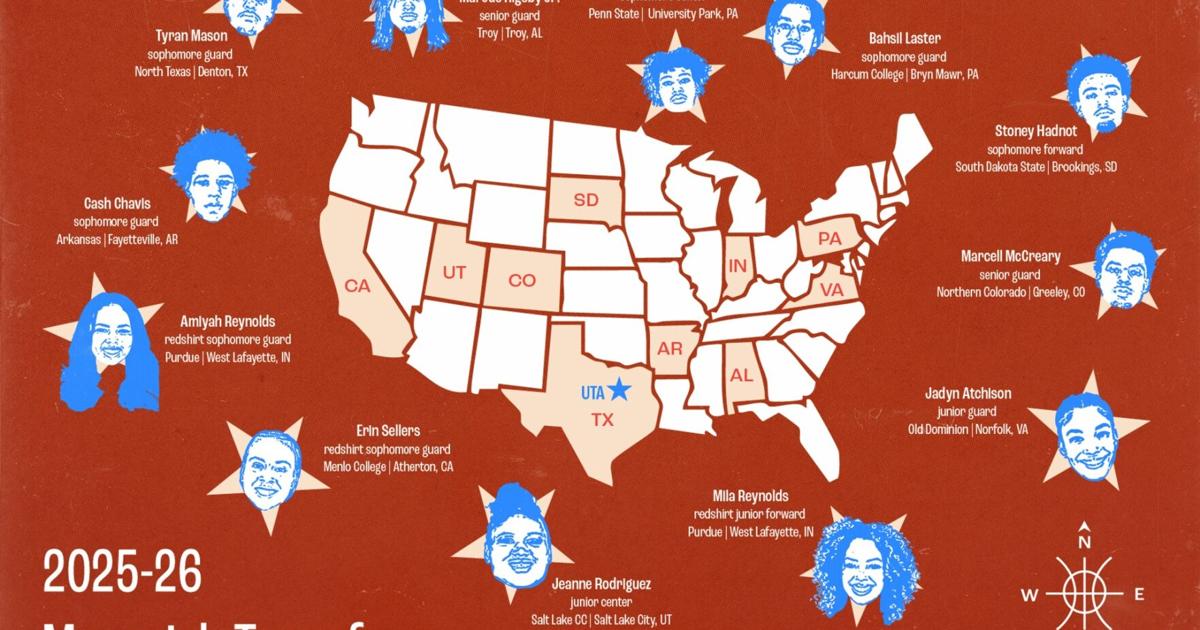
The UTA basketball programs enter the 2025-26 season with notable changes, as the men’s team only sees a couple returners and the women’s team comes back with around half of last year’s roster.
Along with the rest of the Division I collegiate sports scene, the teams have utilized one of the NCAA’s most altering introductions to the game: the transfer portal.
Debuting in 2018, the NCAA Transfer Portal was implemented as a compliance tool. It intends to systematically manage and add transparency to the transfer process among universities, while empowering student-athletes who want to declare their intent to consider other programs, according to the NCAA.
While used by coaches or schools, its primary focus is being an option for student-athletes to broaden their horizons when finding their fit. When an athlete declares this intent, the school’s compliance office has two business days to enter the athlete’s name into the database, opening their name to the buzzing circuit of other players and teams around the nation looking for changes.
While the system is not a mandatory aspect of all collegiate sports, student-athletes are required to enter if they wish to transfer into a Division I school. Athletes in Division II or III also have the option to participate in the portal.
For Shereka Wright, women’s basketball head coach, it has been an impactful tool to restructure the women’s roster this season to build off of last year’s success.
“Transfer portal has been something that now that coaches have started to use, it’s almost looking at the situation of trades and different things on the pro level,” Wright said. “If you’re losing players, it gives you an opportunity and advantage to go get a player that can help you immediately.”
Wright said that in addition to supporting a team with less depth, it can aid a roster with a good core, dabbling in the system to see if any extra players could bolster the team.
Creating a free market aspect to college athletics continues to bridge the gap between it and professional leagues. Many daily aspects of student-athletes now resemble features that started at the pro level, including the portal, conference changes and name, image and likeness deals, according to Forbes.
Wright said that when she uses the portal, she asks questions about why student-athletes would want to choose UTA and what the university can offer them. These questions help her better identify the players’ needs and determine which athletes might be the best fit for the program.
“We look at the fact that they can come in here and compete at a high level. We play a really good schedule every year,” Wright said. “If they want the opportunity to play and continue their career, we have a really good relationship with the Dallas Wings.”
One of the current longest-standing members of the women’s team, senior guard Kali Haizlip, said the portal often allows students to find a team that fits their style of play.
Two of UTA’s players, redshirt junior forward Mila Reynolds and redshirt sophomore guard Amiyah Reynolds, came from a school that prioritizes aggressive man defense. With that being the Lady Mavericks’ “bread and butter” last year, it has helped integrate them into the team, Haizlip said.
“That’s one of the things that you can eat off of when you’re looking for a different school or different opportunity,” she said.
For KT Turner, men’s basketball head coach, he said it can be a demanding aspect of his role, but he finds uses in the system. Through the good and the bad, it has helped cater his roster to fit the team he wants to build this season, he said.
“It’s the recruiting part that’s strenuous; it’s every day, all day because it’s hard to thumb through thousands and thousands of players,” Turner said. “The fun part is just getting new players in here, getting to meet new guys. I’m huge into the relationship part, so these guys are fun to be around.”
The men’s team went into this past off-season with holes to fill, so using the portal has been a crucial part of getting the team back up to speed. Turner said that when scouting for recruits, he wanted size and talent regardless of experience or grade level.
“We were really, really intentional,” Turner said. “In the last two seasons, we were trying to identify shooting, which is a big help, but we wanted to get size to where we could be good in the paint and more athletic.”
@kaleivie_