
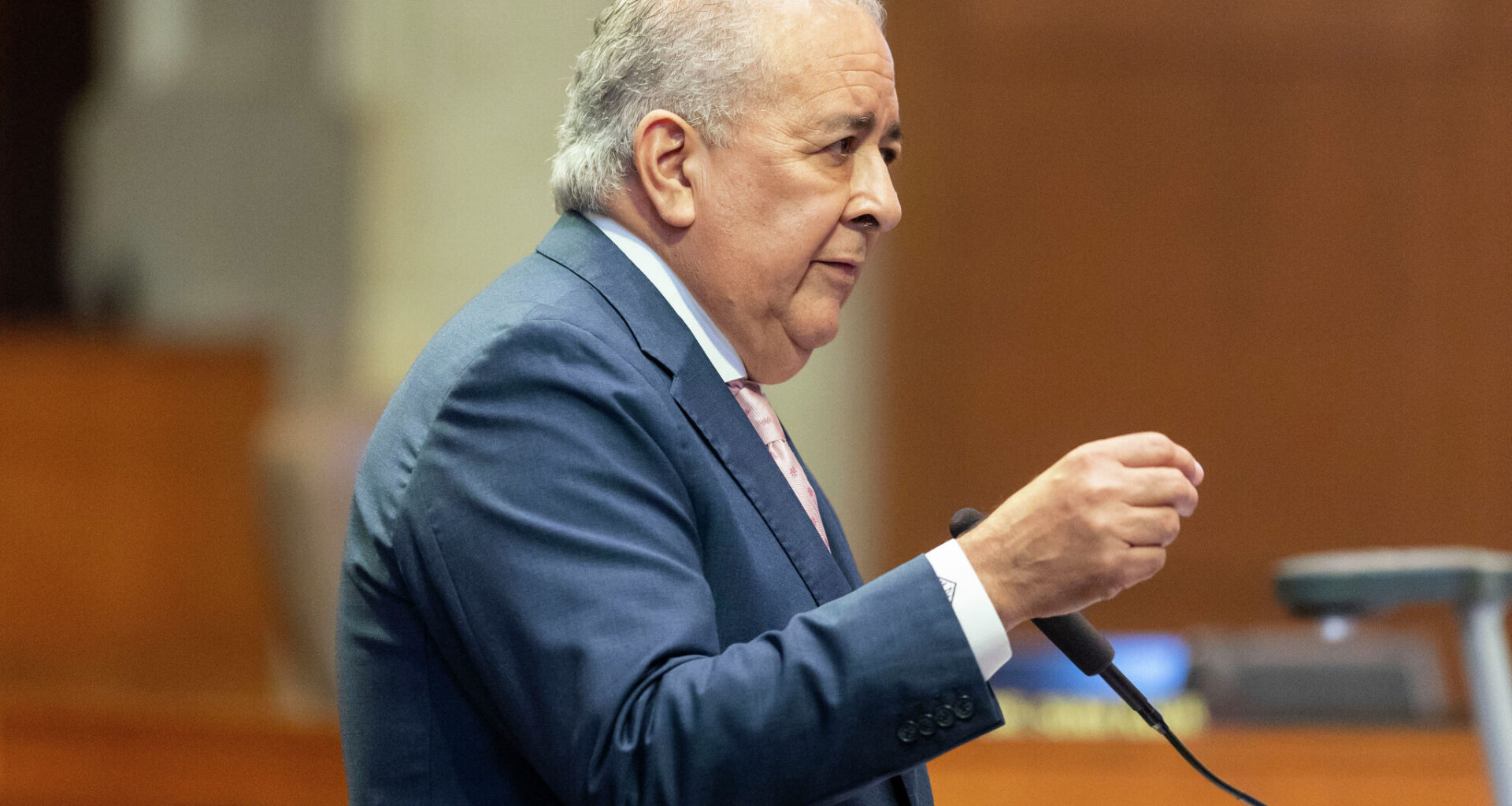
Robert Puente, the president and CEO of San Antonio Water System, addresses the San Antonio City Council during a meeting in May. The utility has asked the council to approve a four-year plan to raise water and sewer rates.
Katina Zentz/San Antonio Express-News
City officials are recommending that San Antonio City Council members adopt slightly lower rate increases than what the San Antonio Water System is requesting — and that the water utility make some budget cuts to make up the difference.

The SAWS board last month approved rate plan that would increase customers’ monthly bills by up to 32.8% over four years.
Article continues below this ad
But because SAWS is owned by the city, the council has the final say on the rates the utility charges its customers. This week, city staff recommended a lower range of rate hikes, ultimately raising bills between 26% and 30% by 2029.
The final amount of the total increase would depend on exact rate increases in 2028 and 2029. The city recommended the council approve guaranteed rate hikes for 2026 and 2027, then ranges for the later years, with city staff approval required to go above the minimum.
Under the SAWS proposal, the average residential customer would see their monthly bill increase from $56.68 per month to $75.19 in 2029. The city’s proposal would lower that to a maximum average bill increase of about $73 in 2029.
Article continues below this ad
The difference between the two proposals is about 1% in each of the first two years. Under the city’s plan, there would then be a rate increase of between 5.5% and 7% in 2028 and between 5% and 6.6% in 2029. City staff would have to review SAWS’ request and brief the council if SAWS wants to go above those minimums.
Budget changes
As part of its plan, the city is suggesting that SAWS make changes to its budget focused in personnel, water contracts and spending on CPS Energy bills, Chief Financial Officer Troy Elliott told the council Wednesday.
Article continues below this ad
SAWS had budgeted to fill 48 current vacancies for its new water meter program, including technicians and inspectors. The utility finished installing more than 600,000 of the new electronic “ConnectH2O” meters late last year, which no longer require manual reading, but SAWS was still budgeting for filling vacancies to manage that program. The city is proposing eliminating those vacancies, saving about $3.8 million.
Another $6 million per year could be cut by changing how SAWS is budgeting for a water contract it holds with a private company, Elliott said. SAWS inherited the contract to buy water from the Trinity Aquifer when it absorbed the former Bexar Metropolitan Water District, CEO Robert Puente said.
“Luckily, this bad contract expires in 2027,” he said.
Under the contract, SAWS could be responsible for paying up to $8 million per year — but in dry years when the water isn’t available, the utility spends much less.
Article continues below this ad
While SAWS budgeted for the full $8 million in its rate proposal, the city wants SAWS to budget $2 million annually, closer to actual spending in recent years, Elliott said, calling it “right-sizing the budget in that area.”
The city also proposes changing how SAWS plans for potential CPS Energy rate increases. SAWS buys power from its fellow city-owned utility for all of its operations, including water delivery and treatment, and has seen those costs rise, Puente said.
The SAWS budget anticipates rate increases, but Elliott said the city doesn’t assume those will come and SAWS shouldn’t either.
If the council adopts the city’s recommendations and CPS Energy does raise rates, “we’ll just have to absorb that cost,” Puente said.
Article continues below this ad
The city is also recommending changes to how SAWS will handle certain debt obligations, reducing the revenue needed by about $3 million, Elliott said.
There were no proposed changes to the utility’s capital improvement plan, including upgrades and repairs at aging wastewater treatment plants and replacing water mains to reduce water loss. Those projects make up the bulk of SAWS’ planned spending from the rate increase.
SAWS’ 2026 and 2027 capital improvement plan “is very detailed, very well laid out,” Elliott said, and the city agrees with how SAWS is allocating money for categories of projects in 2028 and 2029.
READ MORE: As SAWS mulls rate hike, these City Council members want a shakeup at the utility
Article continues below this ad
‘We need to act’
Mayor Gina Ortiz Jones, who also sits on the SAWS board, said it was reassuring that the city’s review resulted in recommendations that are “not too far off” from the utility’s request, and that none of SAWS’ proposed capital projects were eliminated in the process.
She spoke in support of the increase during Wednesday’s meeting. While she has previously signaled she’ll vote in favor of the request, her comments were the strongest endorsement she’s given to the utility.
“We don’t have the luxury of hypothesizing on this. We need to act, and we need to act as one San Antonio,” she said. “When something breaks only because we failed to meet the needs, then we will all feel it, we will all answer for it.”
Article continues below this ad
“Looking just down the street, Corpus Christi reminds us where our inaction would lead,” she said, referencing the coastal city’s impending crisis as insufficient water supply has put it at risk of running out of water.
As she has in recent months, District 7 Council Member Marina Alderete Gavito remained critical of SAWS and the proposed rate increases.
She spoke about finger-pointing between the water utility and the city over responsibility for construction delays and water breaks, among other issues.
“There’s a pattern here and quite frankly it’s unacceptable,” she said. In her comments and in a video posted on social media this week, she criticized SAWS over a water main break near Jefferson High School, calling it another example of problems with SAWS’ operations.
Article continues below this ad
“It does not feel right to me to ask residents to pay more on their water bills, when we can’t get this stuff right,” she said in the video, gesturing to the flowing water behind her.
However, SAWS said that break wasn’t caused by problems with its infrastructure. A city contractor hit the water main, and SAWS will seek to recover costs for the repair and the value of lost water from them, SAWS said.
During the council meeting, Alderete Gavito also criticized SAWS’ prioritization of water line replacements, calling it a “slap in the face” that 70% of the proposed replacements are in districts 1, 2, 3, 4 and 10.
Puente defended SAWS’ methods, saying it identifies pipes for replacement based on age, pipe materials and soil conditions that result in breaks, not by council district lines.
Article continues below this ad
Alderete Gavito asked Puente how SAWS would replace pipes if the rate increase doesn’t pass.
“If we don’t get this rate increase, we’re going to be back here again in the fall asking for a rate increase for ’27, ’28 and ’29,” he said. “These are needs that have to be met.”
He said the city staff’s involvement on this rate request was “much more involved, much more detailed, much longer than others that I’ve been through.”
But he called it a “good thing” that the city is ultimately recommending approving the rate hike. He said the city’s changes to the water contract costs and CPS Energy reflect “a difference in philosophy in how to handle some issues.”
Article continues below this ad
“I am very happy that they validated the project list, because we’ve been saying that all along,” said SAWS board chairwoman Jelynne LeBlanc Jamison. “We’ve been identifying the infrastructure that’s been engineered and evaluated for replacement, and the city validated that today, and so I’m very pleased with that.”
The council is expected to vote on the proposal on June 18. If approved, the new rates would take effect July 1.