
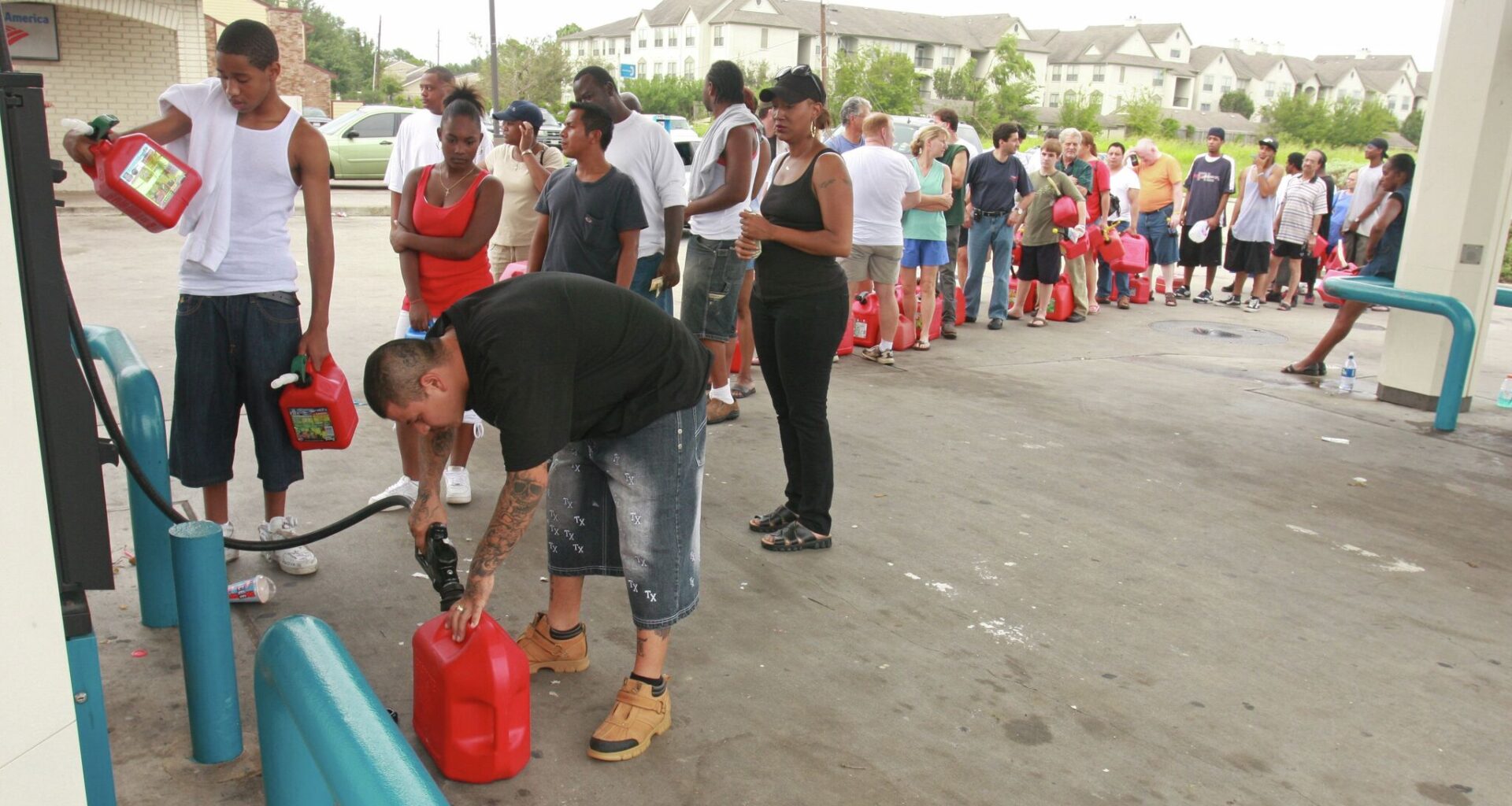
Leonel Gomez fills his gas can after waiting in line for 90 minutes in Houston on Sept. 14, 2008. Power was slowly coming back to the area after Hurricane Ike knocked out power lines.
Gary Fountain / Staff photographer
The thought of hunkering down for a storm is enough to give any Houstonian a headache.
It’s a special kind of anxiety that comes with hurricane season, even if the weather forecast shows the Gulf is calm for now.
We switch into survival mode. Water. Food. Flashlights. Medicine. Prayers.
Article continues below this ad
If you’ve lived through Houston storms, you know the preparation ritual runs deeper than the checklist. You carry memory in your bones after the skies have cleared. You remember filling bathtubs with water, laying sandbags outside the front door, stockpiling groceries, helping neighbors whose homes were crushed by toppling trees, rescuing lost pets and lending a hand to strangers.
Whether a home is nearly a century old, like mine, or built in the last decade, the walls hold the same stories of waiting, watching and praying. Every house on the block becomes shelter when the wind starts to roar and the rain falls.
TO HOUSTON, WITH JOY: A newsletter for a city that’s never simple
But for all the talk we do about preparing for hurricane season, it’s never enough.
Article continues below this ad
“It’s kind of an ever-present reality, but I don’t think we really focus on it like we should because there there are a lot of practical things we could be doing to prepare,” said Jim Blackburn, an environmental law professor and co-director of the Severe Storm Prevention, Education and Evacuation from Disaster at Rice University.
Take the trees. Most of us don’t think about limbs stretching out across our roofs until high winds cause them to snap. Limbs weighted down by rainwater are like concrete swinging on a hinge. Trimming them back is one of the most important things we can do to prepare, Blackburn said.
TREE TRIMMING: CenterPoint blames trees for Beryl power outages — yet keeping limbs off power lines is its job
Old houses carry their own anxieties. I stress over what a serious storm could do to mine. Damaged roof, concrete piers buckling, broken pipes and even mold creeping into the walls. Because they don’t make homes the way they used to, repairs can be punishing. Insurance companies have a way of reminding you how much it costs to rebuild a solid brick home when brick veneer is more commonly used today.
Blackburn offered me a measure of comfort.
Article continues below this ad
“I would be less concerned about an older home,” he said. “Oftentimes, the people back then were just a little more practical. These older homes are elevated real high above the street, which is great, because our streets are going to flood with a hurricane.”
For now, there’s no major storm on the horizon. Chronicle meteorologist Justin Ballard says all is quiet, while tropical development is being monitored across the Atlantic basin, including the Gulf of Mexico, Caribbean Sea and Atlantic Ocean. That gives many of us permission to set aside hurricane preparation for other tasks. We need to resist that impulse.
“We ought to talk much more openly about these risks and about how to deal with them,” Blackburn said. “I haven’t seen a single mention of the evacuation zones. I mean, there’s some areas you just ought not to be staying in your house — you need to evacuate.”
Inside one of my cabinet doors, I have a rough sketch of our floorplan with escape routes marked, in case we ever need to scale down from a second story window. This is not the evacuation plan Blackburn has in mind.
If you live in Harris County, your home may fall into a hurricane evacuation zone, each with designated routes to prevent what happened in 2005 during Hurricane Rita. That evacuation was the largest and deadliest in U.S. history. An estimated 3 million people fled the Texas Gulf Coast, two-thirds of whom were not required to evacuate. Freeways became gridlocked parking lots in the sweltering heat. A bus caught fire near Dallas, killing 23 nursing home residents from Houston. More than 100 people died.
Article continues below this ad
Evacuation zones by ZIP code in the Houston area.
Courtesy image
We don’t talk enough about flood risk either, Blackburn said. After Hurricane Ike in 2008, a marker was installed in a prominent intersection to show how high Category 4 and 5 surges would reach in the Clear Lake area, he said. Several months later, the sign was gone, removed because it interfered with home sales.
“We are more concerned with selling homes than we are about telling the truth about what happens during storms. If you’re moving here from Iowa, you don’t have a clue,” Blackburn said.
The silence on hurricane risks carries a cost that isn’t shared equally. Lower-income neighborhoods have been shortchanged in both preparation and disaster relief, he said, citing the northeast side of Houston that has been routinely neglected for decades.
“That is something that can and should be changed, but it takes a recognition that maybe they hadn’t gotten a fair shake in the past,” Blackburn said.
Article continues below this ad
There’s one more thing that many of us never get around to: pressuring our elected officials to keep storm drains and roadside ditches clear of debris before hurricane season. It’s not glamorous work, but clogged drains can turn a bad storm into a catastrophic one.
Houston is a city that knows how to survive. But survival is not the same as preparation, and preparation should not start when the forecast turns scary. It’s the slow, mundane work we do when the skies are clear, and there’s no storm headed our way.
The Gulf is calm today. Let’s use our time wisely.