
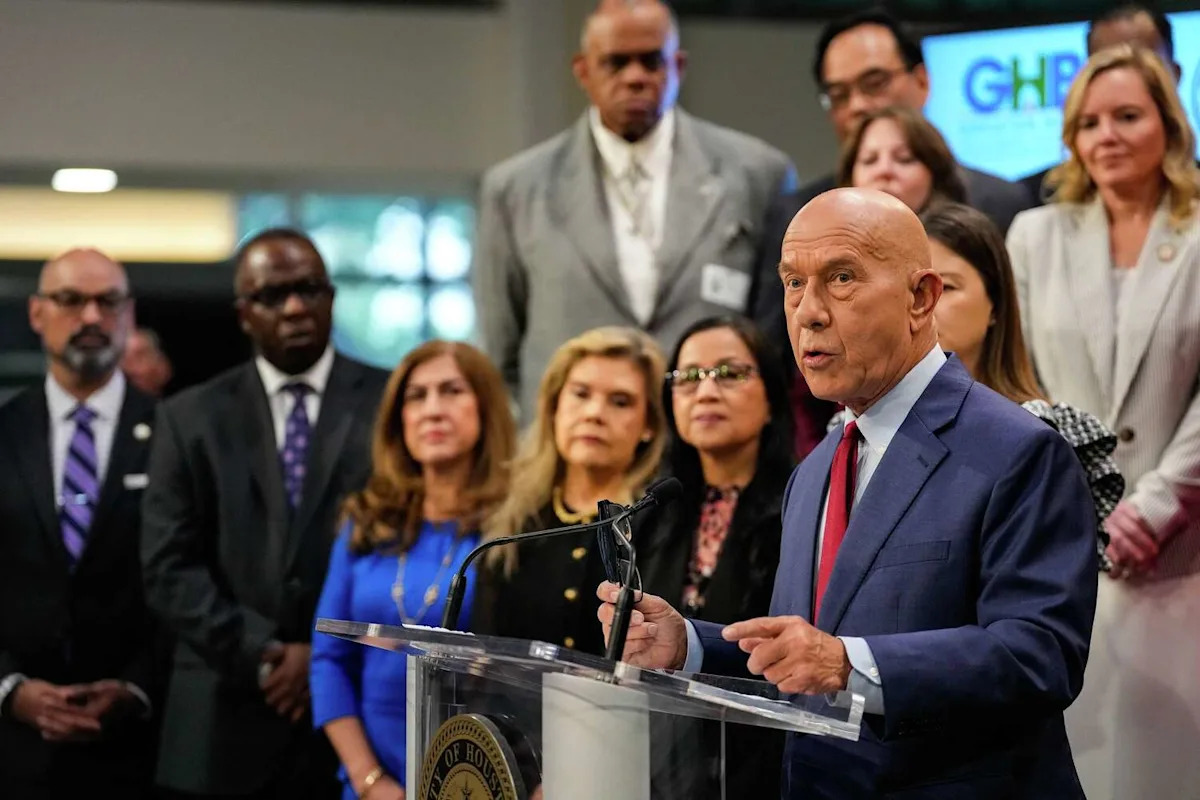
Houstonians this July will begin paying $5 a month for trash and recycling pickup under Mayor John Whitmire’s $7.5 billion budget, passed 15-1 by city council on Wednesday.
The plan marks a significant shift in how the city funds one of its most visible and troubled services, and makes Houston the last major Texas city to adopt a garbage fee. It also underscores the scale of the city’s financial strain, as officials embrace a rare step – new revenue – to stabilize a budget that pays for police, fire and other core services.
EXCLUSIVE: Mayor Whitmire to propose Houston’s first-ever trash fee to help tackle $174M deficit
Whitmire announced the fee as part of a plan to close a $180 million budget gap, and to help improve waste services. Finance department officials say the fee is to rise incrementally to $25 per month by 2031, though council would need to vote to exceed $5 per month. Whitmire has not committed to do so, saying “we’re not going to do what I would call a genuine garbage fee until we improve services.”
Edward Pollard was the only council member who voted against the budget. Council Member Tiffany D. Thomas was absent.
HOUSTON’S YARD WASTE PROBLEM: Houstonians have given up on yard waste pick up, data shows. Will Mayor Whitmire’s budget fix it?
The budget also moves the $134 million solid waste budget from the general fund – fed mostly by property and sales taxes – into the city utility system within Houston Public Works. Waste services will now be funded instead by water bill revenues, plus a projected $24 million from the new fee.
DATA ANALYSIS: Houston struggles with trash pickup more than other Texas cities. Here’s what 311 data shows
The city utility system also will begin paying a fee for its water and sewer pipes using the city right of way, funneling an additional$104 million in water bill revenue into the general fund, which is used to pay for most core services like parks, libraries, police and fire.
Ahead of the vote, Whitmire said the budget wasn’t perfect but was a good foundation to build on, and said the city would continue to seek additional revenue to avoid raising property taxes.
“We haven’t played politics, we came together,” Whitmire said. “I think one of the real outcomes of this budget is to show Houstonians that we know how to work together … Other mayors from other major cities are calling, ‘How are you doing it?’ I’m not doing it, the team’s doing it and council members.”
Some council members said the mayor’s proposal symbolized progress for the city. Council Member Sallie Alcorn, who chairs the body’s budget committee, brought up a February 1985 Texas Monthly story that discussed the council’s tax rate hike discussions as Mayor Kathy Whitmire – John Whitmire’s sister-in-law – fought against it.
Forty years later, not much had changed, Alcorn said.
“Low taxes, low services. It’s kind of the Houston way,” Alcorn said. “However, I see this budget as a positive step toward better services, especially toward a more efficient and better-funded trash service, and certainly public safety and infrastructure services are strong and getting stronger.”
Council Member Amy Peck called her decision to support the budget “a difficult vote,” and said if the new fee does not improve city services she would submit a Proposition A proposal to repeal it.
“I remain convinced that the city should seriously consider getting out of the trash business, because for too long we have demonstrated an inability to consistently provide the level of service our residents deserve,” Peck said.
Some council members, advocates and community members opposed the budget, saying it will strain the utility system, harm some of Houston’s most vulnerable residents and lacks specificity on how the city’s long-struggling waste services will improve. Public Works officials, who now oversee solid waste operations, aren’t scheduled to present the department’s new performance metrics until next month.
Pollard echoed those concerns in voting against the budget, saying the fee is pointless because it will not improve trash service, or street conditions and would not provide more affordable housing or reduce homelessness.
“What are we actually getting for the $5?” Pollard said. “Will we get on-time trash pickup? Because if we are going to get that, then I think people would be in favor of that. But the $5 is a patchwork job.”
As soon as the budget passed, advocates with Northeast Action Collective and their campaign the Houston Peoples’ Budget erupted into protest in the council chamber. A whistle pierced the air as they began to chant, “Red card, red card, budget votes have gone too far.”
The group was escorted out of the chamber, and they continued to chant in the hallway.
EXPLORE HOUSTON’S 2027 BUDGET: See where your tax dollars would go.
Budget amendments
Council members put forward dozens of amendments to the budget, some of which focused on improving solid waste services.
RELATED: Houston council members want trash pickup improvements. Here are six ways they might make it happen
The council voted to dedicate $3 million to address illegal dumping by hiring more workers, purchasing more equipment, increasing surveillance and expanding hours for neighborhood waste drop-off sites. The Whitmire administration will work to identify a funding source.
The amendment, from Council Member Alejandra Salinas, also requires city officials to provide quarterly reports to the council on staff hired, sites cleared, cameras and signs installed and information about illegal dumping cases.
The council also adopted, with Whitmire’s support, an amendment forcing the administration to provide a report to the council on whether the utility fund is healthy enough to “reduce, offset, or eliminate” the fee in future years for “those who are disabled, qualified veterans or senior citizens.” The measure was submitted by Council Members Joaquin Martinez, Mario Castillo and Peck.
Salinas also pushed a measure to let Houstonians paying the new $5 monthly fee receive aid from the city’s Water Aid to Elderly Residents (W.A.T.E.R.) Fund – stocked through charitable donations – to help cover the water bills of seniors, people with disabilities and low-income families. Council plans to vote on the measure in two weeks.
A Castillo amendment also would dedicate $500,000 in the W.A.T.E.R. fund to assist residents who need aid paying the new trash fee was referred to the council’s government operations committee.
Alcorn withdrew an amendment requiring the city to report solid waste revenues and expenditures separately from water and sewer information in the city budget after the administration said it would implement her request.
A Peck and Martinez proposal to let trash and recycling be collected in a single container and separated through an “environmentally sustainable” processing method in hopes of possibly saving operating costs will be discussed in the council’s service delivery committee.
This is a breaking news story and will be updated.
Subscribe
There’s more to Houston with the Chronicle. Subscribe today for just 25¢.
This article originally published at Houston City Council passes Mayor John Whitmire’s $7.5B city budget, paving way for a $5 trash fee.