
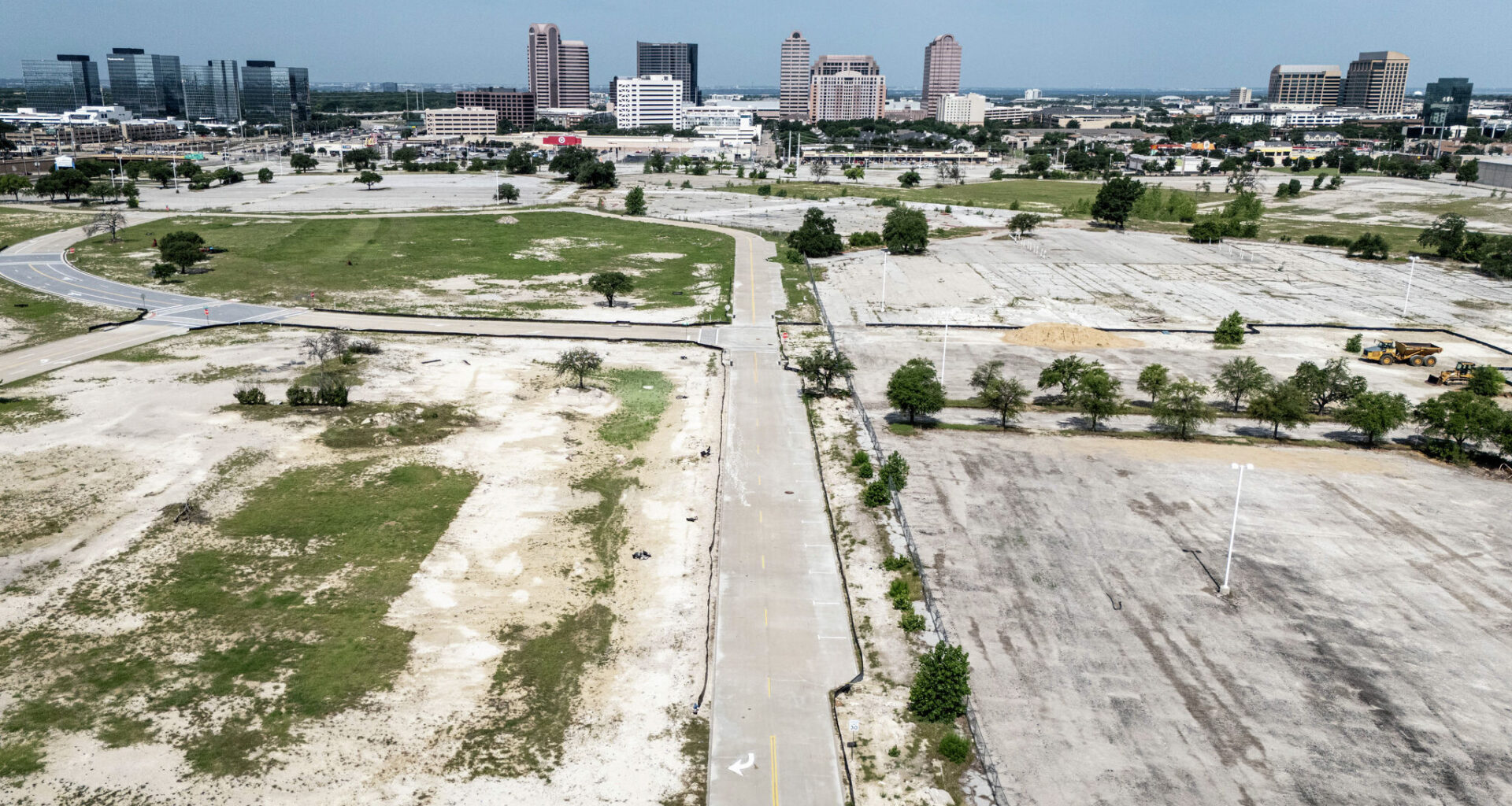
The Valley View site (pictured here) is a terrific choice and not simply because an NBA arena will anchor it. This type of use would allow hundreds of acres to complete the overall vision for residential units, office space and supporting retail, writes former Dallas City Council member Jaynie Schultz.
Angela Piazza/The Dallas Morning News
Fourteen years ago, an ambitious plan to redevelop the Valley View Mall area was launched.
Malls all over the United States were failing. In North Texas, we watched the decline and failure of places like Prestonwood, Big Town, Town East, Irving Mall and more.
Valley View was heading for the same fate. First, Dallas City Council member Linda Koop, then council member Lee Kleinman, brought together key stakeholders to create a plan known as Planned Development District 887 — the Valley View Galleria Plan.
Article continues below this ad
In 2014, the year I joined the City Plan Commission for District 11, we passed zoning to create the largest form-based zoning district in Texas at 450 acres. Form-based means that the use of a building is less important than the way it looks and connects to other buildings around it. This sort of zoning helps create more of a sense of place, the kind of neighborhoods that endure over time. That’s what we wanted for Valley View.
The idea was to have a near square mile of buildings that focused on people walking, using new modes of transit, living, working and playing in the same area. A Dallas ISD school was planned, experimental transit was considered. We wanted a variety of housing types and a giant 21-acre central park to anchor the entire area. The old mall site, around 110 acres, is east of Montfort Road and owned or controlled by Beck Ventures. The west side of Montfort Road is a mélange of older and new apartments, the Galleria and many small office buildings.
A group of passionate people who worked tirelessly from 2014 to 2025 helped form and enact this vision. One thing we knew for sure was that this was the best located real estate in all of North Texas. It was the last “backstop” to head off the migration of people and businesses to the northern suburbs.
As part of the effort, we realized that if Dallas was to seriously complete, our standing as an international city must be solidified. We branded the area, with City Council approval, as the Dallas International District. That meant that a city-owned office building could become the hub for the many global trade offices seeking to build business in Dallas.
Article continues below this ad
Dallas ISD even designated its planned school to be an international STEAM (science, technology, engineering, arts and math) academy. The local maps all referenced the International District. Despite the frustration of the abandoned mall, we reminded people that Uptown took more than three decades to be fully redeveloped.
The Montfort Road redesign was approved and funded, the plan to make Alpha Road more pedestrian friendly began construction, and the Galleria took on a true international ambiance by adding stores from all over the world.
When the old Valley View Mall finally came down under extreme pressure from city officials in late spring 2023, we knew that slowly but surely this area would develop.
The arena announcement confirmed what a small group of Dallasites have known for 12 years: this corner, at the intersection of LBJ Freeway and Preston Road, was always “Main and Main.”
Rumors began flying about the possibility of the International District for the arena. I was doubtful because I could not imagine the Mavericks paying for land that the current city leaders seemed so willing to give away for free.
Article continues below this ad
I had misread the situation. When I heard Mavericks general manager Rick Welts deflect a pointed question about the arena site at the North Dallas Chamber of Commerce annual meeting, I assumed Mavericks ownership believed they could acquire the downtown location for considerably less than the former mall they hold under option.
I was wrong. It turns out that political pain is far more expensive than land. The Mavericks did not want to be associated with the demolition of Dallas City Hall — an I.M. Pei landmark that has become a flashpoint for preservation versus development. I can only hope our elected officials absorb that signal as clearly as the ownership did.
The Valley View site is a terrific choice, and not simply because an NBA arena will anchor it. This type of use fits the high-intensity use of an arena leaving hundreds of acres to complete the overall vision of thousands of residential units, millions of square feet of office space, and all the supporting retail that dense urban living demands.
The area already includes hundreds of aging apartments — many designated affordable, many more qualifying as “naturally occurring affordable housing” by virtue of their age and condition — alongside hundreds of newer, market-rate units built in the last decade. When I first engaged with this district in 2014, we launched a comprehensive plan spanning transportation, parks, housing and capital investment.
Every developer who looked at the site used the same phrase: the corner of “Main and Main.” If Dallas intends to compete with the cities growing just north of our city limits, we must concentrate intense development in the northern area of Dallas to capture the sales tax and other revenue streams that currently flow to Frisco, Allen and beyond.
Article continues below this ad
This is that opportunity.
Jaynie Schultz represented District 11 on the Dallas City Council from 2021 to 2025.
Have thoughts about this? Send a letter to the editor using our letters form or email letters@dallasnews.com. Letters should be no more than 200 words and include the first and last name of the writer and city of residence.