
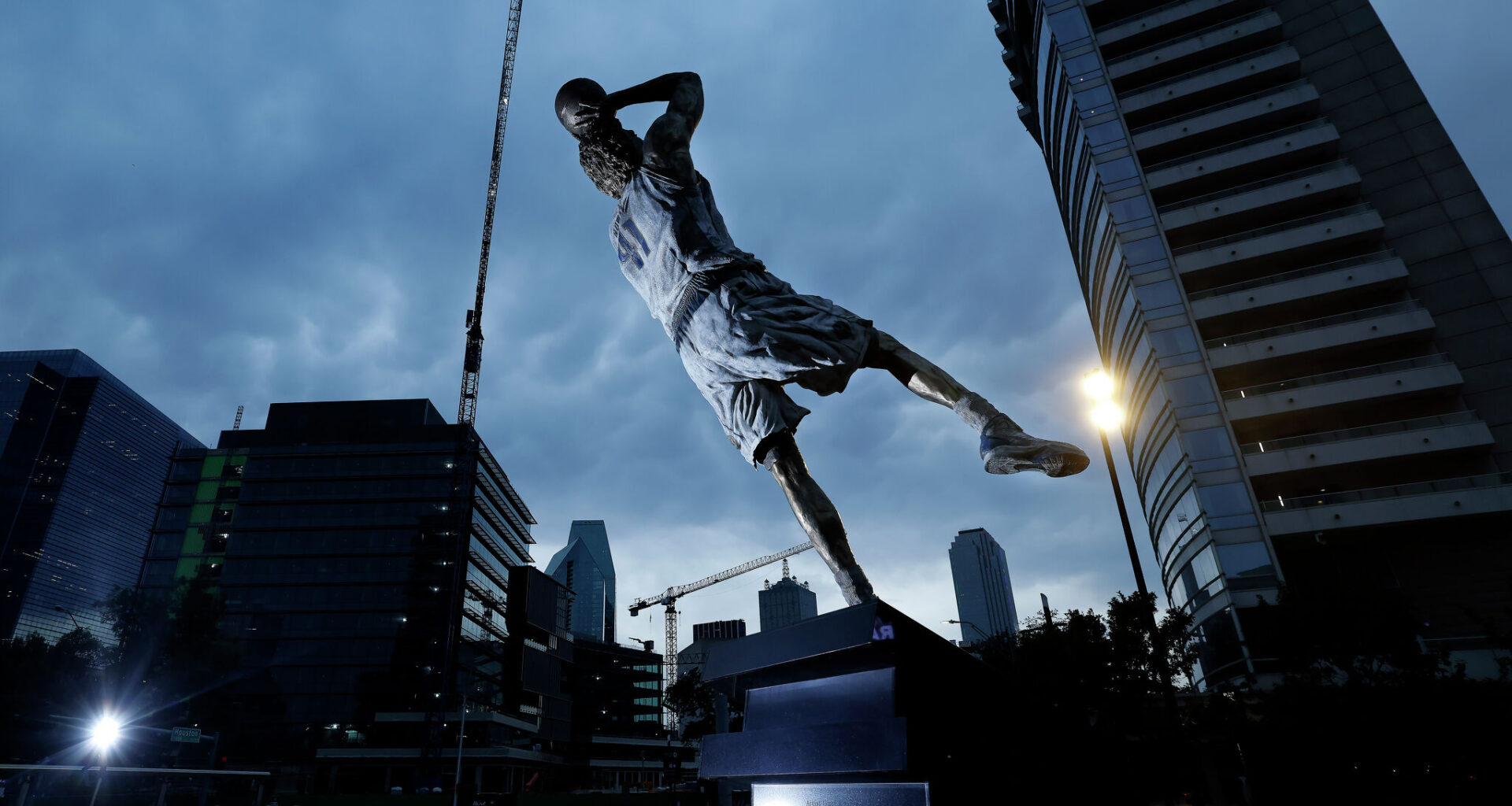
Representative Venton Jones is asking the Mavericks to halt their relocation plans and sit down with community leaders, economic development advocates and stakeholders from southern Dallas. Pictured here is a statue of Dallas Mavericks legend Dirk Nowitzki outside the American Airlines Center in downtown Dallas.
Tom Fox/The Dallas Morning News
Dallas is facing a critical turning point for the economic survival of our urban core and the equitable future of our entire city. What we are witnessing right now is not an isolated real estate transaction or a simple relocation. It is a cascading, multi-billion dollar flight of capital, corporate power and civic identity out of downtown Dallas.
Consider the devastating timeline we have watched unfold just this year. AT&T announced its departure from its downtown headquarters for a suburban campus in Plano. The Dallas Stars moved forward with plans to exit the American Airlines Center for an arena in Plano. The Dallas Mavericks announced an agreement to purchase over a hundred acres in and relocate to Far North Dallas.
And also a few days ago, Saks Global confirmed that the historic century-old Neiman Marcus flagship store on Main Street will close its doors for good this September, leaving downtown without a major department store for the first time in 119 years.
Article continues below this ad
This mass exodus of economic and cultural anchors strikes at the very heart of Texas House District 100, which encompasses Victory Park and surrounds the downtown core. The reality is simple: if Dallas wants to remain one of America’s premier cities, we cannot afford to become complacent in the face of these departures.
For too long, Dallas has assumed it will always be the region’s economic leader. Meanwhile, Fort Worth continues to grow at a remarkable pace, surpassing 1 million residents and aggressively investing in its future. Dallas remains a larger city, but size alone does not guarantee success tomorrow.
If Dallas fails to strengthen its urban core and make bold investments that create economic opportunity, we risk losing our competitive edge. The cities that thrive over the next generation will be the ones willing to invest in transformational projects that attract businesses, residents, visitors and talent.
The future growth of Dallas is not north — it is south.
Article continues below this ad
When major legacy institutions vacate and iconic sports franchises walk away, it guts our city’s tax base. This matters deeply to Oak Cliff, South Dallas and West Dallas because municipal tax revenue is the lifeblood that funds infrastructure, parks, public safety and community development across the entire city. When the central tax base is systematically starved by capital fleeing north and to the suburbs, the funds available to invest in historically marginalized communities dry up.
We can no longer operate on the failed promise of trickle-down economic development, hoping that wealth accumulated on the furthest northern edge of the city will eventually send leftover crumbs past the Interstate 30 corridor. The hardworking families of southern Dallas deserve direct, intentional, front-door investment.
It strengthens our tax base so we can distribute public resources equitably.
It supports our small businesses and the countless local vendors, service providers and entrepreneurs who rely on a dense, active urban core.
It creates genuine economic opportunity by preserving thousands of union, hospitality, retail and service careers right here where working-class Dallas residents can access them.
When the Mavericks ownership states that they believe in Dallas, we must ask: Which Dallas do you believe in? Do you only believe in the Dallas that can comfortably afford luxury suites and high-end retail? Or do you believe in the working-class families, the Black and Latino residents who have served as the cultural and labor backbone of this city for generations, yet continually watch major economic opportunities pass them by?
Article continues below this ad
I am issuing a direct call to action to the leadership of the Dallas Mavericks: Pause this process, hit the brakes and completely reconsider this move to the Valley View area.
I am formally asking the team ownership to halt these relocation plans and sit down with community leaders, economic development advocates and stakeholders from southern Dallas. Come look at the immense potential, the available land and the deeply loyal fanbase that exists south of I-30. Choose to be a historic partner. Choose to leverage your massive economic power to help us rewrite the economic narrative of this city.
If professional sports teams want the support of this city, they must act as true partners to the entire city. We can no longer allow public coordination, zoning priorities and infrastructure focus to be monopolized by projects that further entrench our city’s economic segregation.
Don’t turn your backs on southern Dallas. It is time to stop the corporate bleeding, protect our urban core and ensure that future investments uplift all communities. We must build the community with the community, look south, and help us build an equitable Dallas for everyone.
Article continues below this ad
Venton Jones represents Texas House District 100 in Dallas County, including South Dallas, West Dallas, East Dallas, Victory Park and Oak Cliff.
Have thoughts about this? Send a letter to the editor using our letters form or email letters@dallasnews.com. Letters should be no more than 200 words and include the first and last name of the writer and city of residence.