
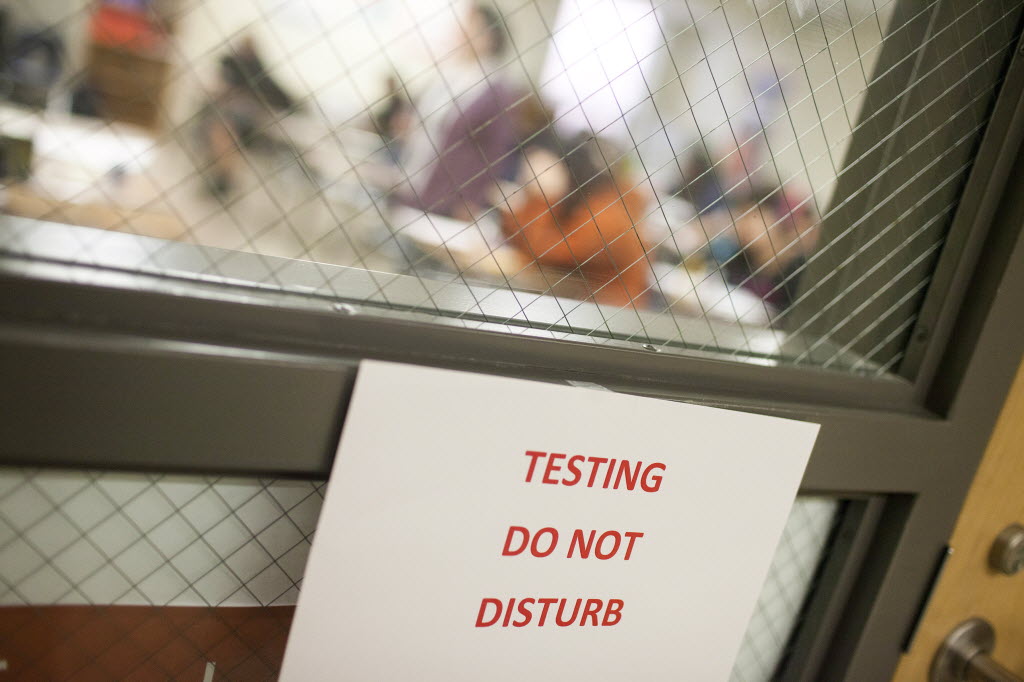
The results of this year’s STAAR tests show Dallas ISD is closing the gap with the rest of the state, Superintendent Stephanie Elizalde said Thursday — and it’s doing so with more students facing challenges that could put them at a disadvantage academically.
Elizalde presented the district’s results from the State of Texas Assessments of Academic Readiness at a board briefing Thursday evening. Across all grade levels and subject areas, the percentage of students performing on grade level either held steady or grew compared with last year.
Ahead of Thursday’s meeting, district leaders released preliminary scores that showed gains in reading and math in grades three through eight. Elizalde cautioned that those results could change before they’re officially released on Tuesday. Notably, the percentage of third graders testing on grade level in reading climbed from 43% last year to 45% this year. School leaders and education researchers say third grade is a critical milestone for reading because students who can’t read proficiently by then are more likely to struggle academically later on.
The preliminary results included scores for all grades and subjects except for seventh grade math. Elizalde said that’s because the district gives seventh graders the eighth grade math test. The percentage of students who scored on grade level on the eighth grade math test held steady at 39%.
TEA officials plan to release statewide, district and campus-level results for grades three through eight on June 16.
Elizalde noted that Dallas ISD’s demographic makeup is starkly different from the rest of the state. During the 2024-25 school year, 89.3% of students in Dallas ISD were classified as economically disadvantaged, and 50.4% were learning English, according to the Texas Education Agency. Statewide, 60.4% of students were economically disadvantaged and 24.3% were learning English.
The academic gains reflected in this year’s test scores are the result of the hard work and dedication of teachers and campus leaders in the district, Elizalde said.
Board member Lance Currie said the test results show that the idea that low-income students and English learners can’t succeed is “definitively false.” While he acknowledged that there are areas where the district needs to grow and improve, he said the test scores are a cause for celebration.
“Our students can learn, our teachers can teach, as long as we have high expectations, and we give them the tools and the resources we need,” he said.
The DMN Education Lab deepens the coverage and conversation about urgent education issues critical to the future of North Texas.
The DMN Education Lab is a community-funded journalism initiative, with support from Bobby and Lottye Lyle, Communities Foundation of Texas, The Dallas Foundation, Dallas Regional Chamber, Deedie Rose, Garrett and Cecilia Boone, Judy and Jim Gibbs, The Meadows Foundation, The Murrell Foundation, Ron Steinhart, Solutions Journalism Network, Southern Methodist University, Sydney Smith Hicks, and the University of Texas at Dallas. The Dallas Morning News retains full editorial control of the Education Lab’s journalism.