
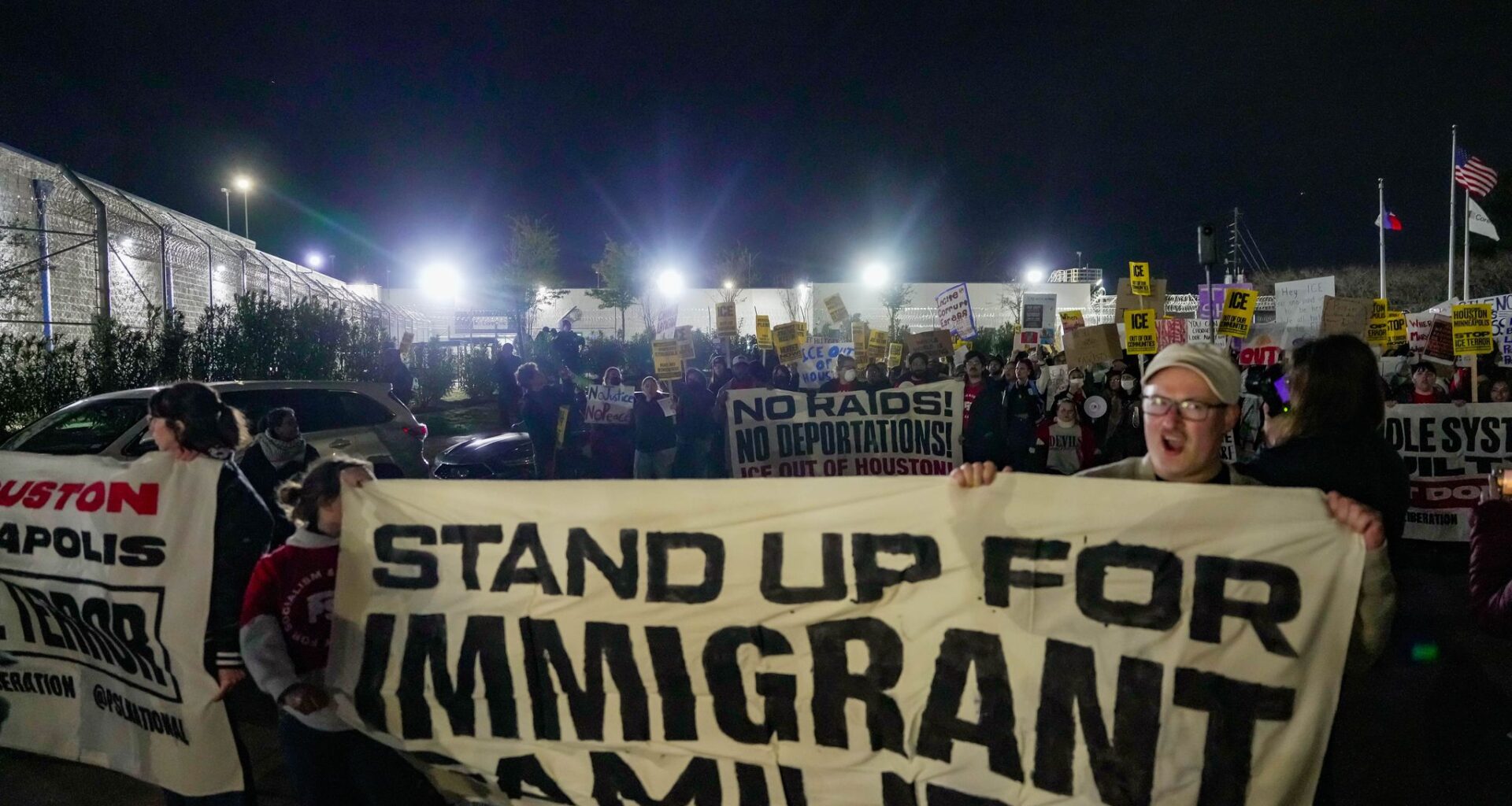
Hundreds of people gather to protest in front of the Core Civic Detention Center in Houston, Friday, Jan. 30, 2026, as part of a nationwide day of action against federal immigration enforcement policies that saw demonstrations and strikes in cities across the United States.
Raquel Natalicchio/Houston Chronicle
A Houston-based law firm is undermining a federal law intended to protect victims of domestic abuse by running a highly profitable scheme that encourages clients to file false claims for immigration benefits, a federal lawsuit alleges.
The Meneses Law firm perfected a business model built on “the systematic exploitation of vulnerable, predominantly Spanish-speaking immigrants” who were coached into applying for relief under the Violence Against Women Act, according to a lawsuit filed in Houston by a former client.
Under VAWA, immigrants who suffered mental or physical abuse at the hands of a spouse, parent or child who is a U.S. citizen or permanent resident can file their own petition for legal status in the U.S.
Article continues below this ad
But the Meneses firm ran an “assembly line” operation where profits took precedence over meaningful legal advice, and clients’ statements were manipulated to construct a false narrative, according to the allegations.
Exclusive: HISD student detained by ICE was on the verge of a successful asylum claim, attorneys say
“This enterprise operates through a coordinated network of attorneys and non-attorney staff using standardized, high-volume processes to manufacture false abuse narratives, obtain client signatures without informed consent, and submit false immigration filings to (U.S. Citizenship and Immigration Services), under penalty of perjury,” the lawsuit alleges.
Michigan-based attorney Robert Alvarez filed the class-action lawsuit on behalf of Reyna Ángeles Acosta, a Mexican citizen living in Austin, and dozens, or possibly hundreds, of others who might have been misled by the firm.
Article continues below this ad
The lawsuit names as defendants Meneses Law; Meneses Enterprises and its members, Frances Christine Meneses and Julio Carlos Meneses; and Robert Torrey, a Texas lawyer who prepared the documents for Acosta.
Meneses Law has hired J. Connelly, a national public relations firm. A spokesperson denied any wrongdoing and said the lawsuit is part of a coordinated effort to take advantage of immigrants.
READ MORE: How Texas officials are responding to noncriminal ICE warrants
“We believe the allegations being advanced against Meneses Law are orchestrated by a group of individuals looking to collect large sums of fees by preying on the immigrant community and their fears in this current political climate,” the spokesperson said. “We have already begun taking actions against these individuals, and we expect many positive developments in the days ahead.”
The spokesperson added that the law firm is pursuing “all appropriate legal remedies and remains fully confident in the integrity of its operations and the strength of its legal position.”
Article continues below this ad
The lawsuit comes amid heightened efforts by the Trump administration to further scrutinize the legal immigration system, including applications for benefits under VAWA and other programs, to ferret out what the administration says is rampant fraud and abuse.
In guidance issued in December, federal officials said filings of VAWA petitions from 2020 to 2024 increased by 360%.
“When unqualified aliens misuse the VAWA program, it causes significant processing delays, harming survivors with legitimate claims,” the guidance states.
An alleged ‘pipeline’
The lawsuit says Acosta retained the Meneses Law firm after seeing online, Spanish-language advertising, and she paid the firm nearly $15,000. Other clients reported paying between $13,550 to $25,000, according to the lawsuit.
Article continues below this ad
The complaint describes a coordinated effort by Meneses attorneys and auxiliary staff to process clients in the same way, regardless of their individual circumstances.
According to the complaint, the law firm posted videos to Facebook, Instagram, TikTok, and YouTube that targeted Spanish-language speakers. Staff promised immigrants solutions and used taglines such as “We say yes when others say no.” The messages did not mention VAWA, domestic violence, or abuse.
Leads were then funneled into a “pipeline” where sales representatives collected information from the prospective clients. The sales representatives were referred to as “licenciadas,” a term used in Spanish-speaking countries in Mexico and Central America that generally refers to an attorney or other legal professionals.
“These sales representatives were not U.S. licensed attorneys in any jurisdiction, were not enrolled in law school, and had no formal legal training,” the lawsuit states. “The use of the title ‘licenciada’ to describe them to Spanish-speaking clients was a deliberate misrepresentation of professional status, calculated to induce retention and fee payment.”
Article continues below this ad
During the intake process, the so-called “licenciadas” interviewed clients using a questionnaire written in a way that elicited information that could be molded into an abuse claim under VAWA, the lawsuit alleges.
The retainer agreements presented to the clients were in English and only made mention of the immigration document that would be filed, known as the I-360 form, without describing the VAWA self-petition or allegations of abuse.
READ MORE: In the nation’s only ICE family detention center, one family has been locked up for 10 months
“The retainers did not explain the nature of VAWA, the elements required to be proven, the allegations that would be made, or the potential consequences of filing a false petition,” the complaint alleges. “The concealment served a critical business function: If clients understood that they were being enrolled in a petition alleging that their own family members had abused them, many would refuse to proceed.”
The marketing videos also included statistics on the so-called approval rate of VAWA petitions that falsely claimed more than 90% of applications were approved, which is not backed up by actual government statistics, according to the lawsuit.
In 2021, the approval rate for spouse-based petitions was about 70%, about 42% for child-based petitions, and less than 25% for parent-based petitions, the lawsuit states.
‘Mental anguish’
The named plaintiff in the case, Reyna Ángeles Acosta, said in the lawsuit that she responded to an ad from the law firm in September 2024 and paid more than $14,000 in fees to Meneses Law.
The complaint states that Acosta raised concerns during her intake interview about her son’s safety and late work schedule. Those comments were manipulated to frame a false abuse narrative, the lawsuit alleges.
“Her concern about his safety was recast as evidence of a pattern of conduct causing her mental anguish,” the complaint alleges. “Normal parent-child tensions were recharacterized through a lens of ‘abuse’ and ‘extreme cruelty.’”
She was never advised that she was submitting information for a VAWA petition, she never spoke to a lawyer, and documents in her application contained “exaggerations and falsehoods,” according to the lawsuit.
When it was time to electronically sign the necessary documents, the lawsuit says they were presented in English, and she was not provided detailed explanations of their context.
The lawsuit alleges that Acosta has suffered mental anguish after unwittingly submitting false information to federal authorities that could lead to possible criminal charges and other immigration-related consequences. She’s also had to spend money on attorneys to amend or withdraw her VAWA petition.
‘Fear and misinformation’
Alvarez said damages related to the Meneses scheme extend beyond the plaintiffs at the heart of the case.
“Practices like this are going to harm not just those individuals who have paid for these services, but the hundreds of credible and legitimate individuals who deserve and are eligible for this benefit,” he said.
Meneses said, however, the legal action against the firm is what harms the immigrant community.
READ MORE: Texas sheriffs will soon be required to work with ICE. Some are hesitating.
“Campaigns built around fear and misinformation in sensitive immigration matters do not simply target the firm, they risk causing real harm to individuals and families navigating an already complex legal system,” a spokesperson for the law firm said. “Sensationalized accusations and public pressure tactics can discourage people from pursuing lawful immigration status or push them into making rushed decisions with serious and potentially irreversible consequences.”
The latest lawsuit isn’t the first time Meneses has been accused of wrongdoing. In December, two U.S. citizens and three Mexican citizens sued Meneses in Colorado federal court, alleging the law firm lured the immigrants through deceptive practices and filed false VAWA claims on their behalf.
In May 2026, an immigrant from Honduras, Ronny Alexander Ramirez Canales, sued the law firm in Houston federal court over similar allegations. Court documents allege that after Ramirez Canales paid more than $13,000, the law firm filed a VAWA petition “based on false, exaggerated, and unauthorized allegations of abuse,” according to the lawsuit. Attorney Alvarez also represents Ramirez Canales.
In July, an immigrant from Guatemala accused the firm during a Houston news conference of charging her husband $15,000 and coaching him into making false statements about an abuse claim. Her husband was later deported.
Meneses later filed a defamation lawsuit against the Raed Gonzalez Olivieri law firm, alleging statements made at the news conference by attorney and shareholder Ross Miller and chairman Raed Gonzalez harmed Meneses’ business.
“Make no mistake – these claims are untrue,” the defamation lawsuit states. “And Gonzalez Olivieri has no evidence to support any of its allegations, nor has it performed any meaningful investigation to confirm their false statements.”
The lawsuit also accuses Gonzalez’s firm of “tortious interference,” the practice of intentionally interfering in another attorney’s business affairs with a third party.
Gonzalez declined to comment on the case against his firm but added that “it has received a number of inquiries from individuals who claim to be in a similar situation with the (Meneses) law firm regarding this issue.”
Gonzalez and Fisher asked a judge to dismiss the case based on the Texas Citizens Participation Act, a 2011 state law passed to protect people from retaliatory lawsuits. The motion was never granted, and the case is now before a state appeals court.