
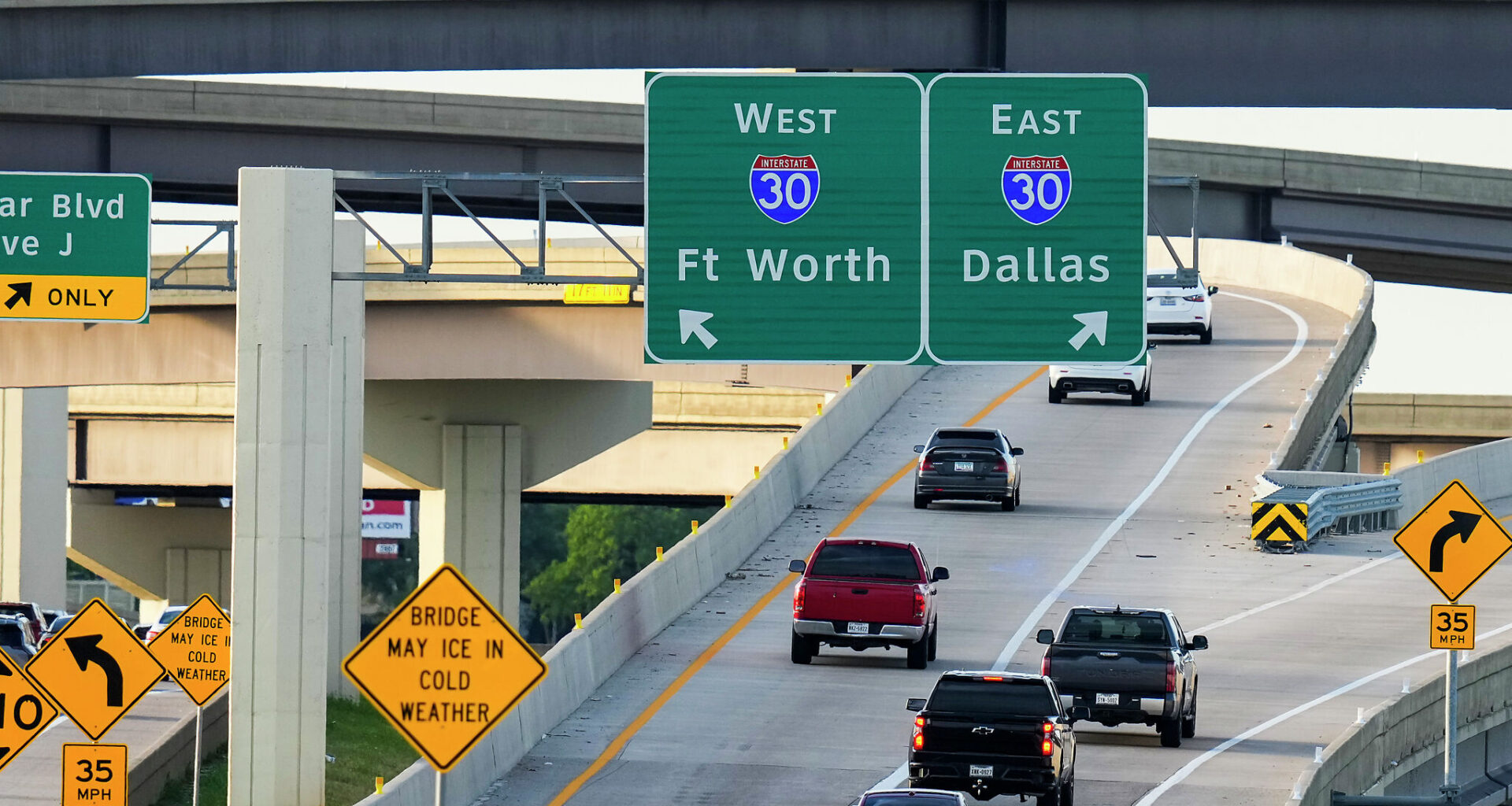
Ready, set, go nowhere.
Traffic in North Texas is expected to increase exponentially during the World Cup this month and next. With nine games, a fan festival and the International Broadcast Center being hosted in Dallas-Fort Worth, transportation officials are estimating over a million additional people will be in the region.
The busiest periods on major road ways are expected to be three to five hours before kickoff and three hours after the matches.
Although several million dollars have been invested in public transit to help combat the congestion, some people will still depend on cars as their primary means of transportation. The North Central Texas Council of Governments announced road closures in Dallas and Arlington taking place on match days and for the duration of the World Cup.
Here’s what major roads are expected to have the most congestion during the World Cup.
The primary east-west route between Dallas and Arlington, I-30 will likely be the most congested highway this summer. It is the main highway heading toward Dallas Stadium. Match attendees, World Cup fans and local commuters will be using this corridor heavily.
Referred to as the “last mile,” SH 360 is the final stretch prior to getting to Arlington’s entertainment district and Dallas Stadium (AT&T Stadium). Whether visitors arrive via I-30, Interstate 20, State Highway 183 or State Highway 114, many will have to funnel onto SH 360 to reach the entertainment district and the stadium.
One of the main airport-access corridors in North Texas, SH 183 will be busy with tourists and locals as they come and go for summer vacation. This highway is another major connector for the mid-cities surrounding Dallas and Arlington, both of which are heavily visited by local commuters and World Cup fans.
Another major airport access road, SH 114 helps connect northwest Tarrant County and North Dallas. Motorists from surrounding areas such as Southlake, Grapevine and Las Colinas also rely on SH 114 as one of their main points of connection. The roadway supports daily commuters, airport travelers and, until July 14, incoming World Cup fans visiting the region.
Sometimes referred to as State Highway 161, the turnpike is a connector for many of the mid-cities such as Plano, Garland, McKinney and Richardson. Commuters living or working in major hubs such as Dallas, Frisco or Arlington use the turnpike as a road on their primary route. It could also potentially experience increased congestion as an indirect result of regional drivers avoiding traffic on other routes to Dallas Stadium (AT&T Stadium).
The southern alternative to I-30, this highway provides access to Arlington from communities south of Dallas and Fort Worth. Oftentimes, when congestion increases on I-30, navigation systems will redirect traffic to I-20. This could result in I-30’s traffic spilling over to I-20 with airport travelers, match attendees or local commuters trying to get around and avoid congestion.