
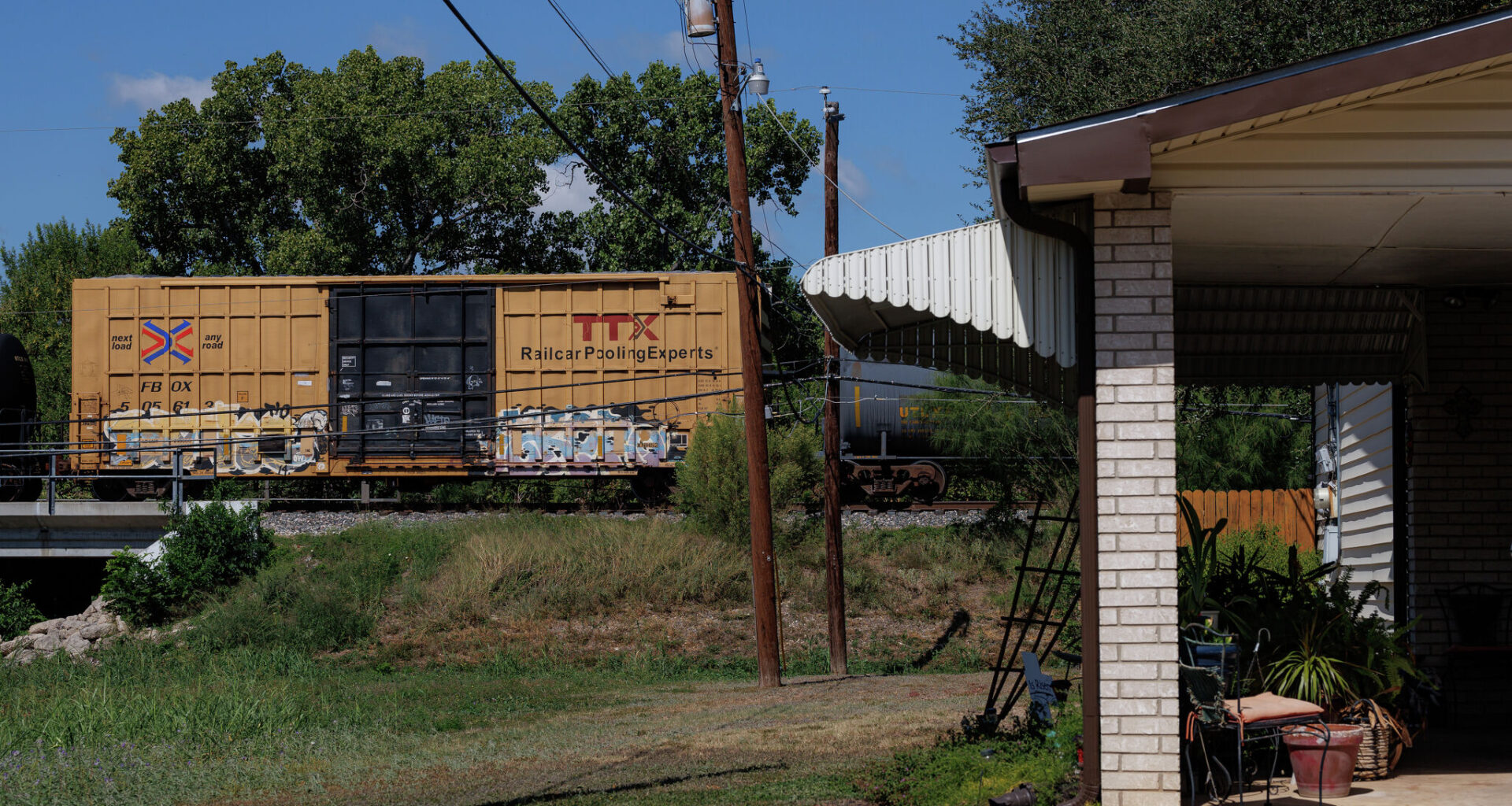
A train moves along the tracks behind a house on San Antonio’s East Side on Oct. 13, 2025. Councilman Jalen McKee-Rodriguez is advocating for a system that would provide real-time information about trains passing through railroad crossings.
Sam Owens/San Antonio Express-News
You’re driving through San Antonio’s East Side, rushing to get to a meeting or running an errand, when you turn down a street and see a railroad crossing.

The crossing arms start coming down and lights begin flashing, heralding an oncoming train, but before you have time to turn around, other drivers are lining up behind you. You’re stuck.
Article continues below this ad
Councilman Jalen McKee-Rodriguez is championing what could a way out of that trap — a system that would alert residents by text message and email when trains are passing through their communities and clogging traffic at railroad crossings so they can take an alternative route.
McKee-Rodriguez says the East Side’s District 2 — which he’s represented since 2021 — has about 20 crossings, more than another City Council district, and drivers spend too much time waiting for trains to pass.
James Nortey doesn’t live on the East Side but he works there as CEO of San Antonio Growth on the Eastside, a nonprofit that promotes economic development. And he’s acutely aware of the disruption brought on by trains.
“If I am having a meeting on the East Side and I want to grab lunch downtown, I’ve been stalled by as much as 20 minutes while waiting for the train,” Nortey said. “Occasionally, the train just stops and stands still for almost an hour. The train is a pain point for so many San Antonians, but especially those in District 2.”
Article continues below this ad
The system McKee-Rodriguez is advocating for would provide real-time information about trains approaching, passing through or stopped at railroad crossings, similar to traffic and mapping apps like Waze and Google Maps.
He’s pushing for a pilot program. The council is expected to discuss next steps for the initiative in the near future.
McKee-Rodriguez has been vocal on social media about the frustration of being stuck at a crossing when a train is passing through.
He chairs the City Council’s Transportation and Infrastructure Committee. During a recent meeting, he said San Antonio could be one of the first cities in the nation to launch a train notification system program.
Article continues below this ad
“We’re one of the most train-impacted cities in the country, and so there’s not really a strong model elsewhere that we’re looking at,” McKee-Rodriguez said. “This is really something that we’re hoping to develop here for other entities to aspire to.”
The city is collaborating with Southwest Research Institute, a San Antonio nonprofit contract-research organization, to develop the notification system for the pilot program. The organization is looking to adapt its Active Vision system, which uses machine learning “to detect and report actionable traffic condition changes,” according to its website.
“Our Active-Vision technology has been used in other city projects, including a 2023 traffic safety study,” said Mike Koets, staff engineer in SwRI’s High-Reliability Systems Department.
Details of the pilot program — such as its costs and where in San Antonio the technology will be tested — are unclear. But officials say it’ll be rolled out at some of the city’s busiest railroad crossings, likely including some on the East Side.
Article continues below this ad
“We’ll be working internally within the city and with Southwest Research to kind of finalize the scope and the cost, and then we’ll be ready to move forward in the next couple of weeks or so,” said Art Reinhardt, director of the city’s Public Works Department.
Funding for the pilot program is expected to come from Public Work’s budget.
This program wouldn’t be the first time city officials have tried to ease residents’ annoyance with trains passing through their neighborhoods. The city tried to address residents’ complaints about trains blasting their horns at railroad crossings by creating “quiet zones” in 2009. Those are sections of railroad corridors where train operators are instructed to not sound their horns. All 10 council districts have quiet zones.
Article continues below this ad