
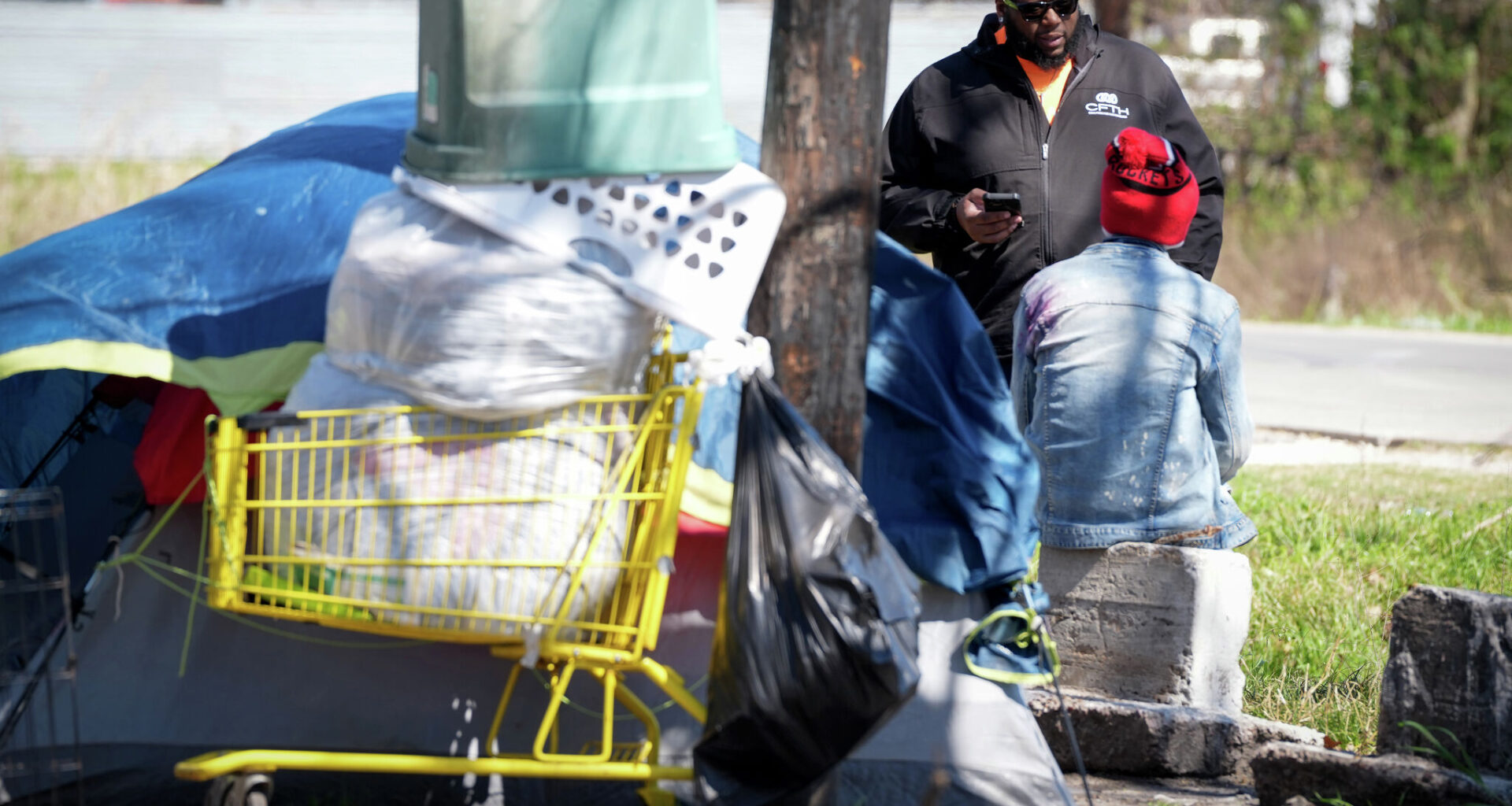
Outreach coordinator with the Coalition for the Homeless Jeremy Sanders speaks with a man who declined to be identified during the annual point-in-time count of people experiencing homelessness Feb. 24, 2026, in Houston’s Fifth Ward.
Jill Karnicki/Staff
Outreach coordinator with the Coalition for the Homeless Jackie Urbina speaks with James Brown, who is living in a van, during the annual point-in-time count of people experiencing homelessness Feb. 24, 2026, in Houston?s Fifth Ward.
Jill Karnicki/Staff
Outreach coordinator with the Coalition for the Homeless Jackie Urbina speaks with James Brown, who is living in a van, during the annual point-in-time count of people experiencing homelessness Feb. 24, 2026, in Houston?s Fifth Ward.
Jill Karnicki/Staff
Outreach coordinators with the Coalition for the Homeless Jackie Urbina and Jeremy Sanders speak with James Brown, who is living in a van, during the annual point-in-time count of people experiencing homelessness Feb. 24, 2026, in Houston?s Fifth Ward.
Jill Karnicki/Staff
A vehicle driven by outreach coordinators with the Coalition for the Homeless is used to conduct research in the Fifth Ward during the annual point-in-time count of people experiencing homelessness Feb. 24, 2026.
Jill Karnicki/Staff
A vehicle driven by outreach coordinators with the Coalition for the Homeless is used to conduct research in the Fifth Ward during the annual point-in-time count of people experiencing homelessness Feb. 24, 2026.
Jill Karnicki/Staff
The number of Houston-area people staying in shelters and living in tents, cars and other places not meant for habitation has held remarkably steady during a time of turbulence for homelessness strategy and funding.
Over 2,050 people slept in shelters in the Houston region, and 1,270 were living without shelter on a single night in February, the Coalition for the Homeless in Houston and Harris County announced Friday morning.
Those numbers represented less than a 1% change from the year before, despite COVID-related federal funding drying up and the unemployed population rising by more than 15,000.
Article continues below this ad
419 EMANCIPATION: EaDo shelter quietly opens for drop-offs. How are homeless Houstonians reacting?
The fact that the numbers have stayed so similar “tells you that the system as a whole is doing what it’s supposed to do,” said Kelly Young, chief executive of the nonprofit Coalition for the Homeless, which coordinates the homeless strategy and federal grant applications for Harris, Fort Bend and Montgomery counties. That system includes the region’s longtime focus on moving chronically homeless individuals with disabilities into permanent housing and providing them with case workers, as well as a more recent strategy of directing some resources to creative, less costly interventions to people who have only been homeless for days or weeks.
“Even with limited new funding and few new programs launched during this reporting period, Houston has remained relatively stable,” said Mike Nichols, who once led the Coalition for the Homeless and now helps head Mayor John Whitmire’s homeless strategy, in an emailed statement.
“Behind every number is a real person, and our goal is to ensure more Houstonians are connected to the right support and a stronger path forward.”
Article continues below this ad
Major shifts in Houston’s fight against homelessness
Houston has long relied on disaster relief to unleash federal funding for objectives it doesn’t have the city budget for. The region’s homelessness strategy was buoyed by Hurricane Harvey funding; then came the $165-million influx from CARES Act, American Rescue Plan Act and private dollars that poured in after the pandemic. But that was spent by 2025. While the city earmarked $41 million from Hurricane Beryl and the Derecho for homelessness, $30 million of that has already been allocated to operating a new shelter at 419 Emancipation St., which only had its soft opening days ago.
“This will be the first time in many, many years that we do not have an extensive amount of additional dollars for housing,” beyond those provided by Congress to fight homelessness, Young said.
And even those funds, referred to as the Continuum of Care, are changing. While the U.S. Department of Housing and Urban Development, which administers the homelessness grants, has long focused on permanent housing as the solution to homelessness, starting in 2025, it began attempting to change the grant requirements to instead prioritize temporary housing and addressing addiction and mental health.
In addition to that financial backdrop, priorities have also changed at the city level. For years, the region dedicated its limited resources to permanent supportive housing, based on the belief that people staying in shelters were still experiencing homelessness and that providing housing was ultimately less expensive per person than operating shelters. During his campaign, however, Mayor John Whitmire often praised San Antonio’s shelter system. Shelters can provide people with a place to stay off the streets while they wait for housing and make it easier to connect them with services and other resources. When he unveiled his new homelessness plan in late 2024, it aimed to end street homelessness.
Article continues below this ad
WHITMIRE’S PLAN: Houston’s homelessness strategy, hailed as a success story by other cities, is changing. Here’s how.
One cornerstone of the plan – a shelter to move people into – did not open until recently, well after the 2026 count.
But the city quickly began rolling out new laws outlawing sitting or lying down on public property in neighborhoods around the city’s core, and in August 2025, it launched a rapid-resolution pilot with partners. In it, newly homeless individuals were offered a place to stay overnight at the Houston Recovery Center, originally designed as a place people go to get sober; the next day, they’d be connected with a case manager at the Beacon, a day shelter, which would try to find a way to solve whatever issue had led to homelessness before their situations became more complicated and difficult to solve.
The rapid resolutions look very different depending on the person’s situation. Young described a case in which someone got into a fight with their roommate and was kicked out. “Can we help you with your roommate figure out what to do?” she asked. Maybe all that the situation would need would be help paying electricity bills or help finding the next place to live? Such quick interventions reduce the trauma people experience and also take far less money than waiting for them to become chronically homeless, then providing them with housing and a caseworker longterm.
The hope is that the pilot will help the region continue to make progress in tackling homelessness during a time of belt-tightening and shifting political priorities.
Article continues below this ad
And Young hopes that the data from the pilot will move philanthropists to invest in the goal of resolving homelessness for anyone “who walks through the door” within 90 days.
“That’s one of the beauties of Houston,” she said. “When you can succinctly identify a problem and then demonstrate what you think intervention should be, and then measure the outcomes, this is a pretty generous city. They’re pretty interested in having those things happen.”
One of a number of measures
The homeless count is conducted by every region that receives federal homelessness funding, and aims to measure both the population sleeping in shelters on the night in question (in this case, Feb. 23) and those sleeping in tents, cars, abandoned buildings and other places not meant for habitation.
Measuring the number of people sleeping in shelters is relatively simple. But measuring the people sleeping without shelter is trickier. In Houston, roughly 400 volunteers – many of them people who work with homelessness for various organizations – canvas Harris, Fort Bend and Montgomery counties over the course of three days. A mobile app coordinates the massive undertaking, showing each team what section of the massive region they’re responsible for, tracking which streets they’ve gone down, and logging their interviews and observations.
Article continues below this ad
But finding homeless individuals, even when you go down every street and even if you’re familiar with the area, depends on the day and the time.
Driving through Fifth Ward, Jackie Urbina, who was volunteering on behalf of the Coalition, pointed out an intersection. “People were there literally last week,” she said. “Where are they? What’s going on? Did they get housing or did they get kicked out?” The point-in-time count, for all of its manpower and effort, couldn’t answer those questions.
While the numbers are almost certainly an undercount of the actual unsheltered population, the count is widely considered the best snapshot available. The hope is that by conducting the count using the same methodology year over year, the data can be used comparatively over time.
The Coalition and its partners also monitor several other data points, such as the number of people who have received any type of homelessness service from the constellation of nonprofits that use a shared information system.That figure fell 9% from the previous year, to 36,000.
Then there’s the number of people the Coalition and their partners have moved out of homelessness into permanent housing, coupled with a case worker: 2,138, up 6% from the year before.
Looking forward, Young expressed optimism on a number of fronts: that the pilot and the work that will be done at the new shelter can help bring homelessness down even in a time of tighter funding, that philanthropists would step up to support the mission, and that the state or city would create a sustainable funding source to supplement what comes from the federal government.
Last week, the Trump administration released guidelines for receiving the next year’s federal homelessness funding. It included significant changes from the strategy it mandated in the past.
Young framed the new strategy, which places greater focus on shorter-term interventions, as things the Coalition has always wanted to do. “I think the overall continuum of care was never funded at the fullest amount – and if it were, then you could have encapsulated all of these interests in all of these things that people wanted,” she said. The underfunding, she explained, was what had led to “either-or” decisions about what services the funding should be used for, rather than an “and” mentality.
Asked whether existing programs would be affected if additional funding sources did not materialize, she remained resolute in her optimism.
“We’re gonna make it work,” she said. “We’ll have to make it work.”