
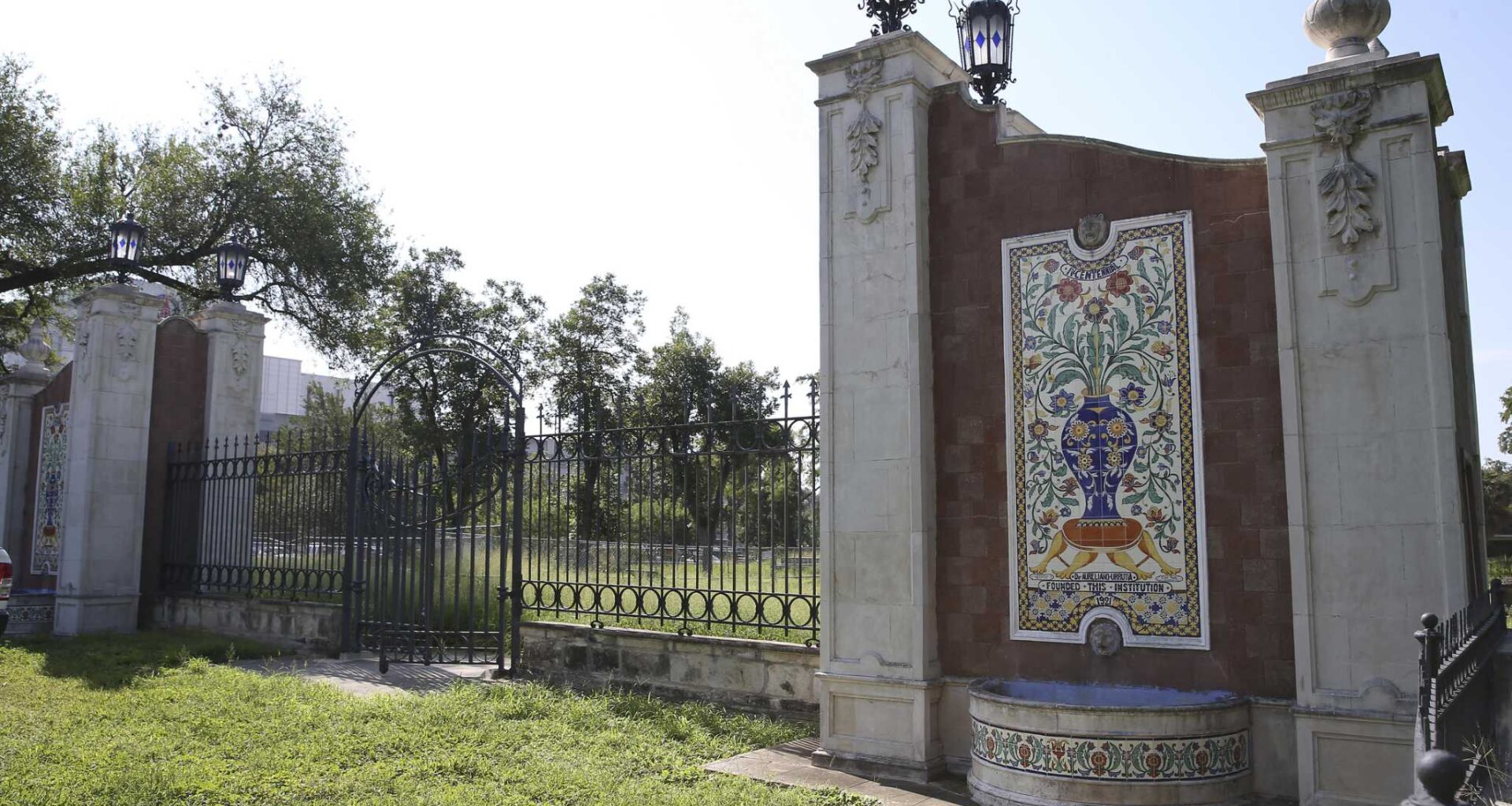
Drivers traveling along East Hildebrand Avenue near Broadway have probably noticed a tiled, gated entrance that’s in clear view from the street.

The massive entrance is a gateway to what remains of Miraflores sculpture garden, a creation more than a century old that was inspired by Mexican culture and now bears nationally recognized historic significance.
This week’s San Antonio Explained examines the history of Miraflores and the long-term restoration project working to revive the historic garden and make it accessible to the public once again.
Article continues below this ad
Its creation
Dr. Aureliano Urrutia, a world-renowned surgeon from Mexico who immigrated to the San Antonio during the Mexican Revolution of the early 1900s, purchased a 15-acre property adjacent to Brackenridge Park in 1921. He established Miraflores as a private garden on the property in 1923. According to archival records, he envisioned the space as a retreat that reflected the art and culture of his native Mexico.
Dr. Aureliano Urrutia, a prominent Mexican-born surgeon, is shown here in 1939 in front of his Miraflores property.
UTSA Special Collections
Miraflores featured trees, ponds, fountains and outdoor sculptures, including works by Mexican-born artist and architect Dionicio Rodriguez. A small guesthouse known as Quinta Maria was built on the property’s northwest side in the 1920s.
Article continues below this ad
Urrutia and his family frequently entertained guests at Miraflores, and the physician was known to begin his days with a swim in one of the site’s fountains.
Its decline
The lush grounds and artistic setting of Miraflores started to decline in the 1960s, after Urrutia retired and sold the property to USAA. Parts of the garden were cleared to make way for office space and parking areas.
Article continues below this ad
As the property’s purpose shifted toward corporate use, the Miraflores that Urrutia had created continued to deteriorate.
Unused parts of Miraflores were left unattended. Sculptures and other artwork, including tiled benches, were damaged by exposure and neglect. The property’s trees and lush greenery suffered from a lack of irrigation and care.
Miraflores, which also has been known as Miraflores Park or Miraflores Alumni Park, changed ownership over the years. Southwestern Bell (later known as AT&T) bought the property in the 1970s and hosted company gatherings there. It was later owned by the University of the Incarnate Word, which sits across the portion of Miraflores that faces Hildebrand Avenue.
A replica of “Winged Victory,” as seen in 2021, is part of the landscape at the Miraflores sculpture garden.
Jerry Lara /San Antonio Express-News
The original 15-acre Miraflores site was reduced to about five acres, as portions of it were sold over the years, historical records show.
Article continues below this ad
The city of San Antonio obtained the property as part of a land swap deal with UIW in 2006. Work to restore Miraflores started in 2007, about a year after it was added to the National Register of Historic Places.
Its restoration
Miraflores’ restoration has experienced “lots of stops and starts,” said Chris Maitre, CEO of the Brackenridge Park Conservancy, which oversees the historic site.
Work completed so far has included cleanup efforts and minor landscaping projects, including the planting of trees last year. Officials have also completed an inventory of the sculptures remaining on the property, moving some into storage to help prevent further deterioration.
A handful of sculptures were determined to be beyond repair, and officials discovered that others were likely removed from the site over the years.
Article continues below this ad
One of the most prominent pieces, the Urrutia gate, was moved to the San Antonio Museum of Art in the late 1990s, according to archival records.
The Miraflores property remains closed to the public, to deter theft and vandalism and to help secure the safety of curious passersby. “It’s not really fit for public tours without a guide,” Maitre said.
The public can schedule a guided tour through the conservancy.
The goal of the long-term, multi-phase restoration project is to transform Miraflores into an educational and cultural destination open to the public. Concepts that have been discussed include an educational center, an amphitheater, a small event venue and a shop or cafe.
Article continues below this ad
A tiled bench is seen at Miraflores sculpture garden in 2021.
Jerry Lara / San Antonio Express-News
About $200,000 has been pledged toward the initial phase of the restoration project, which includes the creation of conceptual renderings. Maitre said an estimated $300,000 is needed to complete those renderings, which would incorporate feedback gathered through public engagement efforts. Fundraising remains ongoing.
Maitre said community input will play a key role in shaping the project’s future, adding that the restoration should both reflect what residents want to see at Miraflores and remain faithful to Urrutia’s original vision for the site.
Article continues below this ad
“We want to develop a concept that serves the public, and do it in a way that’s free to use,” Maitre said.