
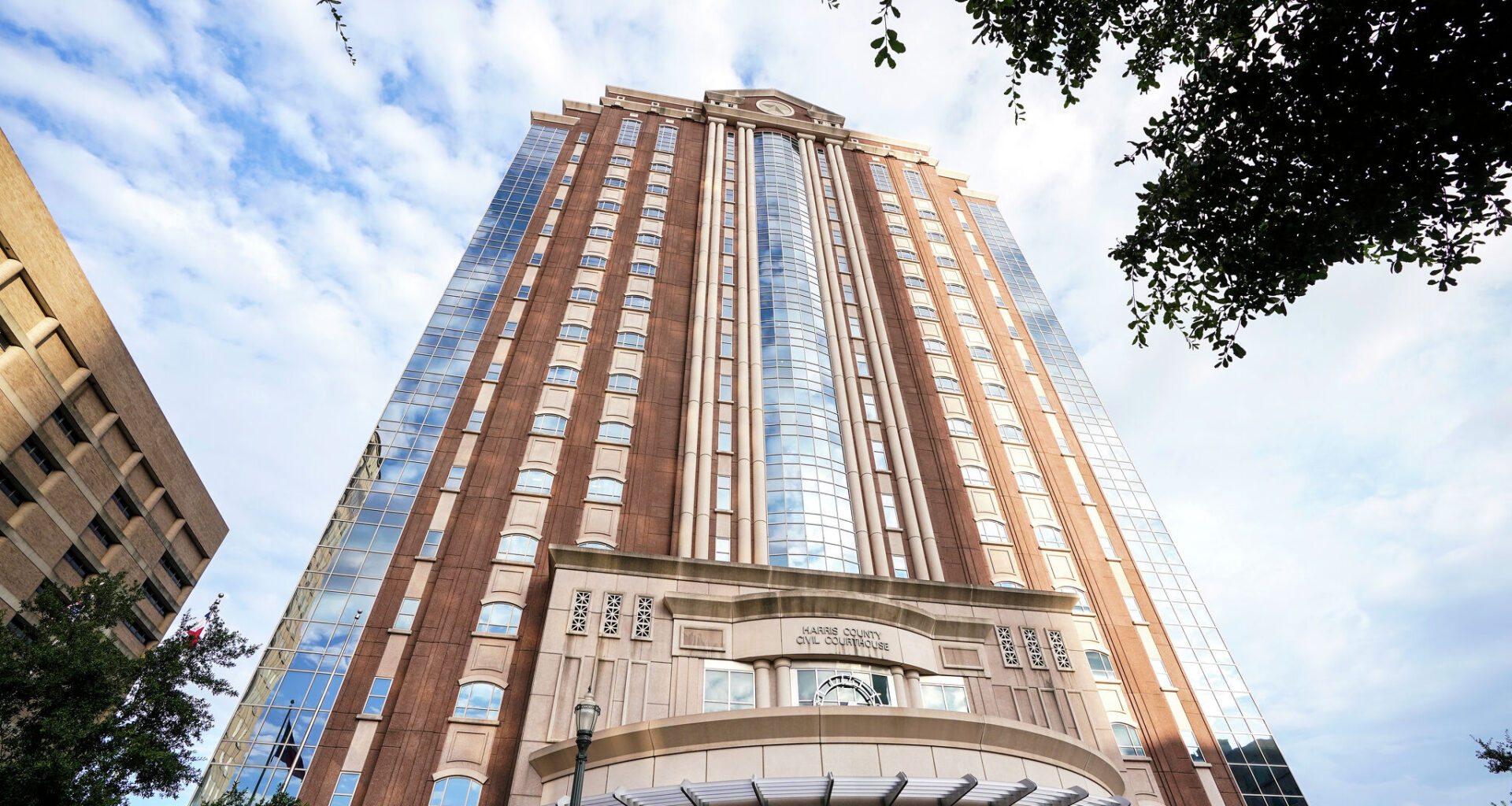
A Democratic judge without a Republican challenger in November has been absent from her family law court for most of 2026, according to Harris County records.
This year, Judge Angela Graves-Harrington used her county-issued badge to swipe into the civil courthouse or any other county building on 13 weekdays — including just once in April, according to badge swipe data through May 13 obtained through an open-records request by the Houston Chronicle.
RELATED: An adviser for Mayor Whitmire making $127k has rarely showed up to work since 2024
Outside of court, she has made public appearances in her capacity as judge. But her presence in the 246th District Court, which handles divorce, child custody and other family proceedings, has been sporadic since around the time of her husband’s death in October 2025. Her absence has continued as recently as May.
Article continues below this ad
Graves-Harrington, whose annual salary consists of $192,500 in state funds and an additional $25,000 from the county, attributed her absence to “medical leave” and declined to elaborate in a brief phone call. She’s still collecting a paycheck, according to Texas Comptroller officials.
Amanda Cain, a spokesperson for the Administrative Office of the Harris County District Courts, declined to comment on the judge’s “personal health matters” or when she would return to the bench.
FROM THE CHRONICLE: Gaps in Harris County’s ankle monitor program helped Lee Gilley flee to Italy
The badge swipes from Harris County Universal Services show the number of times Graves-Harrington entered a county building. The time and location of the badge swipes were redacted. She had last used her badge on May 3 — a Sunday — when Universal Services pulled her records for the Chronicle.
Article continues below this ad
Concerns about her infrequent attendance in the civil courthouse escalated on June 1 when an administrative judge, Susan Brown, ordered Graves-Harrington’s cases to be transferred to other family courts and to block her court from receiving new cases until further notice.
Brown, a governor appointee for the Eleventh Administrative Judicial Region of Texas, did not explain in her order why the transfer of cases was necessary.
Other judges were already handling the bulk of Graves-Harrington’s work. A scattering of retired and former judges paid through state funding were posted to her court following her husband’s death, but requests for outside assignments through Brown’s office came to a halt in January, according to records from the office.
Other sitting judges, including her associate judge, have since filled in on top of their other duties, court documents show. Despite Graves-Harrington’s prolonged absence, her court has managed to maintain a below-average 1,500 cases as of April — even as more and more cases landed in her court — with an above average clearance rate, according to Harris County District Court Administration statistics.
Article continues below this ad
The Chronicle reviewed hundreds of court cases in Graves-Harrington’s court. Most documents were restricted due to the sensitive nature of family law cases, but among the documents available on the Harris County District Clerk website, there were signed court orders from at least six other judges, typically on days she never entered the courthouse with her badge. When she did enter a county building, other judges still proceeded with court business on her behalf, records show.
COURTHOUSE NEWS: Burglar who stole $1M from Jose Altuve’s home sentenced to 22 years
Graves-Harrington sometimes signed court documents, typically dismissal orders, with an electronic signature. On those days, she wasn’t at the courthouse.
Aaron Burdette, a former Republican criminal judge who stepped down in May for private practice, said showing up to court is one of the most important duties an elected judge can have, outside of being fair and impartial.
“It’s hard to think of a more important obligation judges have than to show up and do the work,” Burdette said. “If there’s something that prevents an elected official from showing up to work, the people have a right to know why.”
Article continues below this ad
Public appearances continue
Graves-Harrington’s associate judge, Yahaira Quezada, who is separately running for Harris County Criminal Court at Law No. 14, handled a child custody hearing last week in Graves-Harrington’s court.
Lawyers who cycled in and out of the courtroom offered scant details of how Graves-Harrington’s absence had impacted their cases or clients. Two attorneys, Mickel Newton and Chidi Anunobi, said none of their cases had experienced delays as other judges picked up her workload.
Another lawyer rushed away without giving her name, but empathized with Graves-Harrington dealing with a tragedy in her family.
Gregory Ulmer, a trial lawyer and president of the Houston Bar Association, declined to comment on the judge’s attendance.
Article continues below this ad
Graves-Harrington maintained public-facing commitments during her absences.
She joined fellow jurists for a Black history month event at the 14th Court of Appeals on Feb. 11. She was later listed as a virtual speaker for two Houston Bar Association legal education events with other family law jurists on March 4 and April 1. She also sat at a sponsored table at the Houston Lawyers Association gala on May 2, where she presented a judicial award to a misdemeanor judge.
Graves-Harrington, a family law attorney who took the bench in 2019, won the Democratic primary in March without an opponent. She will be without a Republican challenger in November, ensuring her third term in office unless she withdraws, resigns from office or is otherwise removed from the ballot.
Her re-election bid remains ongoing in political filings, but her campaign website has since been deactivated. One of her last known campaign expenses was a $2,500 filing fee with the Harris County Democratic Party last November to be on the primary ballot, according to a January campaign finance report.
Lola McCants, 5, stands with her family as she was adopted by Victory McCants and Erik Hodges during National Adoption Day hearings in Judge Angela Graves-Harrington’s court Friday, Nov. 18, 2022 in Houston.
Brett Coomer/Staff photographer
Other court absences
While the circumstances differ, Graves-Harrington’s case is the latest example of administrators taking the rare step of managing a court.
Brown similarly moved Judge Kelli Johnson’s criminal docket to visiting judges in 2024 following multiple accounts of strange behavior that coincided with sporadic court attendance, two traffic stops — including one that led to her arrest — as well as a judicial complaint lodged by her court reporter. Johnson returned to the bench nearly a year later following her treatment for what her attorney described as a brain injury.
And although no action was taken in 2021, the criminal defense bar was vocal in questioning the attendance of former Judge Ramona Franklin in her court. Franklin, who is on the November ballot for a different court, was the only criminal judge in 2021, out of 37 elected felony and misdemeanor jurists, who did not preside over a trial.
Texas lawmakers took steps in 2025 to document how judges use their time.
The same legislative bill that gave judges pay raises will soon require them to log the hours spent presiding at a courthouse or performing other judicial duties. Judges will be required to file sworn statements to their regional judge — Brown in the case of Houston-area jurists — and state administrators.
But the new rule, which the Supreme Court of Texas finalized Friday, doesn’t specify the minimum hours needed. A judge can face repercussions with the State Commission on Judicial Conduct if they falsify their reports, but not if they fall short of hours.