
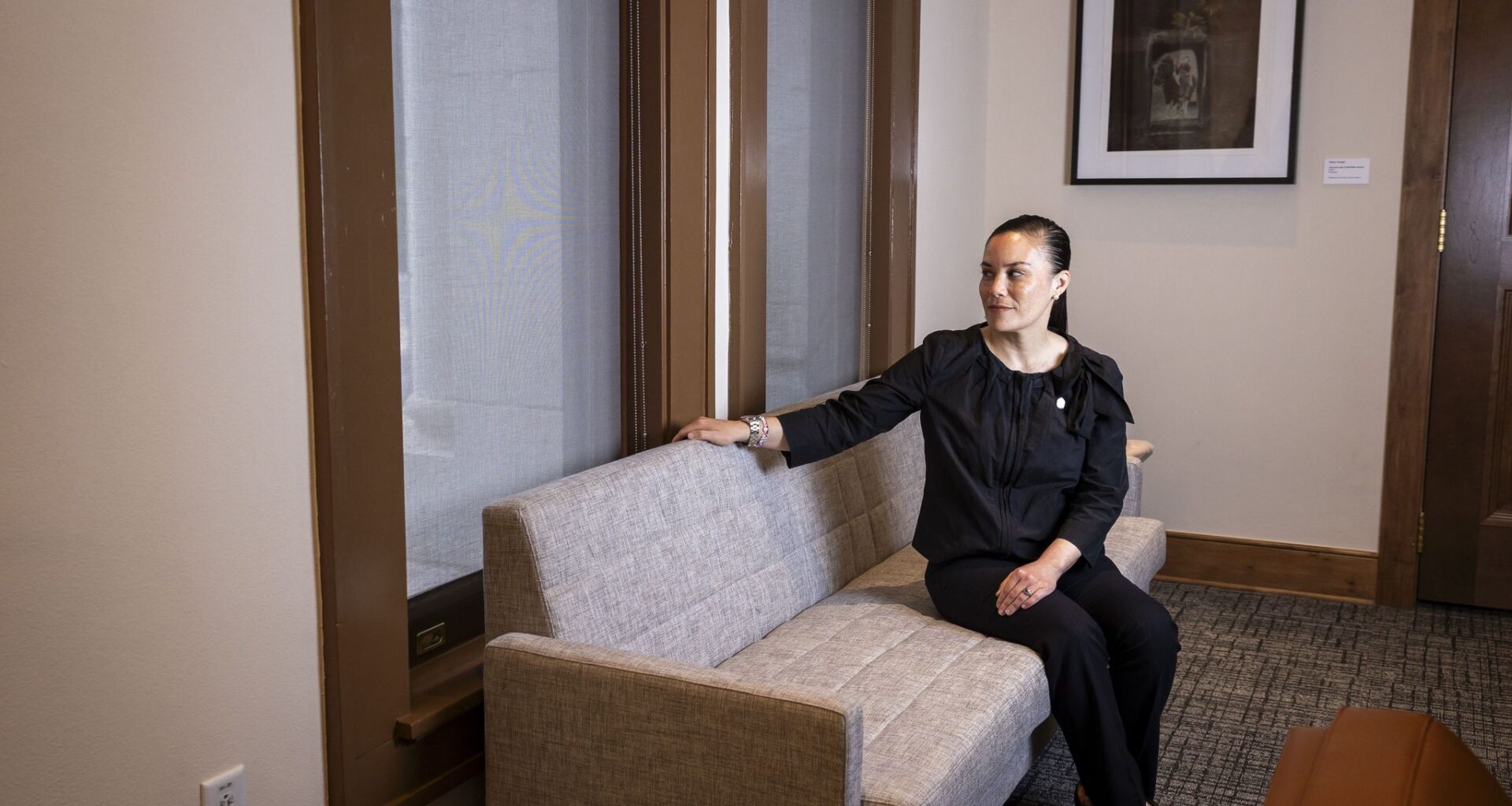
From the outside looking in, Gina Ortiz Jones is a mayor on the move.

She’s in Taiwan, trying to convince company executives to open shop in San Antonio. She’s being interviewed on the nationally distributed radio program 1A about how cities can use artificial intelligence to improve basic services, which she spoke about at a conference in Madrid.
She’s at center stage at events across San Antonio.
Article continues below this ad
Jones is beaming in photos posted on her official social media accounts. She’s shaking hands, fist bumping and hugging everyday San Antonians who are grinning or laughing, matching their mayor’s energy.
It’s a curated and polished look at her administration — which, by most accounts, has struggled since her swearing-in a year ago.
Inside City Hall, Jones has made little effort to build relationships with City Council members, who are key to turning her vision for the city into policy. Indeed, friction between the mayor and the 10-member council came to a head in February, when the council censured Jones for what they described as her “unacceptable” conduct. As part of the censure, the council required Jones to undergo leadership training.
Article continues below this ad
Mayor Gina Ortiz Jones gives a statement before recusing herself from a censure vote on Feb. 27, 2026.
Sam Owens/San Antonio Express-News
District 1 Councilwoman Sukh Kaur, right, speaks to media after the council voted 8-1 on Feb. 27, 2026, to censure Mayor Gina Ortiz Jones for her “unacceptable” conduct toward Kaur.
Sam Owens/San Antonio Express-News
Jones has also struggled to retain staff, many of whom abruptly resigned, leaving key positions unfilled. That’s one reason business and civic leaders continue to privately question whether Jones can effectively lead the city.
Since she took office on June 18, Jones has devoted time and energy to actions that excite her grassroots, Democratic supporters — many of whom have cheered her since she first ran for Congress in 2018 — but that have only remote chances of success.
Article continues below this ad
That includes asking Republican Gov. Greg Abbott to reverse himself and allow the state to join a federal summer lunch program for low-income kids, and writing to the Department of Homeland Security asking it to scrap a planned immigration detention center on the East Side. Neither Abbott nor homeland security leaders were likely to respond positively to the mayor’s publicly released letters.
Jones’ policy agenda includes increasing affordable housing, expanding access to early childhood education, promoting economic development and improving infrastructure, such as flood prevention and mitigation projects.
But when she talks about the progress that she’s made toward enacting that ambitious agenda, the milestones she cites are narrow wins or indirectly related to what she wants to accomplish:
moving city elections from May to November to potentially increase voter participation, and creating a task force to research ways to boost turnout
raising $1.6 million to provide thousands of families with H-E-B gifts card when food assistance paused during the federal government shutdown last fall
calling out the Spurs organization for not paying the city a $5 million penalty because it failed to land a Major League Soccer team for San Antonio
banning some landlords from refusing to rent to veterans who use federal housing vouchers to pay rent
forming an advisory group focused on making the city competitive in artificial intelligence, space manufacturing and other advanced technology industries
Article continues below this ad
“It feels a bit undisciplined,” political consultant Laura Barberena said of Jones’ shifting focus during her first year. “It may be disciplined, but from our perspective, it feels undisciplined because we’re not sure what she’s fighting for, or what her priorities are.”
Mayor Gina Ortiz Jones holds a press conference in front of City Hall on Feb. 27, 2026, to announce an initiative to establish a city voting commission.
Sam Owens/San Antonio Express News file photo
Jones still has plenty of time to leave her mark on San Antonio because her term doesn’t end until November 2029. She’s the first San Antonio mayor to serve a four-year term instead of a two-year one.
But to be effective, she has to remain relevant both inside and outside City Hall — otherwise she’ll lose whatever influence she still has over the initiatives coming out of the City Council.
Article continues below this ad
If Jones isn’t setting council’s priorities, other people will step in to do so, said Steven Pedigo, director of the LBJ Urban Lab at the University of Texas at Austin. That could be ambitious City Council members or the city manager, whose role is to execute the policy the mayor and council set.
“If I was advising her, I would say, ‘After this first year, you’re going to come out in your second year with a real articulation of two or three priorities,’” Pedigo said.
Jones’ agenda
A headline about the Dallas City Council’s unanimous vote to change its municipal election date from May to November caught Jones’ attention. She learned that the Texas Legislature was allowing cities to make such a change without putting the measure to a citywide vote — but there was a limited window of opportunity.
Article continues below this ad
This was in late November 2025. The deadline was Dec. 31, and Jones wanted San Antonio to follow suit and move its elections from May to November of odd-numbered years. She saw it as a way to save money and boost San Antonio’s abysmal voter turnout.
Many City Hall observers expected her election measure to fail. Jones had done little to build consensus among council members, some of whom said the process was too rushed and required more resident input. Jones notified council of her plan on Nov. 25 and scheduled the vote for Dec. 18.
Jones, however, rallied voting rights groups and former San Antonio mayors, including Ron Nirenberg and Julián Castro, to come out in support of the change.
Jones got the five council votes she needed — and, in turn, her first policy win after a long chain of defeats, including her failed attempt in August to pump the brakes on a funding plan for a publicly financed Spurs arena downtown.
Article continues below this ad
District 9 Councilwoman Misty Spears was one of the deciding votes. Spears had been firmly against the move because she preferred changing the municipal election calendar to November of even-years, which coincides with the presidential election. But she sided with Jones after she surveyed her North Side residents and learned they supported the mayor’s proposal.
Jones celebrated her policy win by posting a photo of herself arm-in-arm with labor icon and civil rights activist Dolores Huerta, a stalwart in California Democratic politics. The mayor’s office had invited Huerta to speak to the council to urge them to support the election date switch.
Mayor Gina Ortiz Jones escorts labor leader and civil rights activist Dolores Huerta to a press conference Jones organized outside City Hall on Dec. 18, 2025, to advocate for City Council to move municipal elections from May to November.
Sam Owens/San Antonio Express News file photo
But Jones hasn’t been able to build momentum from that victory.
Article continues below this ad
In April, she tried to push through a proposal to issue a $500 fine against landlords who refuse to rent to veterans who use federal housing vouchers. The Fort Worth City Council did that in 2024.
Jones’ council colleagues instead wanted to go with a plan to get landlords to rent to all housing voucher holders, not just veterans. The San Antonio Board of Realtors was on board with Councilwoman Teri Castillo’s proposal, which would give landlords $500 if they lease to people using vouchers. Council members deemed Jones’ approach too punitive and said it would harm small-time landlords, many of whom aren’t familiar with the voucher process.
Ultimately, Jones and the council struck a compromise after members rejected her plan. They settled on limiting the ban to landlords who own five or more properties, with the city issuing warnings before levying fines.
“It didn’t look exactly like I wanted it to, but I understand my colleagues have different viewpoints on this issue,” Jones said. “I will always err on the side of not discriminating against veterans, and I know we’ll revisit that topic here shortly.”
Article continues below this ad
Spurs arena
At the same May 7 meeting, Jones lost three votes in quick succession, all related to the city’s proposed downtown sports and entertainment district, better known as Project Marvel. The items included contracts for a construction manager and a cost study, as well as a public update on the district.
Jones has been skeptical of the multibillion-dollar project, which was conceived and planned during the final years of Nirenberg’s administration.
She had wanted more analysis of the economic benefits and costs associated with the district before the council was to vote on a non-binding term sheet with Spurs Sports & Entertainment. It committed the city to putting $489 million toward a $1.3 billion arena that will anchor the district. Council approved the term sheet in a 7-4 vote on Aug. 21. Jones was on the losing side.
Article continues below this ad
The way she tried to delay that vote shocked and turned off business leaders and even some on council.
Jones interrupted a news conference to rally support for the agreement in front of City Hall. After awkwardly seizing the microphone, she debated Supers superfan “Spurs Jesus” about whether the team would actually leave the Alamo City if the city didn’t help them build an arena.
She castigated council colleagues for wanting to rush through the deal in a commentary published in the San Antonio Report. She tried to take over a town hall that District 10 Councilman Marc Whyte organized about the city budget to urge attendees to tell their councilman to press pause on arena negotiations. (Whyte voted for the term sheet.) And she publicly grilled Spurs managing partner Peter J. Holt about why he wouldn’t wait for a thorough analysis before asking the city to help fund the arena.
Mayor Gina Ortiz Jones interrupts an Aug. 20, 2025, news conference that business leaders organized to rally support for the city’s Spurs arena deal.
Sam Owens/San Antonio Express News file photo
Tom Zuniga holds up signs denouncing Mayor Gina Ortiz Jones at the Win Together PAC’s election watch party on Nov. 4, 2025. The PAC promoted a measure committing Bexar County tax dollars to a downtown arena, which voters narrowly approved.
Sam Owens/San Antonio Express-News
“I’m proud of the fact that I have, I think, demonstrated my willingness to go to bat for the community when it needs to be done,” Jones said.
Article continues below this ad
Barberena, the political consultant, agrees with the mayor’s self-assessment.
“She’s done a good job to show that she’s willing to stand up to anyone, and I think that’s a leadership trait that people really admire,” Barberena said.
Jones recently wrote to Austin tech billionaire Michael Dell, who owns a 10% stake in the Spurs, to ask him to pay all or part of the city’s $489 million share of the arena financing so that money could go toward other projects.
She continues to push for revenue sharing with the Spurs, which would allow the city to collect some of the money that SS&E will make from ticket sales, concessions or naming rights deals. The franchise has said that proposal is a non-starter.
Article continues below this ad
“When I think about something that we need to do as a community, it’s certainly to ask for what we deserve,” Jones said.
Housing policy
Jones has an opportunity in the near term to shape the city’s approach to housing — if she can get a majority of City Council on her side.
In August, the council will update the city’s 10-year housing strategy, which council adopted in 2021. Then it will decide what affordable housing initiatives to include in the 2027 bond program.
Article continues below this ad
Early in her first year, Jones directed council’s Planning and Community Development Committee to develop recommendations for how to increase housing options for veterans, people with disabilities, seniors and LGBTQ+ youth aged 18 to 24 years old who are homeless. Jones, who is an Air Force veteran and San Antonio’s first openly gay mayor, said these groups have a harder time accessing affordable housing.
Councilman Edward Mungia chairs the PCDC, which convened a task force to research barriers these populations face and the number of “specialized housing” units needed. The group’s report set a target of creating 3,250 units.
Mungia said he doesn’t expect much pushback on the mayor’s objectives.
The debate will come when the council works on the next bond program — which could go before voters as early as next May.
Article continues below this ad
Mayor Gina Ortiz Jones shakes hands with American GI Forum of Bexar County Commander Pete Bernal at an April 23, 2026, press conference she organized to rally support for a veterans housing initiative.
Andrew J. Whitaker/San Antonio Express-News
Manuel De La Rosa and his granddaughter Ezri Pinales play outside the home he repaired with funds from the city’s 2022 affordable housing bond.
Andrew J. Whitaker/San Antonio Express-News
While most council members want part of that bond to pay for affordable housing, they also want it to fund a slew of other projects in their districts. City staff want to dedicate some of the bond funding for the infrastructure needed to support the sports and entertainment district.
Balancing these priorities will be a challenge because the city’s bond capacity has been cut in half by flattening property tax revenue.
Article continues below this ad
“It remains to be seen what funding buckets will be developed out of the housing portion,” Mungia said.
Getting council members to follow her lead has been a challenge for Jones, who prefers rallying the public behind her proposals to try to pressure council members who hold the power to nix or approve them. She is far more comfortable holding tightly controlled news conferences than winning over her council colleagues through one-on-one conversations.
Though that strategy has largely been unsuccessful, Jones continues to gather supporters in front of City Hall as she outlines her positions, her staff snapping photos and shooting video to post on social media.
Unlike big-city mayors who operate in “strong mayor” systems, Jones’ power is limited by San Antonio’s council-city manager form of government.
Article continues below this ad
Here, the mayor doesn’t have the power to unilaterally set policy, control who heads city departments or craft the budget. She’s essentially the eleventh-member of council because her vote carries the same weight as everyone else’s. She is only set apart because she runs council meetings, heads up council’s agenda-setting Governance Committee and sits on the boards of the municipally-owned utilities.
Mayor Gina Ortiz Jones listens to remarks on a city budget proposal from City Manager Erik Walsh on Aug. 14, 2025.
Christopher Lee/San Antonio Express News file photo
“You make these promises out on the campaign trail and then when you get elected, there’s a real wake-up call about what you can actually achieve in your agenda,” said Pedigo of the LBJ Urban Lab. “You’re having to build consensus to say, ‘Here’s our broad agenda. As an elected body, we want to tackle these affordability issues.’”
That requires compromise and being OK with taking incremental steps toward achieving a long-term goal. It means building coalitions with council colleagues and outside organizations and business groups.
Article continues below this ad
That reality can be a hard pill to swallow for mayors operating in council-manager systems.
With three years left in her term, Jones still has time to adjust to this type of governing.
“It takes time to grow into this role,” Pedigo said. “Particularly if you’ve never been on council before, you don’t have these existing relationships, so you’re having to build these relationships and build this trust as you are legislating and as you’re trying to build policy.”
Article continues below this ad
Mayor Gina Ortiz Jones watches a video shown ahead of her speech at The Greater San Antonio Chamber of Commerce’s State of the City event on April 14, 2026.
Katina Zentz/San Antonio Express-News