
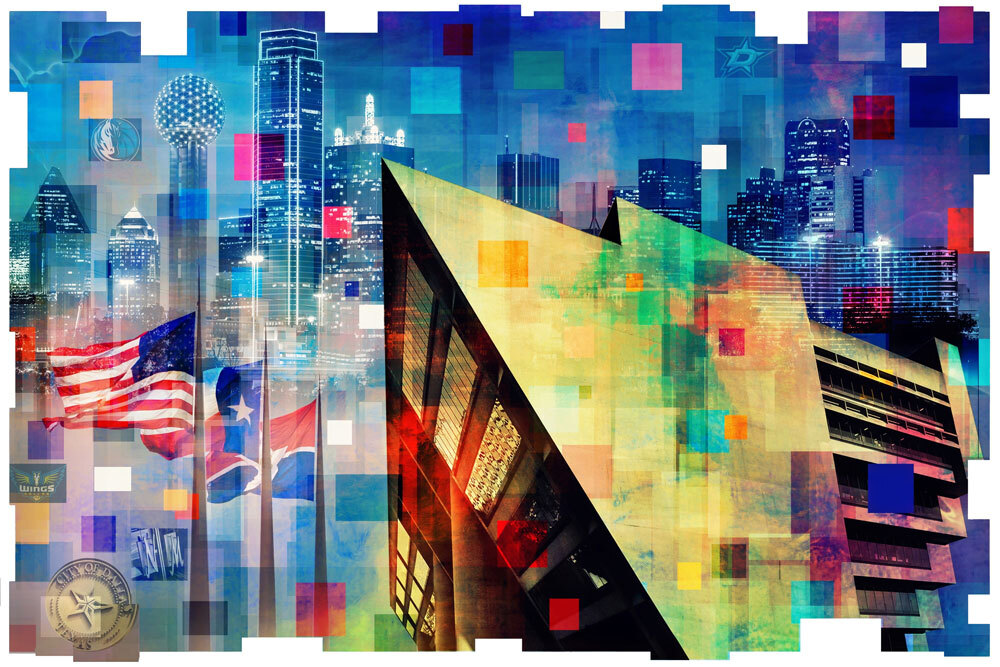
The situation in downtown Dallas is not as dire as some may say.
Photos: DMN Staff; Michael Hogue/Staff Artist
How best to describe the headlong campaign to ram through a decision to abandon Dallas City Hall, and to do so with absolutely no idea of what, if anything, might replace it? Reckless, feckless, foolhardy, self-defeating, divisive and destructive are a few of the more polite words that come to mind.

At the least, the Mavericks’ decision to choose Valley View over a downtown site should have put the brakes on the City Hall discussion. Instead, the push to leave the building has accelerated with such carelessness that it was halted by a judge after two City Council members went to court to stop it.
This is how we make essential decisions about the future of downtown? A rush job, largely conducted behind closed doors, that pits the city against itself? Even after the court’s order, the council voted against a plan to repair the building, and will vote again on June 17 on spending more than $2 million to begin conducting lease negotiations for a new downtown location.
Article continues below this ad
The frantic effort to leave Dallas City Hall is driven by apocalyptic arguments as to the state of the building (it’s a fire hazard loaded with asbestos!) and downtown generally (everyone’s leaving!). “The knives are out for our city,” mayor Eric Johnson, who is leading the demolition campaign, recently told the City Council. “The wolf is at the door.” I’m hardly a Pollyanna, but the reality is that, while both City Hall and the core are challenged, this kind of doomsaying vastly exaggerates the urgency and scale of their problems.
Let’s review the facts.
First off, the Mavs and Stars are leaving Victory Park, where the American Airlines Center is located, and not the downtown core. While it is disappointing that the Stars are moving to Plano, the Mavs — and the revenue they generate — are remaining within city limits. The Mavs’ move will hurt Victory, but have no real impact on the city as a whole (one neighborhood’s loss is another’s gain) or downtown. In fact, the downtown core is gaining a sports team. The ascendant Dallas Wings of the WNBA are scheduled to move into the remade Memorial Auditorium in 2028.
The arena’s redesign is part of the transformation of the Kay Bailey Hutchison Convention Center, a project that is pumping upward of $4 billion into the downtown core, and will produce some 30 acres of developable land next to City Hall — land for which the city has yet to produce a concrete plan. With a glut of vacant office space already, the idea of creating even more by abandoning City Hall makes no sense.
Article continues below this ad
The news that Neiman Marcus will be closing its downtown headquarters is a blow to the civic ego, but the store has been a largely empty vessel for years, remaining open only because the city has subsidized its presence. Downtown will be better off by finding a new life for the building that can generate traffic and energy. Here’s one idea: Turn the building — or parts of it — into an arts, design and fashion incubator with lofts and gallery space. The subsidies paid to Neiman’s can go to artists and other creatives. As demonstrated in the Bishop Arts District, that kind of programming spurs economic development, and would be in the spirit of the building.
Exterior view of the Neiman Marcus flagship store on Main Street in downtown.
Smiley N. Pool/Staff Photographer
The departure of AT&T and the broader commercial vacancy rate are significant problems. But cities everywhere are grappling with empty office towers, and Dallas is well positioned to combat this issue — if it can benefit from thoughtful leadership. The core has a growing population, a history of successful office-to-residential conversions and a handful of exceptional new parks headlined by Klyde Warren.
The city can best take advantage of those assets by improving the downtown environment for the people who live and work there. That means, for starters, repairing and expanding sidewalks, increasing tree cover, creating tax incentives to encourage building on vacant lots and calming traffic on high-speed corridors like Griffin, Lamar, Olive and Pearl streets. Until Dallas builds for people, and not for cars, downtown will forever be troubled. Make downtown an appealing environment, and people — and business — will follow.
What will assuredly not fix downtown is an up-from-scratch district, one that will cannibalize vitality from what is already built elsewhere in the core. Dallas has a poor track record with this kind of development. Victory Park, which is about to lose its principal attractions, required massive public subsidy and remains, after decades, a rather soulless place. Equally problematic is the Harwood District, a collection of towers largely constructed between high-traffic arteries with little connective tissue. It has been subject to several recent foreclosures.
Article continues below this ad
Finally there is the case of City Hall. The mayor and other advocates of abandonment have disingenuously presented those who wish to save the building as naive preservationists solely concerned with aesthetics. While the architectural qualities of the building are undeniably a part of the argument to save it, they represent just one aspect of that argument.
There is, above all, a strong sense that the city has not been straight with its residents. Repair estimates from the city have fluctuated wildly, from less than $100 million to nearly $1 billion to, most recently, $532 million to $611 million. The shifting numbers and well-documented history of back-room dealing leave the city’s taxpayers justified to question the motives and facts offered by proponents of abandonment. With the Mavs and their tight schedule for relocation off the table, the city does not need to rush a decision that will only exacerbate civic polarization.
Instead, the city needs to be clear about what is at stake, both financially and culturally. City Hall is an iconic building owned by the people of Dallas, a symbol of civic boldness created to chart a new optimistic direction and to both literally and figuratively bring people together. When it opened, in 1978, J. Erik Jonsson, the mayor who willed it into being, was hailed for his bold vision, and its architect, I.M. Pei, celebrated for his magnificent design. Despite a long history of negligent care, it has lived up to its promise, operating safely and effectively for nearly half a century.
The current mayor would throw away this legacy with no plan for what would replace City Hall and without any clear idea of what moving out of it would cost. Abandonment would almost certainly create a dead zone that will leave the Cedars and South Dallas even more distant from downtown’s power center.
Article continues below this ad
The world is watching what happens. The demolition of City Hall would be the most significant destruction of an American public building since New York’s Pennsylvania Station was torn down in the 1960s. It would be an act of philistinism with dire financial, environmental and historic consequences.