
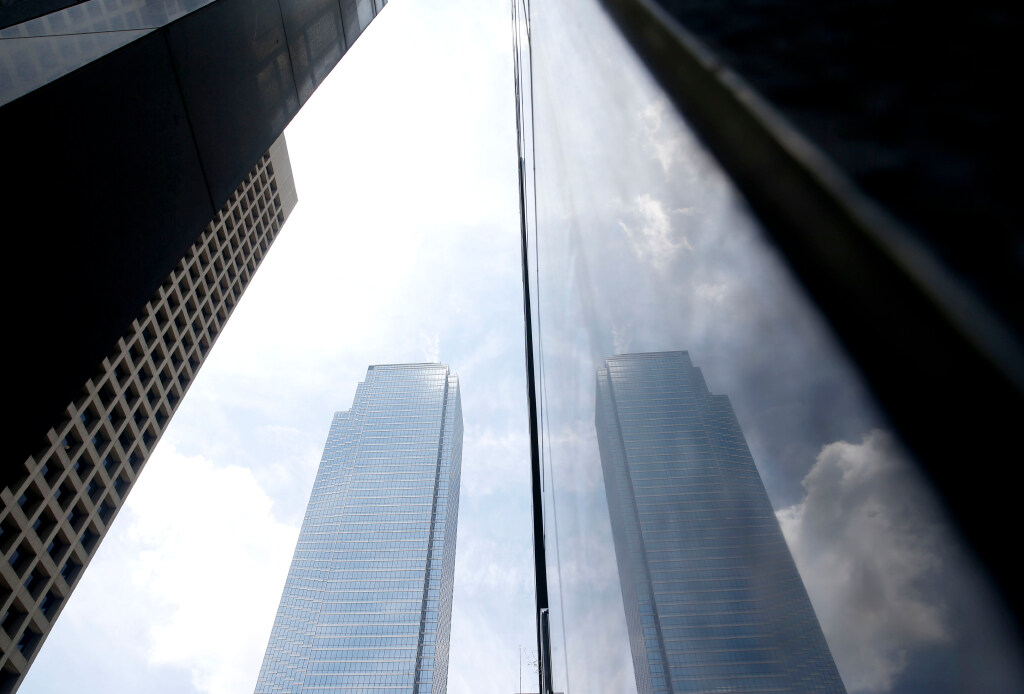
The Bank of America Plaza (left) is seen reflected in the facade of a nearby building in downtown Dallas.
2019 File Photo/Staff
Things are about to get hectic for Bank of America, the official bank of FIFA World Cup 2026, but not as hectic as Dallas has already been.

With more 14,000 employees in North Texas broadly and about 1,000 at its current downtown tower, Bank of America finds itself at the center of both the rapid influx of financial services into Dallas-Fort Worth and — as it plots a move to Uptown — the debate over the future of Dallas’ urban core.
Wendy Stewart, the bank’s Atlanta-based president of global commercial banking, and Jennifer Chandler, Bank of America’s Dallas president and the incoming chair of the Dallas Regional Chamber, spoke with The Dallas Morning News on Wednesday morning on the pressing topics facing the bank and North Texas. Here’s what they said, edited for length and clarity:
Article continues below this ad
Why does a physical presence in a region still matter when much of banking happens through the cloud?
Stewart: “What we find is that it doesn’t matter if you are an individual through the companies that we cover in global commercial banking, and even into the large Fortune 50 companies that are here, at the end of the day, people want to do business with people that they know. Banking is a business that is built on trust, and without a relationship, you can’t have trust. They want to have a local banker, because they have been in these communities for decades, in some cases over 100 years, and they want to have a banker that’s based here, somebody that knows the community, somebody that their kids go to school with, they may worship together, they play sports together, they live life together, and that is crucial.
“So if we don’t have people that are in this community, we’re not going to be set up for success to deliver for clients and what they need. If everybody’s up in the Northeast and has to fly back and forth, that model does not work for us. We’ve been investing heavily into every market, and we find this is the same, whether you’re in Dallas, you’re in Boise, you’re in Atlanta. … We’re in 97 markets around the United States, and that sentiment from clients, where ‘I want somebody on the ground and local,’ is really strong, and that’s why we’ve been investing heavily in all of these markets, not just Dallas, but around the U.S.”
Jennifer Chandler, Bank of America’s Dallas president, speaks during the Dallas Regional Chamber’s 2026 annual meeting at Music Hall at Fair Park in February.
Chitose Suzuki/Staff Photographer
You’ll be moving out of Bank of America Plaza for Bank of America Tower at Parkside next year. What will the new location bring to the table?
Article continues below this ad
Chandler: “We’ve got a beautiful building, One Bryant Park in New York, and when you’re there, you see the vibrancy, the interaction across our colleagues, bringing us together. So it was time. It was important to stay in the city of Dallas, that was very key to the decision, and we have a lot of expertise on our real estate team that went through the process, and that location is going to be great for our clients. We’re incredibly excited to be co-located with the Texas Stock Exchange, and all that’s going on there, and it’ll have all the amenities we need. It’s really important we do an incredible job retaining our employees. This is a great place to work. I mentioned I’ve been here 25 years, that’s very common. But knowing their needs, so amenities like having Klyde Warren Park right across the street, how exciting is that? … But it was a thoughtful process. Most importantly, is it great for our clients? Yes. Was it great for our employees? And then, could we stay in the city of Dallas?
“The other challenges you see in downtown Dallas, we’re going to keep supporting. We’ve personally donated several million to help with Dallas Housing Forward to look at what we’re doing to compassionately help the homeless. Safe In The City, Bank of America was supportive of that. So we’ll continue to support downtown. We want it to be vibrant as well, and we played a key role in that and continue to.”
Related story: Dallas wants to put ‘Y’all Street’ on the map, marking the city’s growing financial corridor
Talk about y’all’s relationship with the Texas Stock Exchange and sharing a building in the future.
Chandler: “With the Texas Stock Exchange, you can imagine the corporate clients that Wendy’s team covers and our investment banking team covers, those are our clients. You’ll be able to walk through the door, have the experience, and so that just put a ribbon around [the new building].
Article continues below this ad
“We obviously have a significant market share banking corporate clients, and the way we do that’s incredibly important. It’s a seamless experience from the individuals that walk through our financial centers, the CEOs that work with those companies, and bridging the conversation to the investment banks. So when you think about IPOs, all that’s going to occur in that building.
“Taking a broader step back, and what it means for the bank, the attraction of companies incorporating in Texas. People think of the stock exchange like, go ring the bell, and that’s a fun, great thing. But the more exciting story is the work we’re doing in Austin, and what we did ahead of the Texas Stock Exchange. It’s here for a reason. We made the regulatory environment easier for people to list. We made it less expensive, and then the continued work is also to incentivize the company to incorporate in Texas versus places like Delaware. So that’s the bigger part of the story. The physical location is incredible, but it’s all that legislative work behind it that’s going to mean that story continues to happen.”
Was Bank of America part of the conversation in getting the Texas Stock Exchange to eventually sign a lease at the new tower?
Chandler: “We left that to all the appropriate real estate people. I think everybody involved could probably see the natural synergy, but I wouldn’t say we inserted ourselves in that process, nor even with the location. There’s great buildings all over the Metroplex. We have relationships with every exchange. So I would just say we all, I think, saw the synergy and how incredible it would be, but we didn’t drive the conversation.”
At first ‘Y’all Street’ was this nebulous concept of finance in North Texas. Now, there’s a defined financial district emerging around Klyde Warren Park, near your new office. What’s y’all’s take on that?
Article continues below this ad
Chandler: “I always say, all the tides rise together. There’s plenty of opportunity for all of us, so it’s exciting. It’s not the old days, like when you literally had to walk the certificate down. So some of it is more symbolic, but the real synergy is important. One, we’re going to be able to help make Dallas more vibrant across the board. All of the jobs, people are coming here, they’re adding to the economic vitality and growth of North Texas. So that’s huge. It’s a win for the city of Dallas, because if you think of all the ancillary partners, the jobs, it’s not just the exchanges and the financial institutions. There’s regulatory, there’s compliance, there’s data, there’s processing. So it means a win for this entire hub, and I already said it, but I’ll say it again. It does also mean a win for downtown, which is so important to all of us. It will mean growth here. It’s a great place for young talent. Dallas is a young city. They love to be able to work right here and hop over to the Katy Trail. It means we’ll keep the financial services talent.
A rendering shows the Bank of America Tower at Parkside.
Courtesy of TXSE
Stewart: “It also really helps to diversify the economy. Over the last 20 years, when you think about the U.S. economy and the cities or the geographies that have fared better than others, the more diversified the economies, those are the cities that are growing and thriving. And conversely, you can look at certain cities around the U.S. where that hasn’t been the case. So I think to be able to diversify the economy for Dallas is huge. I totally agree with you on the talent, and what we typically see when we look at migration trends is, if someone moves into a community post-grad, the likelihood that they stay is going to be better. So that’s just going to keep growing the economy over the long term.”
How is Bank of America implementing AI, and how do you see AI changing banking?
Stewart: “When we think about [the generative and agentic AI] ecosystem, for us there are really four things that we want to deliver. The first is continue to deliver an even better client experience, so everything we’re doing for using AI needs to deliver that better client experience. The second: We have to continue to enable our frontline team, so that they’ve got the best insights, they can be as effective as possible with these conversations that they’re having to help a client with their financial needs. The third is just continue to improve processes. We are a very process-heavy organization. We have over 3,700 processes to run the bank, and they need to be as efficient as possible. Using AI to do that is going to continue to be a game-changer. And then the final thing is driving more efficiency. We want to be as efficient as possible. Our team wants to be efficient, our clients want us to be efficient, and that’s how we think about using AI to accomplish all of that. And certain use cases may hit one or two of those things, other use cases hit all of them. It just depends on what the use case is, but we have hundreds of use cases right now that we’re working through to hit on one or more of those four things.
Article continues below this ad
“The other thing I would say is, I think that there are a lot of companies that are sort of using AI on a very experimental basis, and I think that’s a fine place to start, but I think if you want to use AI where you’re actually executing in a very holistic manner, there are a couple foundational things you’ve got to have in place first. The first is you have to understand your processes, and then the second thing is you’ve got to have clean data, because if you don’t have both, all the AI in the world is not going to solve for bad process or data that you can’t actually get to in an organized way. We’ve spent a lot of time doing all that foundational work years before this came on the scene, and I think that’s what has enabled us to move quickly, and really move from that experimentation to execution.”
Related story: How Westlake-based Charles Schwab is leaning into AI efficiency without sacrificing workers
Chandler: “We’re also continuing to bring in talent, so we just brought in 4,000 interns and analysts, who will start over the summer, and we’re excited about what they bring to the table for this conversation. They’re curious, they’re innovative. The other thing I would add is a lot of that work and the enhancements in technology are happening right out of Plano, Texas. I used to say we have more patents than NASA, you can confirm that. But a lot of the patents and technology literally are coming out of Plano, Texas, and a lot of our 14,000 employees are technology employees.
“We also have something we call The Academy, so we can easily and effectively reskill people. Whether it’s times when, let’s say, mortgage rates go up, so we need less mortgage officers, we shift them to [home equity line of credit]. So the beauty of this firm, and as many people as we have, if we see trends, let’s say we create an efficiency, that just means we can redeploy that talent to go do something more effective and exciting, where maybe it’s more time with the clients. So we use that Academy to bring our folks and get them prepared for the next thing, and I think that that’s going to be exciting and even more leveraged in the future with all this going on.”