
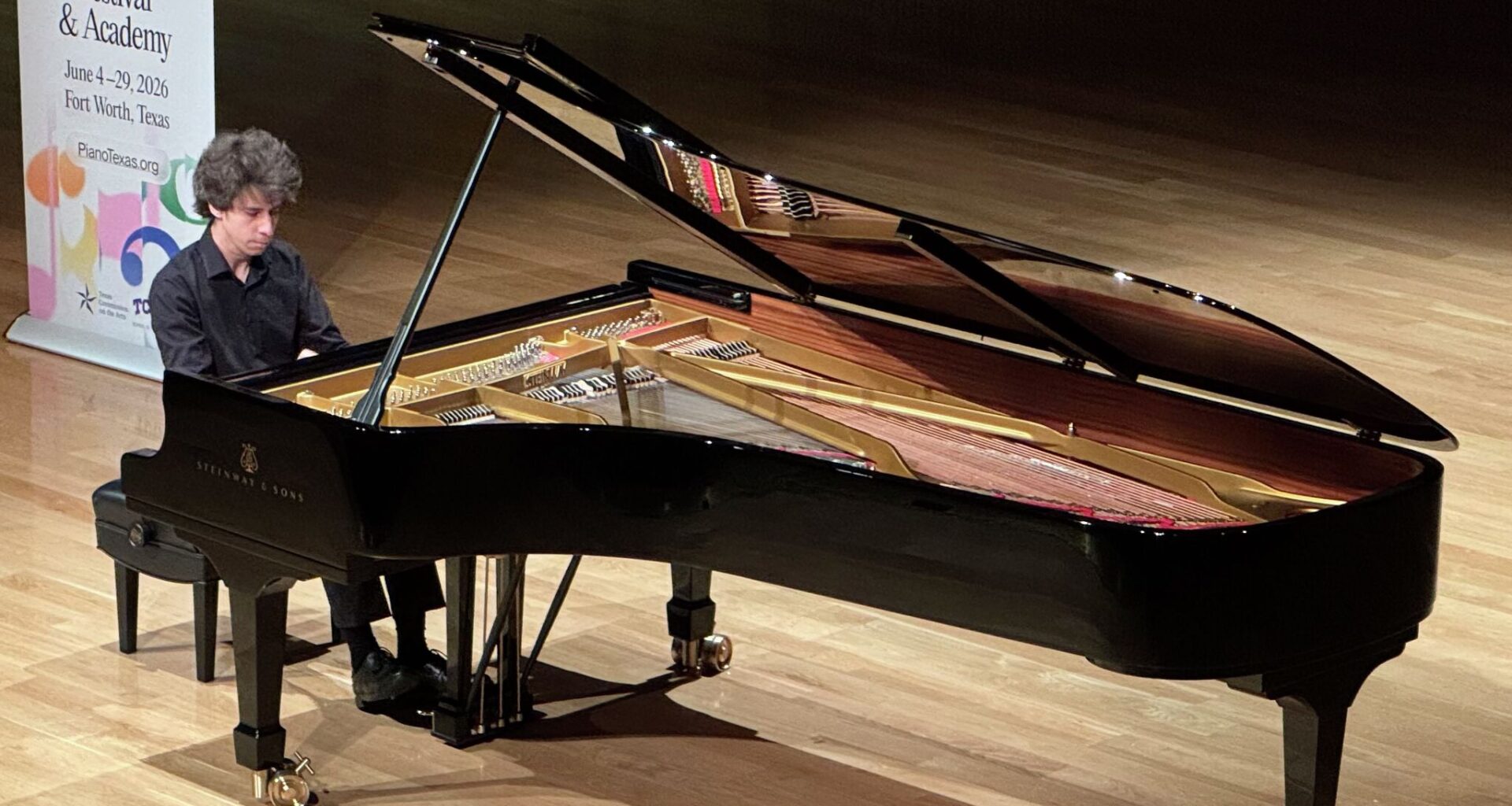
Vitaly Starikov performs a recital at Texas Christian University’s Van Cliburn Concert Hall during the PianoTexas International Festival & Academy on June 13, 2026.
Scott Cantrell
FORT WORTH — At the 2025 Van Cliburn International Piano Competition it was clear that Vitaly Starikov was in the running for one of the top prizes. Sure enough, playing of authority and nuance netted the Russian-Israeli pianist the silver medal.

On Saturday night, he returned to Fort Worth for an imaginative, even provocative, program, and, with one reservation, played it to the hilt. Presented at Texas Christian University’s Van Cliburn Concert Hall, it was the first of three Distinguished Artists recitals this month in TCU’s PianoTexas International Festival & Academy.
The two largest works on the program were both composed in wartime: Debussy’s 12 Etudes (1915) and Shostakovich’s Sonata No. 2 in B minor (1943). And each represents a side of its composer different from the most familiar works.
Article continues below this ad
If you think of Debussy as decoratively watery, vaporous and pastel, the Etudes can come as a shock. Etudes can be pieces for working out technical problems, but also showpieces of technical brilliance. Each of Debussy’s starts with a basic idea, identified by a grouping of notes, exploring possibilities and introducing contrasting effects.
The interval of a third is dispensed in rustlings and cascades. Fourths produce bell-like effects; sixths shimmer and chatter. “Pour les agréments” demonstrates not baroque ornaments but decorations more generally. An etude in chords supplies a rousing finale, with an introspective central section for contrast.
To someone expecting the Shostakovich of symphonies alternating between militant assault and crippling depression, the Second Sonata will be a surprise. Its sometimes spare intimacy is closer in spirit to the composer’s string quartets.
From a spidery accompaniment emerges a jolly, almost folkish tune, which develops into pretty rumbustious music. In the central Largo a meandering melody is accompanied by chords that don’t always sound as if they belong, the movement continuing with spooky, disembodied ruminations.
Article continues below this ad
A long minor-mode tune becomes the subject of the finale’s set of variations, which cycle through contrasting sonorities, textures and emotions. Although the sonata was composed during the brutal German siege of Leningrad, from which Shostakovich had been whisked away to safety, only one of the variations suggests an approaching enemy. A quiet close recalls the sonata’s opening.
Neither an obvious audience pleaser, both the Shostakovich and Debussy are real challenges to bring off. But Starikov captured shifting tones, textures and moods with uncanny precision and evocative effect. The legendary technical difficulties of the Debussy seemed to hold no terrors for him. This was a brilliant, thoughtful artist at work.
Opening the program, the Bach Italian Concerto had an aptly spirited first movement, and imagining the central Andante as an almost operatic aria rang true. But the finale was too fast to dance as it should have.
The encores were an electrifying Precipitato from Prokofiev’s Seventh Sonata and, nicely soft-edged, the first of Chopin’s Op. 25 Etudes.
Article continues below this ad
The PianoTexas series will continue with Cliburn medalists Olga Kern (June 20) and Antonio Pompa-Baldi (June 27), both at 7:30 p.m. in Van Cliburn Concert Hall at TCU, 2900 W. Lowden St., Fort Worth. $40; discounts for students. There are also lots of public performances by the festival’s students, amateurs and teachers, including concertos with the Fort Worth Symphony Orchestra. 817-257-7232, pianotexas.tcu.edu.