
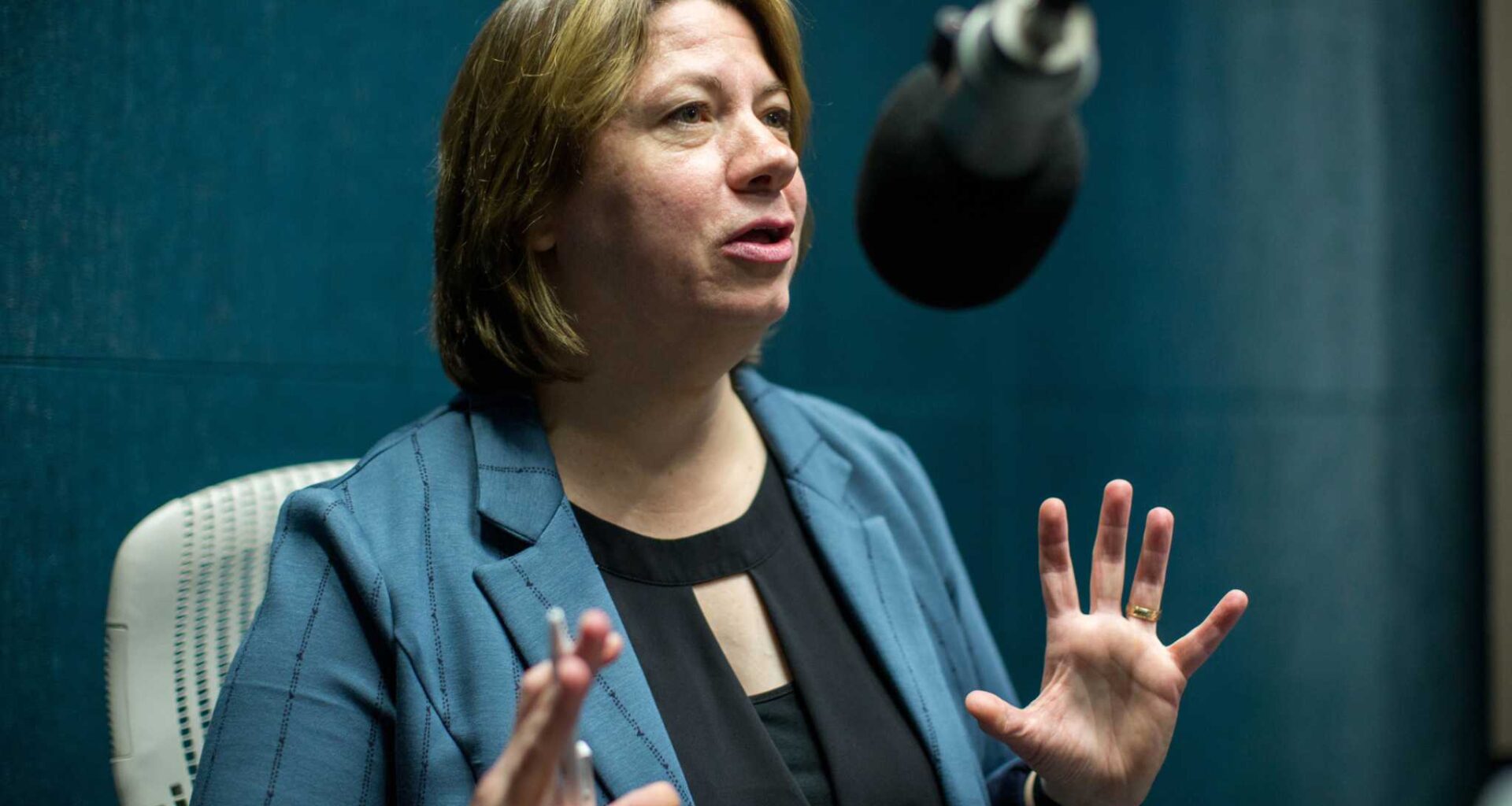
UT has fired KUT General Manager Debbie Hiott, who has led the station since 2019.
Courtesy of KUT/ Gabriel C. Pérez
The University of Texas fired KUT General Manager Debbie Hiott on Monday, weeks after a public firestorm over the radio station’s planning of its inaugural community festival.

University officials claimed the festival had issues related to security, forcing the station to move some events at the last minute. Some worried whether UT’s intervention in the event was an attempt to stifle political speech.
Article continues below this ad
Hiott told the American-Statesman that she was called into a 3 p.m. meeting with Anita Vangelisti, the UT interim dean of the Moody College of Communication, and university representatives from human resources and legal departments. They presented her with the option of resigning or facing immediate termination.
“I said I guess you are going to have to fire me,” Hiott said.
She said she was given the reasons of “insufficient planning” for the festival, safety concerns and her own public comments about the festival dispute in which she challenged statements by UT officials about security matters.
UT raised concerns about security in the days leading up to the festival, prompting KUT to move some of the event to a private facility in East Austin.
Article continues below this ad
Although no firm evidence exists, festival patrons and others have suggested that UT may have had other motives in trying to boot the event from campus. The festival featured multiple politicians, including Democratic U.S. Sen. Cory Booker as a keynote speaker.
Like many other public radio stations across the country, KUT operates inside the university, but with a structure meant to separate university ownership from newsroom decision-making. The stations are licensed through UT and housed in Moody College, and their employees are university employees. Hiott reported to the Moody dean.
But KUT has said university officials outside the newsroom do not direct its news coverage, and the stations are funded by community and business support.
Hiott’s background in journalism
Hiott had led KUT Public Media since 2019, overseeing KUT 90.5 and KUTX 98.9 from within UT’s Moody College of Communication. UT hired her as general manager of the two stations and executive director of media operations after a long career in Austin journalism.
Article continues below this ad
Before joining UT, Hiott spent more than two decades at the Austin American-Statesman.
Her role at KUT placed her at the head of one of Austin’s most prominent public media operations. KUT is Austin’s NPR station, while KUTX focuses on music and Austin’s local music scene. In 2024, Hiott was also elected by NPR member stations to serve on NPR’s board of directors, with a term running through 2027.
Hiott’s firing came after a dispute between KUT leadership and UT officials over the station’s inaugural KUT Festival, which UT ordered the radio station to scale back and move events off campus days before it began. UT officials cited safety and planning concerns and later accused KUT of making false statements. Hiott disputed that account, saying the station had followed university police guidance and was not given a meaningful chance to address the concerns.
Article continues below this ad
The firing comes as both NPR and UT Austin have been caught in broader conservative political fights. Nationally, NPR and other public media outlets have long been targets of conservative criticism. President Donald Trump and congressional Republicans have pushed to cut federal support for NPR, PBS and the Corporation for Public Broadcasting over claims of political bias.
At the same time, UT has undergone its own rightward pressure from state leaders. The university gutted DEI programs, launched a $100 million civics school backed by right-leaning donors, consolidated ethnic and gender studies departments, dropped transgender health services and installed new leadership with ties to GOP-backed institutions. Officials described the changes as compliant with state laws and centered on mission-driven restructuring; critics call it a coordinated conservative shift at the state’s flagship university.