
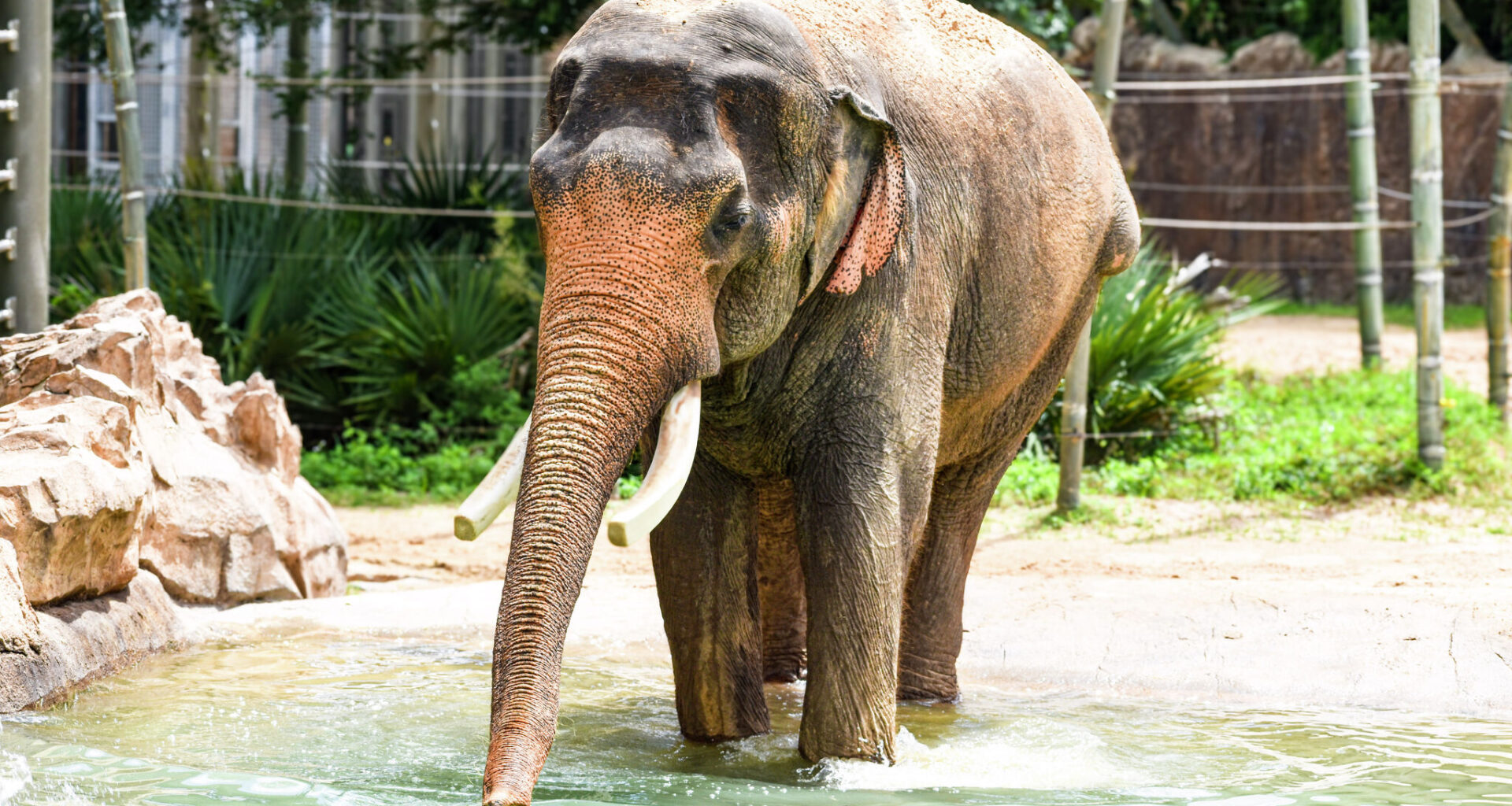
Thailand is getting a birthday cake on Tuesday, but not the kind most 61-year-olds would recognize. The Houston Zoo’s oldest elephant will celebrate with a special grain-based treat and the daily health routine that has helped him become one of the oldest Asian elephants in North America.

Thailand’s milestone birthday also offers a glimpse into the specialized care that helps aging elephants thrive. His hay is chopped into smaller pieces because of worn teeth. Veterinarians closely monitor his kidneys. Across the habitat, 57-year-old Methai receives shockwave therapy for arthritis and daily stretching exercises to help keep her moving comfortably.
Together, Thailand and Methai are the oldest members of the Houston Zoo’s Asian elephant herd.
Article continues below this ad
“When you think about elderly elephant care, there’s a couple of things that really come top of mind,” said Dr. Christine Molter, the zoo’s animal health director. “Making sure that we have collaborative, creative, customized and compassionate care for them.”
Like aging humans, older elephants often develop arthritis, dental issues and other age-related conditions. At the Houston Zoo, that means routine bloodwork, organ monitoring, annual eye exams and close observation from keepers who know the animals well enough to spot even subtle changes.
Thailand’s care starts with his teeth
Thailand arrived at the Houston Zoo in 1980 and is one of its longest-tenured residents. He is also one of the most prolific breeding male Asian elephants in North America, having sired more than 15 calves.
Article continues below this ad
Despite his age, Thailand remains active. He still participates in twice-daily exercise sessions, sleeps lying down at night and enjoys swimming in the habitat’s pool.
Thailand, the Houston Zoo’s oldest elephant, enjoys a swim in his habitat’s pool ahead of his 61st birthday.
Ariana Garcia
His biggest age-related challenge is his teeth.
Article continues below this ad
Elephants go through six sets of molars during their lifetime. Thailand is now on his last set.
“An extra decade of chewing can make those molars smoother,” said elephant supervisor Kristin Windle. “We noticed that he was not able to digest his hay as well as he used to.”
To compensate, the zoo’s nutrition team chops about 90 percent of his hay into smaller pieces. Thailand eats roughly 200 pounds of hay a day.
Thailand’s hay is chopped into smaller pieces to help him chew and digest more easily.
Ariana Garcia
Veterinarians are also keeping a close eye on his kidneys after detecting early signs of chronic kidney disease.
Article continues below this ad
“It’s fortunately been very, very slow for him,” Molter said. “It’s likely something that he’s going to live with for the rest of his life.”
On hot days, staff encourages hydration with shade, pools, hose water and moisture-rich treats such as watermelon, one of Thailand’s favorites.
The zoo has also shortened his tusks to reduce strain on his joints.
“His front legs are going to bear about 60 percent of his body weight,” Molter said. “If we can decrease that a little bit, it’s just better for his joints and his muscles.”
Article continues below this ad
The herd’s patriarch
Thailand’s importance extends beyond his genetics.
While male elephants often spend time apart from family groups, Thailand can spend time with calves, other bulls, and other females. He also serves as a mentor to younger males in the herd.
“He can go with the babies,” Windle said. “He meets babies when they’re just a couple of weeks old and does really great with them.”
Article continues below this ad
Thailand, the oldest elephant at the Houston Zoo, turned 61 on Tuesday.
Ariana Garcia
He still enjoys enrichment activities and learning new behaviors. According to Windle, one of the best signs an elephant is feeling good is a willingness to participate.
“If he wants to participate and interact with us, it’s really a sign of their overall well-being,” she said.
Keeping Methai moving
Methai arrived at the Houston Zoo in 1981 and today serves as the herd’s matriarch.
Article continues below this ad
“She is the boss of everyone, and that includes us,” Windle said. “And she’s allowed to be.”
Her care focuses largely on managing arthritis and maintaining mobility.
Methai participates in twice-daily stretching exercises that keepers jokingly call “elephant yoga.” Staff tracks her movement and range of motion over time, looking for changes that could indicate discomfort.
Methai participates in daily stretching exercises to help maintain her mobility as she ages.
Ariana Garcia
“If you watch her move, she can’t lift her feet as high as she once could 30 years ago,” Windle said. “Her arthritis has caused her not to be able to use her ankle joints as smoothly.”
Article continues below this ad
Several months ago, the zoo added shockwave therapy to her treatment plan.
The therapy uses acoustic waves to stimulate healing in sore joints and muscles and has become another tool for helping Methai stay comfortable.
“It’s really great for animals like Methai,” Molter said. “Mobility is really important to maintain their comfort and their independence.”
Methai receives shockwave therapy as part of her arthritis treatment plan at the Houston Zoo.
Ariana Garcia
Since starting the treatments, keepers have seen noticeable improvement. “We have seen her kind of go back to what we would consider her normal,” Windle said.
Article continues below this ad
Like Thailand, Methai voluntarily participates in blood draws, exams and treatments rather than being sedated.
The matriarch
Methai has had five calves, but her biggest contribution today may be helping raise the next generation.
She serves as the herd’s matriarch, guiding younger elephants and often responding first when a calf becomes distressed.
Article continues below this ad
“We have a multi-generational herd, so we see a true matriarch,” Windle said. “She’s always the first there.”
Though she is not related to most of the younger elephants in Houston’s herd, they regularly seek her out for comfort and guidance.
Methai has also played a critical role in one of the zoo’s biggest elephant success stories.
Houston Zoo elephant supervisor Kristin Windle shows a tattoo of Methai, the herd’s 57-year-old matriarch.
Ariana Garcia
In 2019, a young elephant named Joy became critically ill with elephant endotheliotropic herpesvirus, or EEHV, a disease that is often fatal in young elephants. Methai was the zoo’s only suitable blood donor at the time.
Article continues below this ad
Over the course of a week, she donated 17 units of blood and plasma.
“She honestly saved her life,” Windle said.
“You see an elephant get to that point, it’s their point of no return,” Molter said. “The fact that the team was able to bring her back through all of their expertise and training was nothing short of a miracle.”
Article continues below this ad
Helping elephants reach their late 50s and 60s takes an enormous team effort, Windle said, from keepers and veterinarians to nutritionists, overnight staff and volunteers.
“It takes all of these teams,” Windle said. “It takes the collaborative efforts of every team in the zoo.”