
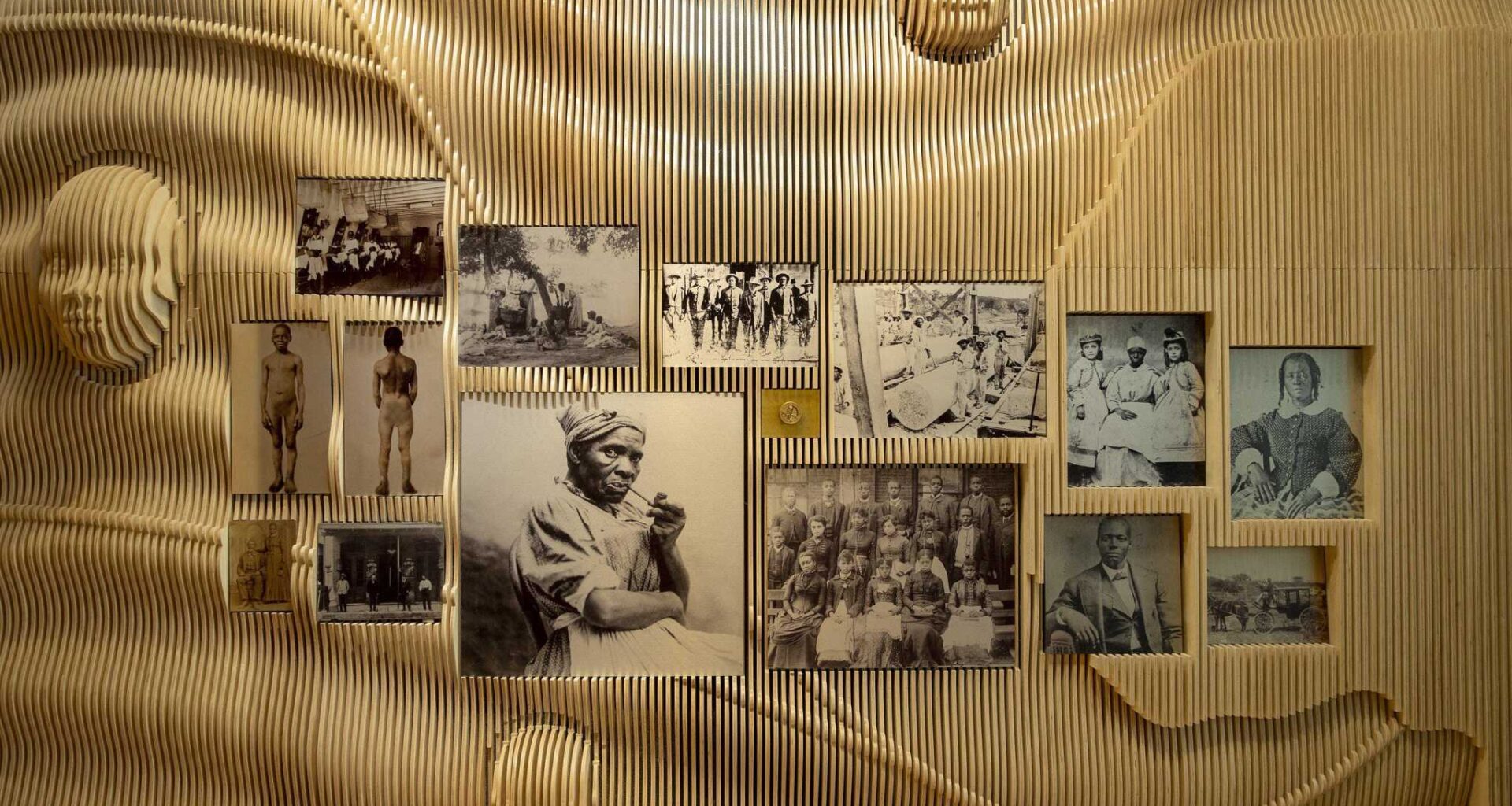
“The African American Presence in Nineteenth Century Texas” exhibit is on display at the George Washington Carver Museum.
JAY JANNER/AMERICAN-STATESMAN
As Austin prepares to celebrate Juneteenth Friday, the George Washington Carver Museum, Cultural and Genealogy Center invites visitors to consider both the weight of history and the meaning of freedom still unfolding today.

Two exhibitions separated by only a few steps span generations. One traces the history of slavery, freedom and Black life in Texas following emancipation. The other reflects on legacies left behind. Both offer a meditation on Juneteenth as a living, breathing tradition.
Article continues below this ad
Tracing Black life in 19th century Texas
“The African-American Presence in 19th Century Texas” is split into five different sections: the African Impulse in African American Culture, Slavery in Texas, African Americans in Texas Politics, Freedmen’s Communities of Texas and Juneteenth.
Ana Gutierrez / Austin American-Statesman
At one end of the museum, “The African-American Presence in 19th Century Texas” confronts visitors with artifacts of enslavement and survival. Shackles sit behind glass. A receipt documents the sale of a 17-year-old enslaved person. Nearby hangs an 1858 portrait of a nude Black boy, reportedly commissioned by his white owner to record his physical condition before a slave auction.
Article continues below this ad
The exhibition traces the history of slavery in Texas and the long road to emancipation. Visitors learn how many Black Texans remained enslaved for two years after the Emancipation Proclamation was signed on January 1, 1863. News of their liberation reached them when Union troops arrived in Galveston on June 19, 1865.
The gallery also tells the story of what came after.
Head of the Clarksville Community Development Corporation, Felecia Miller, explains people pictured in photographs on the walls of the Haskell House in Clarksville, Jan. 31, 2026. The house is the oldest documented residence in the historic district and one of the only remaining original structures from the area, one of Austin’s original Black neighborhoods.
Sara Diggins/Austin American-Statesman
In Austin, newly freed Black Texans established communities such as Clarksville, founded by Charles Clark, who changed his name from Charles Griffin after emancipation. Through photographs, documents and personal histories, the exhibition explores the freedoms that followed: the ability to worship, own land, choose one’s name and participate in government.
Article continues below this ad
It remembers the first Black elected officials who represented their communities during Reconstruction, facing hostility and racism while serving in predominantly white political institutions.
The artifacts illustrate a history that is closer than it may seem. The exhibition honors those who imagined a future they might never live to see.
A contemporary reflection on Juneteenth
Hakeem Adewumi’s solo exhibition “Seeing Further” is on display at the Carver Museum through Oct. 10, 2026.
Ana Gutierrez / Austin American-Statesman
Just steps away, artist Hakeem Adewumi’s solo exhibition, “Seeing Further,” explores many of the same themes through a contemporary lens. The exhibition is on display through Oct. 10.
Article continues below this ad
Through photography and found objects salvaged from his Texas homestead, Adewumi examines Black lineage, memory and liberation.
In “Insurrection Resurrection, and the Salvaged Land,” farming tools, family photographs and household objects occupy a darkened gallery space, transforming everyday artifacts into markers of survival and inheritance.
In a neighboring room, text spread across red walls describes Juneteenth as “a lived story of adaptation” and a tradition that “rejects decorum and invites us to live with indescribable vividness.”
Curatorial advisor Rachel E. Winston writes that Juneteenth is a “Black Southern tradition informed by Texas mythology, African spirituality, and a worldview that becomes supernatural.”
Article continues below this ad
Jonathan “Chaka” Mahone of Riders Against the Storm is featured in a video presentation at the Carver Museum.
RICARDO B. BRAZZIELL/AMERICAN-STATESMAN FILE
For Jonathan “Chaka” Mahone, freedom remains an ongoing process rather than a finished achievement.
“There are still forces that we encounter on an everyday basis that keep us in a certain reality,” he said in the museum’s video presentation. “Freedom is actually a mind state.”
Freedom as a living practice
The Austin E.M.M.A. (Educate, Motivate, Minorities & Achieve) Lady Royals Dance Team performs during a Juneteenth parade.
Terry Hagerty/Special to American-Statesman
At the other end of the Carver Museum, another expression of freedom awaits.
Article continues below this ad
The sounds of children singing, dancing and playing drift through the museum halls. History gives way to the present tense. The stories preserved in photographs, documents and artifacts meet the lives still being lived beyond the gallery walls.
Morris Walker walks Rosewood Avenue carrying a pan-African flag during the Central Texas Juneteenth Park Festival at Rosewood Neighborhood Park on Thursday, June 19, 2025 in Austin.
Aaron E. Martinez / American Statesman
“We are a resilient, beautiful people,” Faith Weaver, education coordinator at the Carver, said in the film. “There’s that quote about being our ancestors’ wildest dreams. I also feel like we’re the answer to their prayers.”
Inside the Carver Museum, Juneteenth is both remembrance and celebration.
Article continues below this ad
Juneteenth events in East Austin
June 19: Central Texas Juneteenth at Rosewood Park. Parade, live entertainment, food vendors, community resources and cultural activities.10 a.m. to 5 p.m.
June 20: Juneteenth at the Carver Library. Music, puppet show, capoeira, African dance, kids’ activities and refreshments. 11:30 a.m. to 3:30 p.m.