
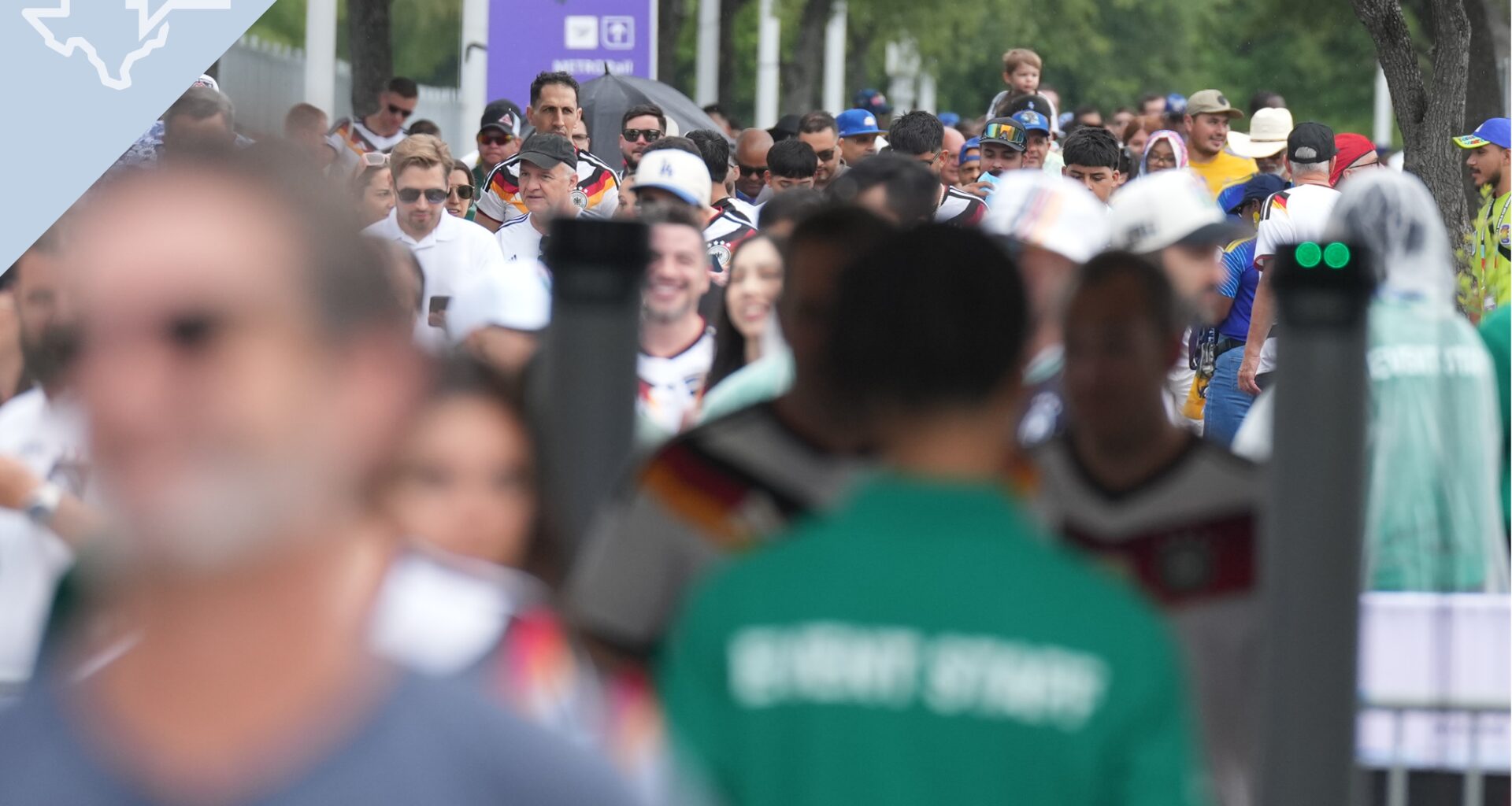
Soccer fans line out to go through security as they head to FIFA’s Houston stadium to watch Germany and Curaçao play on Sunday, June 14, 2026.
Elizabeth Conley/Houston Chronicle
Join us on a journey to better understand Houston, one question at a time. Sign up to get the Houston Explained newsletter in your inbox every Tuesday and Friday.
With the World Cup in Houston, I pretended to be a tourist for a day in my own city.
A map of the Green Corridor?
Courtesy of the FIFA World Cup 2
Because METRO, the city and the local host committee have been telling us (and the whole planet, really) that Houston was ready for the biggest event on earth for months now; that the city was more walkable and more transitable than it had ever been; that the money poured into this moment would carry half a million visitors to their hotels, to the East Downtown FIFA Fan Festival, to Houston Stadium, to anywhere they wanted to go, with ease and comfort.
Article continues below this ad
So, I set out to test those promises, traveling from my front door through the downtown crowds to Houston Stadium and back on nothing but my own two feet and the system this city hopes will impress the world.
Like any tourist, I began my journey by overpacking.
How the Red Line handled the World Cup crowds
It was raining hard when I woke up on Sunday for Houston’s first-ever World Cup game, the Group E matchup between Germany and Curaçao.
Article continues below this ad
The sky was so gray and the morning so wet that, surely, I told myself, I would not need sunscreen (remember, I’m a tourist and don’t know any better). But I packed it into my clear drawstring bag anyway, along with a rain jacket, a battery pack (although I, unfortunately, forgot a charging cable), my reporter’s notebook, a bag of trail mix, beef jerky, a baseball cap and an 18-ounce metal water bottle that wouldn’t have been allowed into the stadium (if I even had a ticket) or the fan festival.
After pounding an energy drink that surely had more caffeine than overseas regulators would’ve allowed, I caught the Route 20 bus near the Galleria a little after 9:30 a.m. and joined a quiet cabin of visitors in jerseys and Houstonians running errands.
The other World Cup-goers and I spilled out of the bus in downtown Houston at Louisiana and Preston and walked over to Main Street, where it seemed Houston had cleaned up its act for company. The new Main Street Promenade, a $17 million project completed right before the World Cup came to town, has handed seven blocks of downtown back to pedestrians, with cars expelled, walkways widened, new trees planted and shade structures erected to help fight the summer heat.
Soccer balls dangled from the awnings outside nearby businesses, music drifted from propped-open doors and bars advertised watch parties.
Article continues below this ad
The newly-enhanced Main Street Promenade is shown during the Impact Houston 26 tour of the Green Corridor in Houston, Tuesday, May 19, 2026. The tour highlighted innovative environmental solutions, expanded green space, and enhanced infrastructure being implemented for the FIFA World Cup that will leave a lasting legacy.
Brett Coomer/Houston Chronicle
In the middle of it all was METRO’s Central Station Main, where organized chaos reigned as tourists packed onto the Red Line train like tinned fish. The light rail was operating at capacity, METRO said, with trains arriving every six or so minutes.
Sweaty Germans filed in wearing flag-colored wigs and full lederhosen, necks already red and face paint running in a heat that feels like it’s climbing toward 100. A family in Peru jerseys nervously folded their child’s stroller to wedge it aboard. METRO Police Department officers and fare inspectors (I didn’t see them check a single person’s fare) were also there, apparently keeping things in order.
Despite pretending to be a tourist for the day, I am not built to seal myself into a metal tube with a few hundred strangers. So, I hung back and watched METRO try to meet the moment.
And I’m glad I did; Two friends I ran into later, Sam Scott and Catalina Pinto, said it took them an hour and a half to reach Houston Stadium that morning on the Red Line because their packed train kept stalling in car traffic.
Article continues below this ad
“It was stop, start, stop, start,” Scott said.
“There was no priority given to the train,” Pinto added.
By 11 a.m., an hour before kickoff, the crowd had thinned enough that I boarded with a seat to spare.
Ricardo Montero, visiting from Costa Rica, summed up the ride: “Easy is the word,” he said in Spanish. “And the train comes very frequently.”
There were still stops, for traffic and for the crowds boarding at other stations along the line, but we reached the stadium within half hour of leaving downtown. Not bad.
Article continues below this ad
The long, hot wait to leave Houston Stadium
Without a ticket, I spent the match sitting in the grass outside Houston Stadium and watching the late crowd trickle in. The venue roared for each goal 30 seconds before it reached the stream I was watching on my phone.
Christina Perpich, a Houstonian who rode the Red Line in, told me the air conditioning had dripped on her the whole way there in a packed train.
“Not the most pleasant experience, but it did get us here,” she said. “So that’s positive.”
Getting there, it turns out, would be the easiest part of the day. The real test was getting home.
English tourist Nick Elliott and his Houstonian friend Shawn Schiller saw it coming, so they left early.
“We knew the match was about over,” Elliott said as he walked toward the Red Line station with Germany already routing their opponents and a quarter of the game left to go.
They were right to run. METRO Police Chief Ban Tien told the Chronicle he expected more than 20,000 fans to leave the complex by transit.
With about 10 minutes left, the crowd began pouring toward the Stadium Park/Astrodome station on Fannin, first by the hundreds and then the thousands, into a line that was both miserable and, it turned out, pointless.
The rain clouds were long gone, and the sun was bearing down in full force (that sunscreen came in handy). FIFA volunteers handed out water and waved people toward the rail. A big white tent meant for shade overflowed within minutes, leaving fans on steaming concrete or crowded under trees beside the portable toilets. And the whole time, I watched countless people cut the line, walking off the stadium grounds, onto the sidewalk along Fannin and straight onto the station platform without ever passing through the tent.
“We waited in a tented cow line for over 30 minutes and then realized they were just letting people in from outside,” said Elizabeth Webb, visiting from Chicago. “What a mess.”
A METRO worker kept yelling, “Squeeze, y’all! Squeeze!” as each train filled, while another shouted, “Hot rail!” whenever another approached so the crowd would clear the tracks.
Hot rail, indeed, because the heat and the sun were starting to take a toll on the people still waiting to leave the stadium nearly two hours after the final whistle. A Houston Fire Department engine and an ambulance were called for minor heat cases. A German tourist, Lyssane Muckenhaut, told me she stepped out of the tent after feeling faint.
“It was very humid, very crowded in there, so there was no fresh air,” she said, a cold water bottle pressed to her forehead.
Tired of the inefficiency, I did what a growing number of people around me had already started doing: I gave up hopes of getting on the train and walked.
My lonely walk to the FIFA Fan Festival
The Columbia Tap Trail is shown during the Impact Houston 26 tour of the Green Corridor in Houston, Tuesday, May 19, 2026. The tour highlighted innovative environmental solutions, expanded green space, and enhanced infrastructure being implemented for the FIFA World Cup that will leave a lasting legacy.
Brett Coomer/Houston Chronicle
I could have walked a bit to a station down the line and caught the train there, or hopped on a bus partway. But our local World Cup overlords had been bragging to locals and tourists alike about something called the Green Corridor, and I wanted to see what it was about.
The corridor is a 14-mile route that the host committee says will allow World Cup-goers move between the Fan Festival in East Downtown and Houston Stadium entirely by public transportation (mostly the Red Line), on foot and by bike along city streets, bayous and the Columbia Tap Trail.
There were promises of shade structures and water stations along the way, so I went looking for the best (and worst) of this so-called walkable city.
I trekked down Old Spanish Trail, then Almeda, then the Brays Bayou greenway, aiming for the Columbia Tap near Ardmore.
The worst came first: Along OST and Almeda, the cracked sidewalks had turned to shallow canals from the morning rain and ran beside mosquito-infested drainage ditches choked with trash. Some of the yard signs meant to mark the corridor were knocked over, and the teal “Green Corridor” stickers on the pavement were crumpled up and tossed aside.
Much of the Green Corridor, it turned out, was actually gray from the concrete bayou banks and broken walkways littered with beer bottles and rotting takeout. It seemed no one had cleaned up out here as well as they did downtown.
Then Hermann Park, ever generous, saved me with its shade and water fountains. There, I met a Mexican couple who had been at the game and, like me, had chosen to walk to where they parked their car (many fans drove and simply parked along the rail line) rather than wait in that stadium crowd any longer.
When they reached their car, past Hermann Park, they offered me a ride to East Downtown. But I turned it down because, by then, I was committed to the bit.
From the Columbia Tap Trail, it was a straight shot toward the fan festival, and while the walk was slowly crushing my spirit, this was where so-called walkable Houston finally delivered. The path cut through Third Ward, where people were out on bikes and walking their dogs and where the trees were actually green. It was also where I felt most ridiculous because I was the only World Cup “tourist” on the whole trail, stepping around broken mirrors and rotting mattresses and discarded candy wrappers. I walked past Texas Southern, past Elgin and then finally, after two hours, reached the Gulf Freeway.
I had forgotten to reapply sunscreen, and my shins felt ready to split like tree trunks struck by lightning. As I walked right past bus routes that could have carried me home, sweating and swatting mosquitoes, I wondered whether any real tourist would be dumb enough to walk from the stadium to East Downtown in the middle of June.
Then, the rain started back up as I crossed the underpass into Second Ward. I passed luxury condos and the Oak Farms Dairy as my legs began to quit, and I sat on any bench I could find because I am no athlete.
I knew I was close when the soccer fans reappeared: families in the colors of Ecuador, Mexico, Colombia, Korea, Spain, Japan, Morocco, Curaçao, Germany, etc.
By then, I was delirious and out of water, and for a corridor that promised water stations, there were precious few. My savior turned up near the end in the form of a man handing out ice-cold water bottles along the trail. I took one, poked holes in the cap and hosed myself down.
I limped the last stretch toward the noise and the crowd, and when I finally reached the Fan Festival, it was closed because of the weather. All I wanted was to buy a $9 Coke Zero and watch the rest of the day’s games!
So, instead, I hobbled to the nearest Route 20 stop, defeated and yet somehow proud for having walked so long across Houston of all places.

What is your Houston question?
Fans leave the 2026 FIFA World Cup Fan Festival as Germany faces against Curaçao due to weather in Houston, June 14, 2026.
Jacob Lujan/Houston Chronicle