
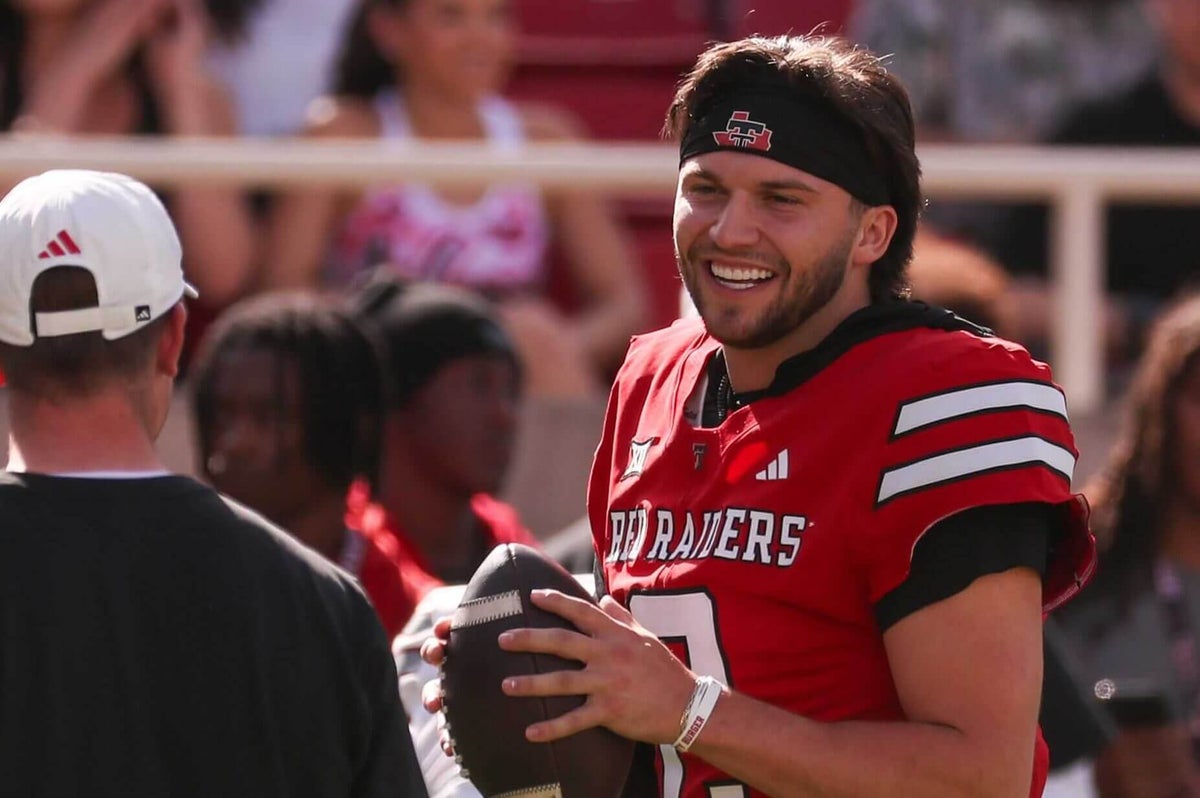
Brendan Sorsby won’t play for Texas Tech, so college football will avoid turning into professional wrestling.
Sorsby’s out, so pressure to do the right thing — all of it intense, some of it accompanied by hyperbole, some of it carefully crafted by lawyers — can work, even in this industry, even after a local judge makes a ruling that makes no sense.
Sorsby is off to the NFL Supplemental Draft, so he’s better off. Texas Tech is not. In more ways than one.
This isn’t quite a reason to celebrate, this decision by Sorsby and Texas Tech to part ways. But it’s worth a sigh of relief. It eliminates the possibility of a player who gambled on games involving his own team remaining in college football. And it’s the safest possible outcome for Sorsby, who has been receiving treatment for a gambling addiction.
Which should remind everyone of the worst aspect of Texas Tech’s role in this saga. Yes, it would have been nice to see the school shut down any notion of Sorsby playing next season, despite committing millions to him to play quarterback for the Red Raiders in 2026. That would have been the appropriate response to an NCAA ban for Sorsby’s gambling violations, which included betting on games involving Indiana when he was at the school.
It’s also fair to wonder how many other schools in the same situation would have accepted a significant downturn in prospects for the upcoming season and a major financial loss to protect the integrity of the game.
I’d like to think some would have done the right thing. I’d feel comfortable declaring none in particular. College football is the place for people who want rules as long as the rules don’t interfere with their own ambitions.
But the spin campaign Texas Tech unleashed after Lubbock County Judge Ken Curry decided to grant Sorsby a temporary injunction so he could play in the fall is a lasting stain. It wasn’t just embarrassing. It didn’t just stoke the anger of every college football stakeholder stationed outside of Lubbock, Texas.
It earned Texas Tech and its billionaire benefactor, Cody Campbell, disdain for reasons much more serious than overpaying athletes and shaking up the sport’s traditional hierarchy. It was a torrent of rationalizations centering around the idea of giving mental health support to a student-athlete under duress. When, in reality, the 2026 season would have multiplied that duress.
Somehow, Campbell and Texas Tech coach Joey McGuire and athletic director Kirby Hocutt and president Lawrence Schovanec, in their unsolicited ramblings, never entertained the downside of freeing Sorsby to earn his pay and try to win football games for them. Such as the attention he’d attract as the sport’s foremost persona non grata.
Or the things he would see and hear at opposing stadiums. Or the speculation that would follow every bad performance — if not every misfire from the pocket. Multiple mental health professionals who specialize in gambling told The Athletic’s Grace Raynor that Sorsby would be better off not immediately returning to football, one saying he’d like to see at least a year of recovery before a return.
One said he agreed with Curry’s assertion (put forth by Sorsby’s legal team) that removing Sorsby from a football environment could be detrimental to him. But this is a brand-new team, not a collection of familiar faces. Just as an NFL team that takes a chance on Sorsby will be.
Except the pressure and public exposure in the next several months — critical recovery months — will now be reduced dramatically. Brendan Sorsby. That name has been uttered a few million times over the past few weeks by people who had no idea who he was on April 26. It’s well past time for a break.
There’s no telling what will become of Sorsby’s career, and he was only partially able to cash in (about $1 million, per sources) on his final spin in the transfer portal. But logic and the information available tell us this outcome, forced by the Big 12 lawyering up like a crime family, is best for him.
It’s certainly best for a sport that would still like to be considered a sport. Only the dishonest would argue that the participation of someone who did what Sorsby did wouldn’t jeopardize that.
Campbell invoked the Jerry Sandusky scandal at Penn State, among other absurd comparisons, and claimed the pushback was purely about Texas Tech’s rise in college athletics. The truth is, a lot of us have enjoyed the Texas Tech story — same as Indiana, same as Vanderbilt. They are the highlights of this era.
And Campbell has been accessible, has put forth some promising reform ideas, and has shown a refreshing willingness to poke at the SEC and Big Ten bullies. But this saga can’t be undone. The things the Texas Tech people said can’t be unheard. We’ll see if the Sorsby affair ends up as more than a temporary humiliation.
In the meantime, college football can finally move on. Oh, goodie. More failed legislation, anyone? More obstructive arguments against the viability of collective bargaining? Maybe throw in another unthinkable ruling from a local judge?
Summer vacation can’t end soon enough. Just bring us the games, games without singlets.
— Grace Raynor contributed to this story.