
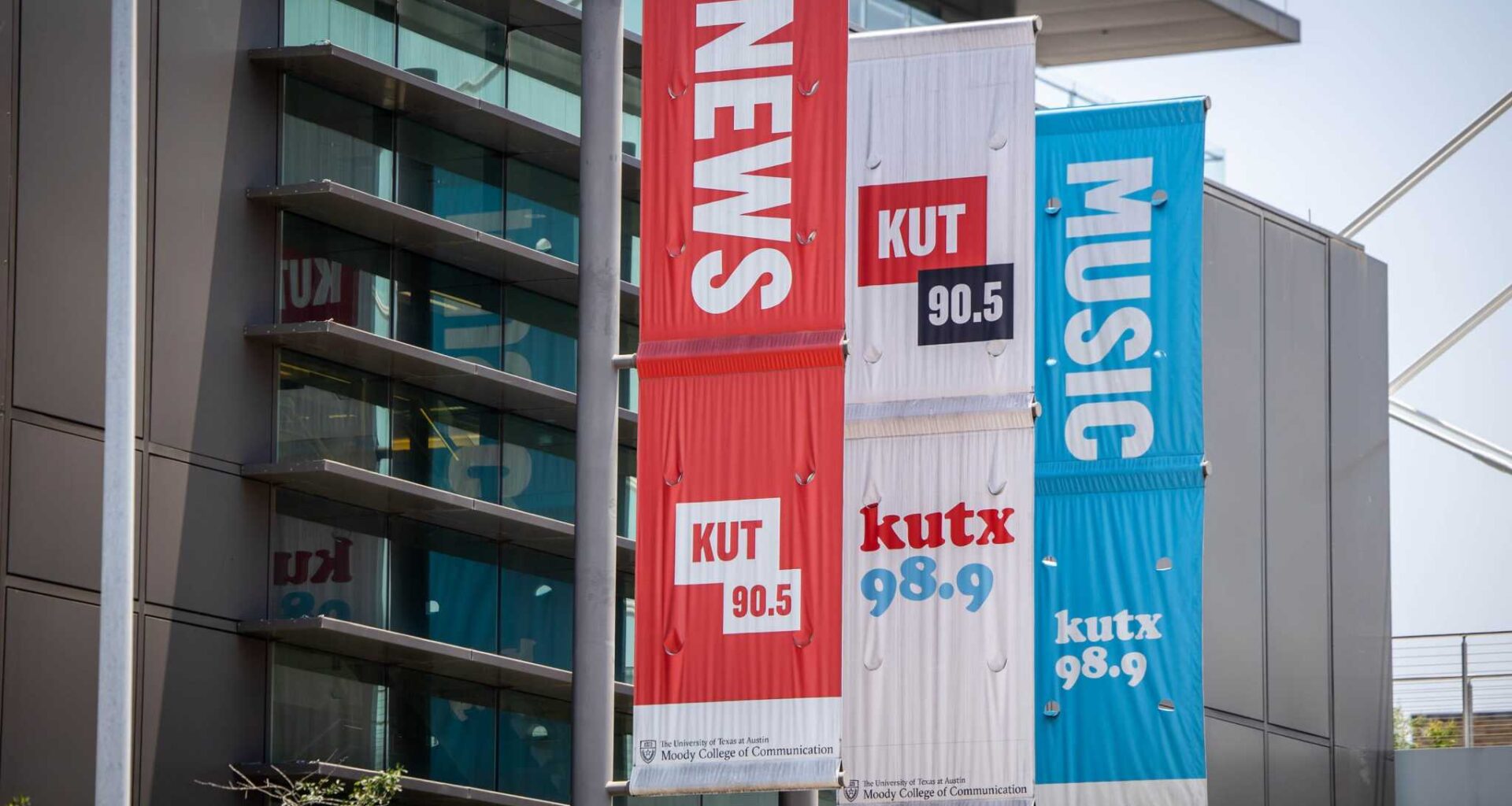
UT fired KUT General Manager Debbie Hiott on Monday over how the station planned for its inaugural festival.
Courtesy of KUT/ Michael Minasi
The University of Texas’ firing of a respected journalist and general manager of public radio station KUT reverberated from Austin to Washington, D.C., on Tuesday, raising questions about the station’s increasingly fraught relationship with UT.

University officials terminated Debbie Hiott on Monday over her planning of the station’s inaugural community festival. Days before the festival was set to take place, UT leaders ordered KUT to scale back its plans over security concerns, prompting the station to move some events off campus.
Article continues below this ad
Some worried that the university was attempting to curtail political speech at the event, where Democratic U.S. Sen. Cory Booker was the keynote speaker. Hiott’s public response has since brought questions about whether security concerns were a pretext to remove the festival from campus.
Over the past year, universities in Texas and across the nation — including UT — have faced tremendous pressure to curtail left-leaning speech.
New UT leaders have promised to rid the university of any liberal bias and made controversial decisions — from ending transgender health services to consolidating ethnic and gender studies — that have prompted concerns that UT is pushing a conservative agenda. They’ve also been increasingly hostile to the media, with President Jim Davis refusing to talk to media outlets in his first term in office.
At the same time, President Donald Trump has accused public broadcasting of liberal bias, and congressional Republicans have slashed its funding.
Article continues below this ad
In the day after Hiott’s firing, Austin Democrats and journalism advocates sounded the alarm over what the decision could mean for KUT’s future.
“KUT is an Austin institution,” said U.S. Rep. Greg Casar, an Austin Democrat. “Debbie Hiott is a hero for speaking out, no matter the consequences. The White House, and now UT, are trying to crack down on those they think are disobedient. I demand full transparency about what led to Debbie’s firing.”
State Sen. Sarah Eckhardt, D-Austin, called the situation “yet another example of the state’s power not being used to the benefit of the community or Texas but to suppress any dissent.”
“The (Freedom of Information Foundation of Texas) is committed to transparency in public institutions and the free flow of information to the people of our state,” said the foundation, where Hiott is a board member, in a statement. “We are concerned that the firing of Debbie Hiott as general manager of KUT is contrary to both of these principles.”
Article continues below this ad
Hiott, who was a longtime top editor for the American-Statesman, said in a social media post on Tuesday that she hopes the community will continue to support KUT. But in an interview with the station, she also said that UT is no longer an appropriate home for the public radio institution.
KUT has operated at UT for its entire 68-year existence. It is a common practice for the Federal Communications Commission to license local stations to universities, which began acquiring and partially funding radio stations in the 1920s in an effort to expand their community impact.
“It is a clear sign that a community asset as important as KUT should not be in the hands of an institution that doesn’t have any sense of accountability or concern for the community,” Hiott said. “My hope would be that the university would relinquish the licenses to the community.”
Multiple members of KUT’s advisory board did not return calls seeking comment or had no comment.
Article continues below this ad
KUT General Manager Debbie Hiott led the radio station since 2019 before being fired by UT on Monday.
Courtesy of KUT/ Gabriel C. Pérez
How top UT leaders shaped festival changes, messaging
Emails obtained through the Texas Public Information Act between Anita Vangelisti, interim dean of the Moody College of Communication, and Hiott paint a picture of top university leaders stepping outside their purview to find security flaws in KUT’s plans and shape messaging about the changes.
The top leaders involved include UT’s provost, vice president for communications, senior adviser to the president and vice president of legal affairs, according to the emails.
Article continues below this ad
Amanda Cochran-McCall, UT’s chief legal officer, first raised concerns about the festival on April 22, asking if KUT had obtained an exception to provide alcohol or had adequate crowd-control plans, according to an email. Hiott responded to her concerns the next day in writing, listing the policies that grant permit exceptions for alcohol sales and saying KUT was happy to make changes.
But two days later, when UT canceled the outdoor portions of the event citing “significant safety and legal concerns associated with insufficient planning,” Vangelisti told Hiott there was no appeals process as “safety and security issues are non-negotiable.” The interim dean said Hiott could ask Jay Swann, who holds a new university safety cabinet position, for more information. At that point, Hiott told Vangelisti she had never received a list of concerns.
Swann forwarded a message from Hiott asking what specifically had to be cancelled to Nancy Brazziel, a chief advisor to President Davis, on Sunday, April 26. Swann later told Hiott he was “not in the place to make a decision about what events you decide to keep on the schedule for UT” and referred her back to Vangelisti.
Vangelisti was in contact with Provost William Inboden and his chief of staff, Drayton Cullen, that weekend, asking them to approve KUT’s messaging about why it was cancelling the festival and what specific portions would be cancelled.
Article continues below this ad
As the university’s chief academic officer, Inboden does not oversee public safety or communications. The university did not respond to questions about why he was involved and whether his participation in the discussion was typical.
“Hello Will, I have talked with Debbie about how to message the changes to the KUT festival and asked her to draft some language,” Vangelisti wrote on April 26. She asked for his messaging approval to send to Pat Wiseman, UT’s VP of media and communications. Inboden approved the draft language, which was redacted from public record.
In a meeting the next morning with emergency personnel and Cochran-McCall, Hiott and KUT’s event planning partner, Panacea Collective, agreed to meet all of UT’s requests for additional security and address any other concerns, according to notes Hiott later shared with Vangelisti.
“Nowhere in this conversation did I get any indication of what the issues were that led to the cancellation of the outdoor portion, but at least we have assurances that they don’t see any problems going forward,” Hiott wrote to the dean.
Article continues below this ad
Once the event changes became public April 29, the university and Hiott gave contradictory statements about the reasons for the festival moving off campus, escalating tensions between the parties. Cochran-McCall accused Hiott of dishonesty in her public remarks and “poor planning,” saying university intervention was warranted to maintain the safety of campus.
Hiott told the Statesman on Monday after her firing that UT officials told her that she was terminated because of insufficient security considerations and her public statements defending KUT’s planning. UT did not respond to a request for comment about the reasons for Hiott’s termination. The university typically does not comment on personnel matters.
“I knew when I spoke out against the university’s lies about our festival that there might be consequences, but I had hoped that logic and sense would prevail,” Hiott wrote in a social media post Tuesday. “To allow a false narrative to stand would be the antithesis of what news organizations like KUT are trying to accomplish every day.”
Provost William Inboden was involved behind the scenes in the dispute between UT and KUT over the radio station’s inaugural festival.
Rodolfo Gonzalez/Austin American-Statesman
UT and KUT’s relationship
The Federal Communications Commission licensed UT to run KUT in 1958, and the station is described as a “unit” of UT in public messaging. However, the fallout of the festival highlights the complexity of that relationship and the university’s leverage over Austin’s independent radio station.
Article continues below this ad
KUT states it is editorially independent from the university and funded wholly by the community. But KUT is closely intertwined with UT, which houses the station and processes all its expenses and payroll.
The station adheres to university procedures and policies and “is governed by the University of Texas Board of Regents,” according to financial documents posted by the radio station. In turn, KUT staff serve as a “university resource for journalism expertise,” and the station employs 30 college interns a year from across Central Texas, including from UT, KUT’s website states.
UT’s contribution to KUT’s total annual revenue is just 6%, with about $1 million contributed through in-kind donations including facilities, IT support and payroll, according to financial statements. That amount is roughly equivalent to what the federal government provided KUT until congressional lawmakers voted to gut support in 2025.
The bulk of KUT’s funding — about 86% — comes from community support and sponsorship.
Article continues below this ad
Since Trump ordered the end of taxpayer-supported funding for NPR in May 2025, Congress and several universities have cut support for local affiliates. Penn State University trustees voted to “wind down” operations at its radio station due to funding pressures in 2025, and Baylor University cut its $209,000 annual contribution to KWBU the same year, another NPR affiliate.
Nationally, about 500 radio stations are licensed to or affiliated with universities. UT is licensed to run KUT until 2029.