
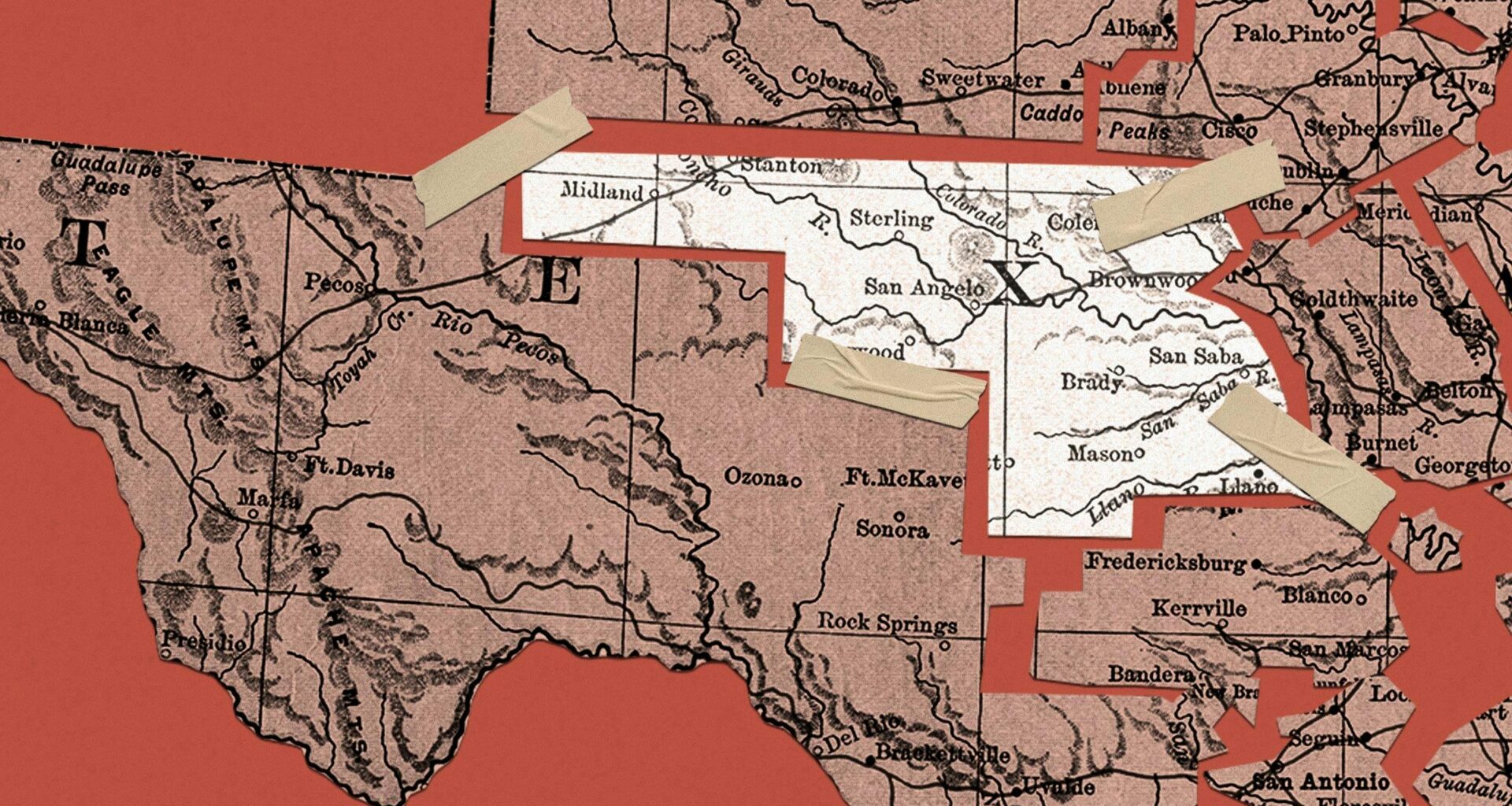
The distance from the eastern edge of Pflugerville to West Odessa is roughly the same distance as the drive from Durham, North Carolina, to Philadelphia, Pennsylvania. The two Texas cities haven’t got much in common. Pflugerville is a suburb of Austin; major employers in the area include tech titans such as Dell, Samsung, and Tesla. The median family income is around $118,000 annually, per the U.S. Census Bureau. In West Odessa, meanwhile, top employers include oil-and-gas giants Halliburton, NexTier, and Liberty Energy, and the average household brings in less than $65,000 a year, or only a little more than half of what a family in Pflugerville earns. Politically, the contrast is even more stark: In Travis County, where Pflugerville resides, voters preferred Kamala Harris over Donald Trump in the 2024 presidential election by nearly forty points; out in Ector County, home to Odessa, Trump won by more than fifty.
And yet residents of the two cities have one thing in common: They’ll both be voting for a representative in Texas’s Eleventh Congressional District, per the new maps drawn as part of last summer’s redistricting at the behest of the Trump administration. To give Republicans a further edge, the new maps pulled voters who had been in one of two districts in deep-blue Austin into districts that had voted in overwhelming numbers for the GOP. As a result, the Eleventh went from favoring Republicans by 46 points to giving them a mere 34 point advantage. The only losers, in this scenario, ought to be Democrats and folks in Austin who wanted to be represented by someone who more closely shares their views.
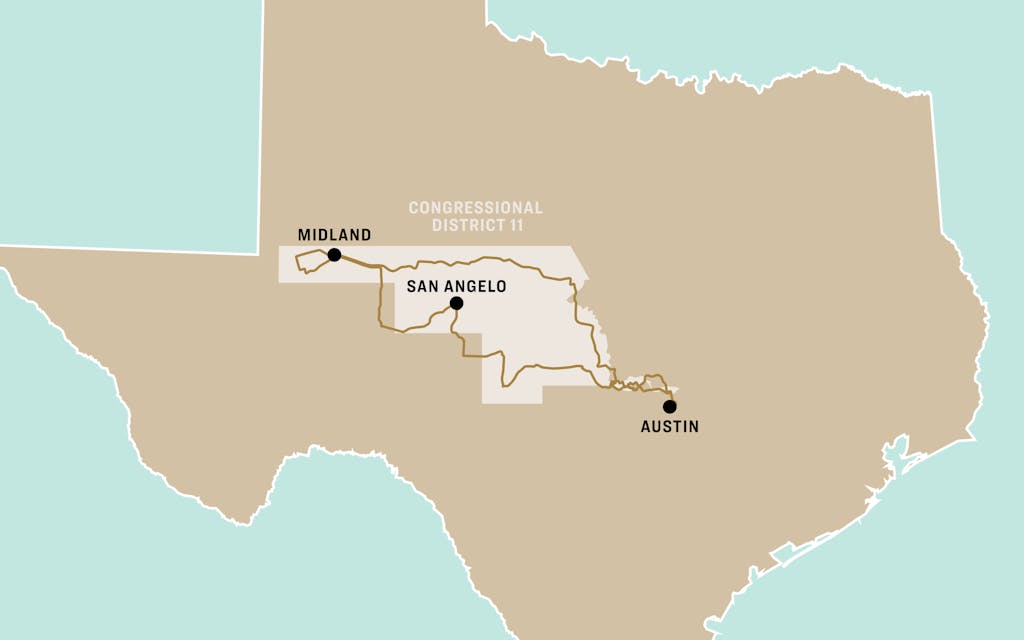 The writer’s driving route through the Eleventh Congressional District.Texas Monthly
Statistics are a fine way to get a sense of how different the two communities might be, but in order to really grasp the dynamics of TX-11, I knew I’d need to get more hands-on. I’d need to see it—all of it—for myself.
I began by mapping out a route of the perimeter of the district. The straightest line from Pflugerville to Odessa is a route of 344 miles, but the district is far more vast than a simple straight line; the southern edge of the district, at Junction, is more than a hundred miles from its northern boundary, in Winters. It includes all or a portion of twenty different counties. I wanted to understand what voters in all of these places might possibly have in common, so I could grasp how a single human being—almost certainly Midland’s August Pfluger, who’s represented the district since 2021—could substantively represent all of their interests in the House of Representatives.
I plotted a route that would adhere as closely to the boundaries Texas’s Eleventh as possible—the big, chunky, straight-lined parts that represent the majority of the western portion of the district, as well as the snaking lil’ sliver that starts a bit to the west of Austin and then delicately carves out portions of Travis County, taking tens of thousands of voters out of their current districts to shove ‘em into the Eleventh. In total, there and back, the route would take me 971 miles. I gave myself three days for the drive—plenty of time to meet folks, see the sights, enjoy the food, and soak in all that Texas’s Eleventh Congressional District has to offer.
Mile 0: I begin at the district’s northeastern edge near Pflugerville, at the intersection of Cameron Road and FM 973. I’m only 25 miles from the Capitol, but the rural path I’m on looks more like the western part of the district than it does Austin, with the odd gas station or tire store breaking up the grazing land.
Mile 4.9: Well, that’s over. We’re in the suburbs now. Glancing to the left, I spot a sign for a realtor one could contact if they were looking to buy a home in Pflugerville: John Pfluger Realty, which seems appropriate for Pflugerville.
Pfluger, of course, is also the last name of the district’s current representative, August Pfluger, of Midland. Both John August Pfluger—who passed in 2015, but whose John Pfluger Realty lives on—and Representative August Pfluger are descendents of Henry Pfluger Sr., the German immigrant who homesteaded the plot of land that would eventually become Pflugerville with his family. How incongruous can it be for Pflugerville to be in a congressional district with Midland and Odessa if the newly added part of the district is literally named after the current representative’s ancestor? Much to ponder, and we’re only a few minutes in.
Mile 33.3: I’m still in the Austin area when I hit my first roadblock—literally, in this case. The path to stay within the boundaries of TX-11 is narrow in the Travis County portion of the district, and my route has me driving through some small, residential streets. In this case, I’ve been driving through suburban Leander, which is a part of the district I’m familiar with. I was not, however, familiar with the specific roads my map app told me to take in order to trace the outline of the eleventh, and, alas, when I hit the Crystal Falls Golf Club, I find myself at a private road, with a gate that one must live within the community to enter.
It hadn’t specifically occurred to me that I might encounter such a dead end on this trip, but I was aware that the way districts are drawn tends to defy human logic. A few people familiar with the mapmaking process said that if I wanted to fully trace the outline of the district, I’d be crossing through people’s backyards and hopping over fences—that’s how carefully spliced together these districts are.
After briefly considering trying to follow another car through the gate, I decide to take a slight detour. I wind my way through Cedar Park, passing the Sri Shirdi Sai Baba Temple of Austin, which I assume will be the only Hindu temple in the district.
Mile 57.4: I’ve arrived at Travis Peak, a summit in the Hill Country that, despite only being a little more than an hour away from my house, I’ve not only never visited but never even heard of. Getting here requires driving along a winding, sparsely traveled road through some lovely, tree-lined scenery—but as I start to descend the hill, I hit yet another obstacle.
This time, it’s a shallow creek that, because of the rainy spring in Central Texas, currently runs over the road. The creek is not deep—eyeballing it, I reckon there’s maybe a half foot of water—but I am a city boy, and all I really know about driving across running water comes from the PSAs that explain that a car can float in as few as six inches of water. I’m in a Ford Maverick, which is a small pickup truck that a quick web search tells me has about nine inches of ground clearance. Which means I should be okay? I hit the creek with a splash and cross over it quickly.
It’s exhilarating, but it also strikes me that in order to drive from one end of the district to the other, you have to hope it hasn’t been raining too much—or get yourself a lift kit for your truck. To avoid further potential roadblocks,, I decide to amend my route so that I’m only driving on roads with lines painted on them, even if that means I occasionally dip outside the district.
Mile 76.7: After continuing on for another fifteen minutes or so, the road meets up with FM 1431, and I hit Marble Falls, a quaint Hill Country town I’m familiar with as a popular weekend getaway for folks in Austin and San Antonio. Relieved at the sight of such signs of civilization as a Dairy Queen and an HTeaO, I stop for a small, dipped cone and to use the bathroom before pressing on, even though I’ll be outside of TX-11 for a stretch while I take U.S. 281 to U.S. 290.
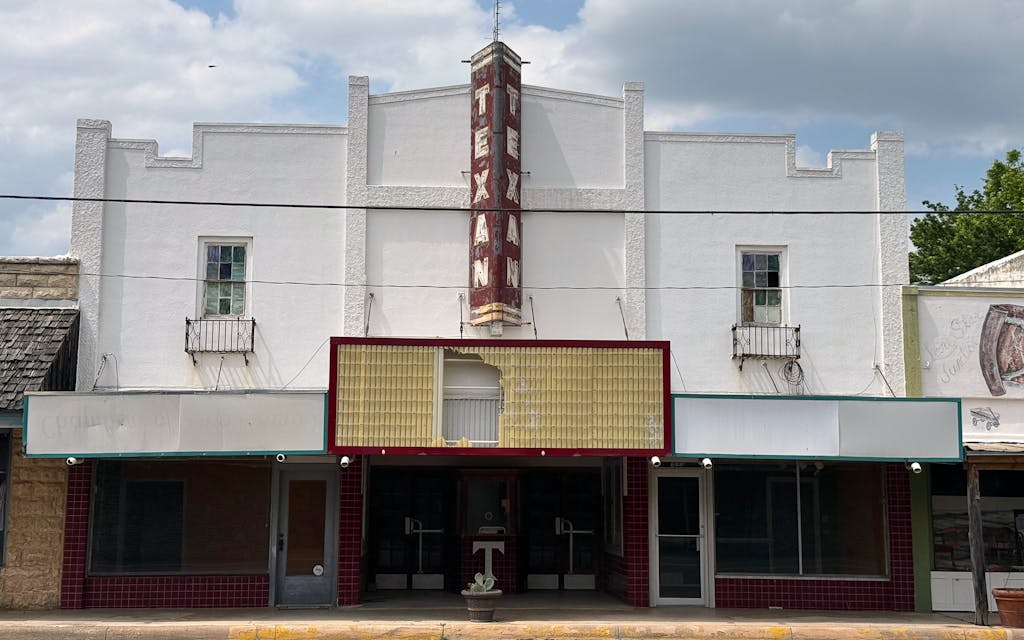 The former Texan Theatre in Junction.Dan Solomon
Mile 191.0: I’ve driven along 290 many times, so none of this is new to me. I pass roadside peach stands outside Fredericksburg, which seem to be mostly closed pending the start of the season. Texas has had a poor peach crop so far this year, so who knows how these businesses will do. But now, in Junction, there are gas stations, hotels, and a dying square, all nestled along the banks of the Llano River. It’s nice to be back in the district.
Mile 315.8: It’s not a revelation that the further west one goes in Texas, the greater the distance between places becomes. Roughly thirty miles after Junction, I hit Menard, a small town that looks a lot like Junction to my eye, except it’s on the San Saba River instead of the Llano. About sixty miles after that, I come across Christoval, a town of around five hundred people that has a charming pizzeria called 1982 Pizza Co., with branding not all that different from what you might see in Austin, and a tiny, picturesque post office that looks exactly like what you might imagine a small-town Texas post office would look. I drove along a route called the Toe Nail Trail, though no one could tell me how it acquired that name, and passed a sign that reads “Wind turbines destroy land value (among other things),” which is not the first political message I’d seen outside a ranch out this way—though more of them seem to object to data centers than turbines.
Now, though, I’m in San Angelo, a city of about 100,000 and the home of Angelo State University and Goodfellow Air Force Base. San Angelo has been a part of the district for decades, though in the nineties, it was shoehorned in awkwardly with a portion of San Antonio, instead. Here, I meet with Jon Mark Hogg. Hogg is the chairman of the Tom Green County Democratic Party and actually challenged Pfluger to represent the Eleventh Congressional District in 2020 (he got less than 20 percent of the vote).
Hogg tells me the sheer size of the district, in his view, makes it almost impossible for any one person to effectively represent it.
The maps might be drawn for partisan advantage—but the problem with them goes beyond partisanship, according to Hogg, and into the way the local economies are constructed. “I don’t know how you can represent all the varied interests from that huge swathe of territory,” he says. “The needs of people on this side of the district are completely different than the needs of people in Midland, Odessa, that kind of territory.” Midland and Odessa have an oil-and-gas-based economy, and Pfluger represents those interests by serving on the Energy and Commerce Committee. San Angelo’s economy is based around Goodfellow Air Force Base, light manufacturing, education, farming, and agriculture.
In previous iterations of the district, he tells me, those issues were limited because the vast majority of the district was rural. “It should be primarily a rural district with a few population centers like San Angelo, Midland, and Odessa—nothing like Austin,” he says. “We don’t have the same economies.”
This troubles him because, while folks in the Austin sliver of the district are reasonably concerned about their voting power being diluted, as was the intention when the new maps were drawn, there are more than 67,000 voters in the Austin part of the district who cast ballots in the 2024 election. In the previous iteration of TX-11, a total of 211,000 voters participated in that election—which means that Austin could represent nearly a third of the ballots cast. That wouldn’t be enough to turn such a red district blue, but it could make things uncomfortable for voters in the western part of the district when it comes to future GOP primaries.
“Austin is a dangerous place to redraw those lines,” Hogg says. “And it’s dangerous for a Republican too. I think a strong Republican from the Austin area could take that district.” I ask him how he thinks Republicans in San Angelo, Midland, or Odessa might feel if an Austin Republican who was focused more on, say, tech regulation than agriculture or oil and gas ends up challenging Pfluger in a primary and succeeding. “It’s just one man’s opinion, but it’d be like not having a representative at all,” he says. “And I think that’s what people in the area of Austin that’s in this district are going to feel like.”
Mile 386.7: I’ve gone through Mertzon, passing a few gas stations and the Mertzon Meat Co, which does both butcher cuts and wild-game processing, and now I’m in Big Lake. I’m generally fond of cities whose names are simple descriptions of a single geographic feature, and Big Lake, the county seat of Reagan County with a population of almost 3,000, looks like a veritable metropolis compared to Mertzon or Menard. There are hotels, a supermarket, even a truck stop with a Taco Bell and a Cinnabon, plus a Chevy dealership and a town square.
It occurs to me, as I reflect on what Hogg said, that his concerns about the Austin slice of the district potentially having an outsized influence could be valid. In 2024, fewer than a thousand people voted in Reagan County; that number wasn’t much bigger in Menard County, and while it was closer to 2,500 in Kimble County, where Junction is, that’s a tiny fraction of the number of voters who turned out in the Austin part of the Eleventh. Folks here in Big Lake haven’t got much in common with their district mates in Austin, at least in terms of what they need from their representative in Congress.
Mile 471.3: I pull into Midland, which is the biggest city I’ve been in since I left Austin. (And, it turns out, there’s a second Hindu temple in the district here, about a mile past the Texas Roadhouse and Walmart Supercenter.) After getting into town, I stop at the Martinez Bakery, an expansive, cafeteria-style spot that serves tacos, tortas, and an array of pastries. Most everyday residents of the district I’ve met have no real opinion on sharing a representative with people in Austin—when I’ve tried to start conversations with folks at restaurants or hotels about it, I haven’t encountered anyone who knows that their district had been redrawn. So I grab a cinnamon roll and meet with Cathy Broadrick, who is running as a Democrat to represent Midland in the Texas House, challenging entrenched incumbent Republican Tom Craddick.
Broadrick has a host of issues with both Craddick and August Pfluger, as you might expect, but I’m mostly interested in her perspective on the issues facing her hometown. She points to challenges distinct from those in Austin or San Angelo. There’s transportation—“The roads around here are crap because of all the truck traffic”—as well as the local environment: “When the flaring starts, and there’s clouds above, it blocks it down. Those are the nights when I can’t sit on my patio.” She might find bedfellows in some parts of the state—concerns about public education are shared by those in San Angelo, for instance, and progressive Austinites might be sympathetic to the environmental concerns—but each area has its own priorities.
Broadrick says that this problem predates the new gerrymander, and it predates August Pfluger. Before the Legislature’s first mid-decade redistricting, in 2003, Texas’s Eleventh Congressional District comprised a relatively compact stretch of Central Texas anchored by Waco and Fort Hood, and it was represented by a Democrat, Chet Edwards. When it was redrawn, she says, it was drawn to create a district for Midland oil-and-gas executive and George W. Bush ally Mike Conaway and was almost entirely rural, with its eastern boundary stopping in Burnet County, a good hour away from Austin. Edwards ran in a different district, and Conaway cruised to victory, winning by 55 points; it would go on to become the smallest margin of his political career until his retirement in 2019. Broadrick doesn’t expect her fellow Democrats in Pflugerville to flip the Eleventh blue, but she expects the margins will probably be smaller than fifty-plus points in the future.
I ask Broadrick directly if she thinks any single individual could fairly represent the district. “When [we had] Mike Conaway in the original big district, we were rural and agricultural, along with the oil people in West Texas. It was more of a community,” Broadrick tells me. It was redrawn again following the 2010 census, and that incarnation scooped up a bunch of counties in the Edwards Plateau, leaking out in the northeast all the way to Mineral Wells, about fifty miles from Fort Worth. When the map was redrawn yet again after the 2020 census, the Lege opted to shore up Republican advantages in many districts after several close calls in the 2020 election, and TX-11 left North Texas in favor of scooping up a swatch of military voters in Killeen and Harker Heights. She doesn’t like the fact that the Lege drew the map to add a portion of Travis County along a very narrow path to create her district. “If they would just stack the counties on top of each other . . . we would all have more in common.”
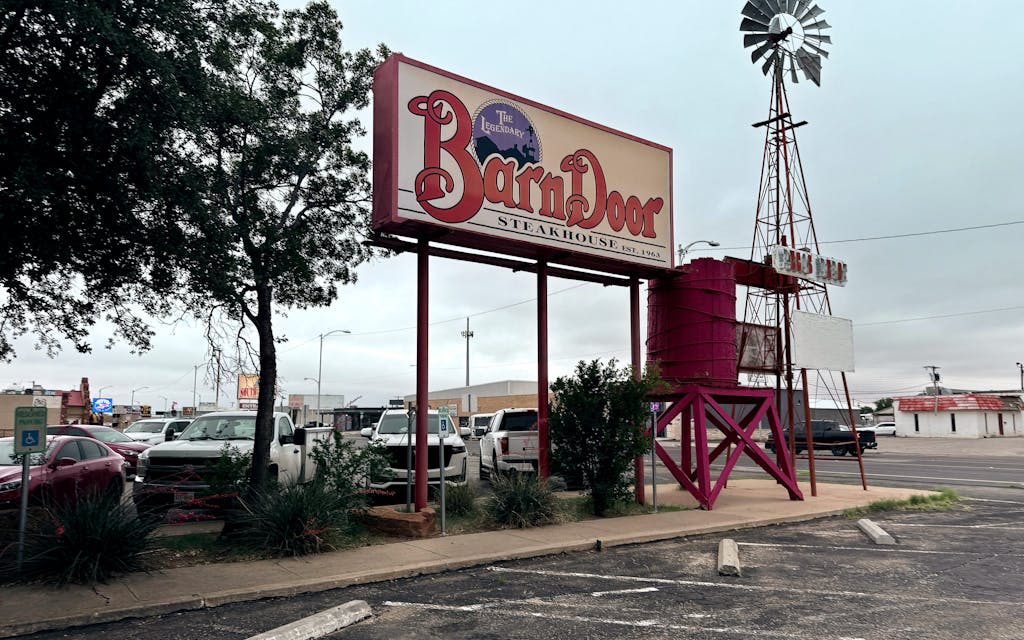 The Legendary Barn Door Steakhouse, in Odessa.Dan Solomon
Mile 607.4: After staying the night in Odessa, I start my trek back toward Austin, this time tracing the northern edge of the district. A sharp downpour starts as I approach the town of Robert Lee, the “Playground of West Texas.” After splashing down hard in a low water crossing, I decide to pull over at a gas station just past the Family Dollar and wait for the rain to calm down. I search the town online to learn what gives it its nickname, and I learn about the scenic drives, volunteer opportunities, the “Rabbit Twisters” pageant, a musical theater production first staged in 1978 and telling the history of Coke County.
Mile 675.5: The rain’s calmed down, and I’m tired of driving, so I’m eager to get back home, but when I pass through Coleman, I decide to stop—the place feels like a throwback to the sort of small-city downtown where I grew up in in Indiana, down to the local drug store and soda fountain, which is lively as I drop in. There’s a flower shop, a bookstore, and a few restaurants, all seemingly doing well. Seems like a nice place to share a district with!
Mile 704.9: I’m still thinking about how varied the district is when I drive into Brownwood. After Midland, Odessa, San Angelo, and the Austin area, Brownwood is the fifth-largest population center in TX-11. On the edge of town, I decide to stop for lunch and pull into Humphrey Pete’s Steakhouse, where I order the Texas Tumbleweed, a bloomin’ onion-style piece of fried deliciousness that will haunt my dreams for weeks to come.
As I try to make sense of the unwieldy district, I decide to call Lee Drutman, a political scientist at the New America think tank whose work has focused on ways Congress could be reformed to better serve all Americans. He’s suggested multimember districts, with members elected proportionally—so if a district had five representatives, and Republicans got 60 percent of the vote while Democrats got 40 percent of the vote, three of those five representatives would be Republicans, and the other two would be Democrats.
I’m interested in what it would mean for Texas’s Eleventh Congressional District. I started this trip with the basic assumption that the district had been gerrymandered in a way that was intended to effectively leave the likely Democratic voters of the Austin sliver without meaningful representation by smooshing them together with a vast majority of voters who prefer Republicans. That may be true, but my journey has underscored another problem that exists outside partisan politics—the challenge of scooping up 766,987 people across the wide-open spaces of West Texas and tasking a lone individual with representing all their varied interests. San Angelenos and Midlanders would struggle to have their interests represented by an Austin Republican whose priorities were cryptocurrency and cancel culture, even if that representative had an R by their name.
“While in the binary political identity of Republican versus Democrat, people identify as one or the other, the parties are actually pretty big coalitions with a lot of internal diversity, and a lot of that gets lost and ignored when every election is D versus R,” Drutman tells me. “And the way both parties address that is to say, ‘Hey, I might not be your sort of Republican, but we definitely don’t want a Democrat.’”
That is a different problem than simple gerrymandering, but according to Drutman, the two are related. “The single-member district is the thing that makes gerrymandering possible, because you get all these different lines to draw, and it matters how you distribute your voters in that system,” he says. “Whereas in a system of proportional representation, there’s no benefit to putting 45 percent of your opposing party into a district, because they’re not going to get nothing. So it just totally changes the logic of the gerrymander.”
I think about that as I sit with my large fried onion in Brownwood. Many of the voters in Austin who’ll be represented by August Pfluger would certainly prefer a Democrat, but they’ll mostly want someone who needs and cares about their votes and who can be responsive to their concerns. That’s the same thing voters in San Angelo want—same as in Junction, and in Coleman, and in Midland, and in Odessa, and in Christoval. I guess in that way, they have something in common after all.
Read Next