
This cropped image from an 1869 map of Houston shows Block 319 and the Black Methodist church that was erected there by May 1866. The block served as the starting point for the first Juneteenth procession in Houston a few weeks later. Courtesy of Beinecke Library, Yale University.
W. Caleb McDaniel
Juneteenth, our newest federal holiday, was born in Galveston. That’s where, on June 19, 1865, Maj. Gen. Gordon Granger issued General Order No. 3. It declared that the Emancipation Proclamation would now be enforced in the Lone Star State.
But Houston also played a crucial role in the origins of Juneteenth. In fact, my new research, just published in the Journal of Texas History, shows that the very first documented public celebration of the June 19 anniversary took place here — in Houston.
And that first event still has much to teach Americans today, especially about true patriotism and the meaning of Juneteenth.
Article continues below this ad
It happened 160 years ago in 1866, exactly one year after Granger’s famous order.
That morning, a large crowd of formerly enslaved Texans gathered at a Black Methodist church on Travis Street between Bell and Clay. (The site is a parking lot now, but the congregation lives on as Trinity United Methodist Church on Holman Street.)
The church’s members had recently moved their building plank by plank to this spot, on a city block they had purchased. Now, waving red, white and blue banners, the whole assembly paraded to Main Street in the center of town, led by two Black ministers on horseback.
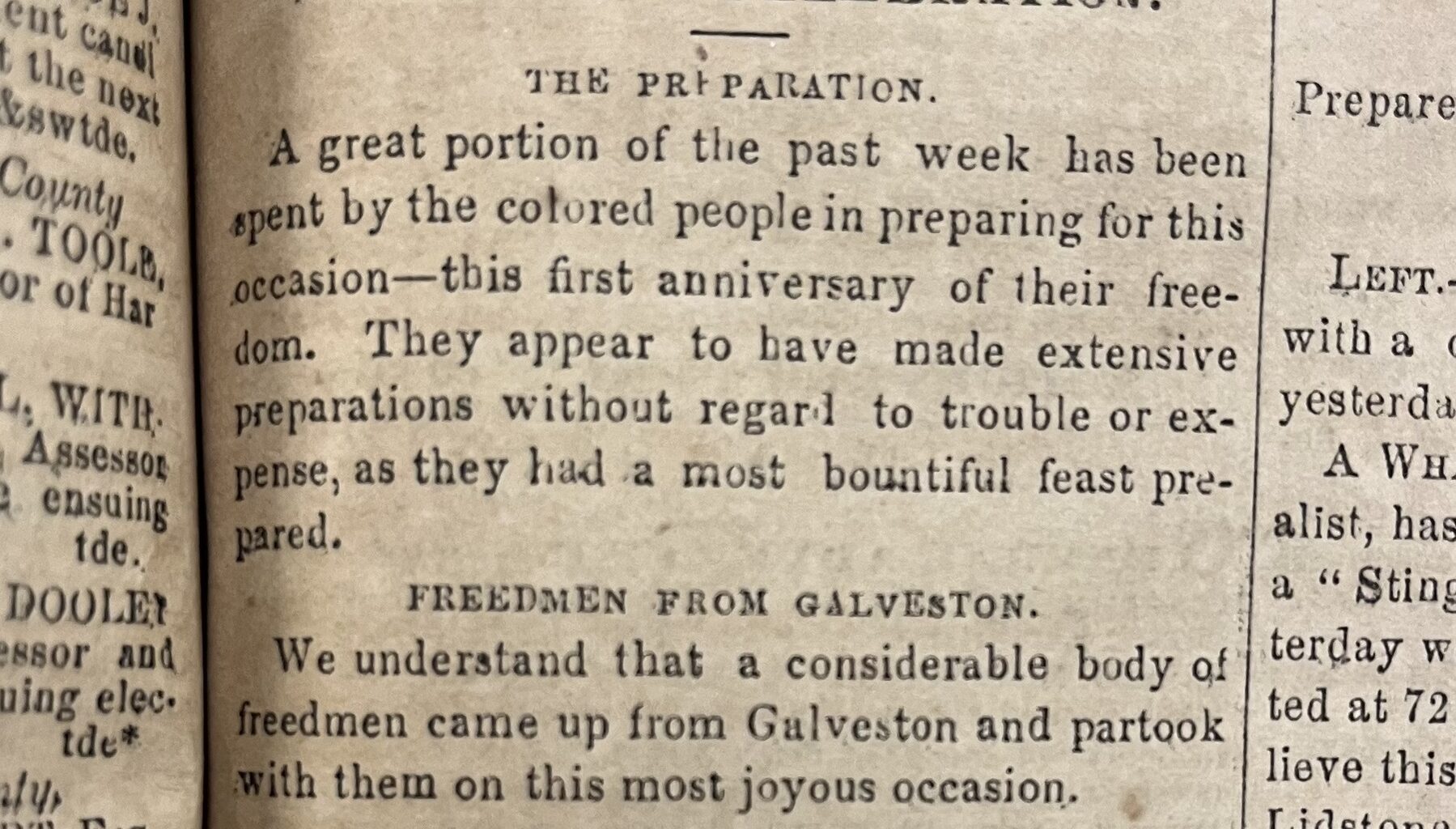
The marchers stopped at a grove on the outskirts of the city’s Second Ward for speeches, “spiritual songs” and a “bountiful dinner” of barbecue, all under the shadow of an American flag.
Article continues below this ad
Then the festivities continued all day long, drawing crowds from well beyond the city limits. According to a reporter for the Houston Daily Evening Star, some 3,000 to 4,000 attendees filled the picnic spot for the “Freedmen’s Celebration,” exceeding the total African American population of Houston at the time.
No wonder, then, that the events of June 19, 1866, would long be remembered in Houston.
Until, that is, they were largely forgotten.
“Freedmen’s Celebration,” Houston Daily Evening Star, June 20, 1866. Photograph by author from copy preserved in the Texas Newspaper Collection at the Texas State Library and Archives Commission.
W. Caleb McDaniel
A rare newspaper account
The “Freedmen’s Celebration” was not the first time the end of slavery had been celebrated in Texas. But it was the first to treat June 19 as a special anniversary, a decision that was not inevitable in 1866.
Article continues below this ad
Earlier that year, Black Texans in Galveston held their own parade and celebration of freedom on Jan. 1, 1866, which marked the third anniversary of the Emancipation Proclamation. But six months later, on June 19, there were no published reports of an anniversary observance in Galveston or anywhere else. Houston apparently took center stage.
The Houston Daily Evening Star even reported that a “considerable body of freedmen came up from Galveston” to celebrate June 19, 1866, in the Bayou City.
Unfortunately, the details of that “joyous occasion” have long been overlooked by historians and Houstonians.
That is partly because the Evening Star, which printed the fullest account of the event, ceased publication not long afterwards. The surviving copies of the paper are in a rare, bound volume stored in the state archives in Austin, where I was able to look at them last year.
I first learned about the details of the “Freedmen’s Celebration” while looking through yellowing pages of other people’s notes.
Article continues below this ad
In the 1930s, teams of researchers were hired by the federal Works Progress Administration (WPA) to write new historical accounts of the state. They combed through rare historical newspapers, including the Evening Star, and one of them typed a transcription of the paper’s account of the “Freedmen’s Celebration.”
I found that aging typescript in an archival collection at the Houston Public Library’s research center in the Julia Ideson Building downtown.
But the WPA researchers never published the details they uncovered about that first June 19 anniversary. The full paper remained available only to those who traveled to Austin, and it has never been cited in previous Juneteenth histories.
Today, however, a digital copy of the newspaper and its report on the first Juneteenth is finally available online for anyone to see.
And oh, what you can see by the Star’s early light!
Article continues below this ad
For example, the Evening Star identified the organizers of the celebration by name.
At the front of the parade were community leaders like Sandy Parker, a formerly enslaved Black Baptist minister who helped establish what became the historic Antioch Missionary Baptist Church. He later served as one of Houston’s first Black members of City Council in 1870.
The Reverend David Elias Dibble, minister of the Black Methodist church where Houstonians gathered on June 19, served as president of the parade. Dibble is perhaps best known for his church’s role in raising funds for the 1872 purchase of Emancipation Park, where a memorial to the minister stands today.
But the long forgotten article in the Evening Star suggests that Dibble was a founding father not only of Emancipation Park, but of the Juneteenth holiday itself.
On Juneteenth’s tenth anniversary in 1875, at one of the earliest celebrations held at Emancipation Park, Dibble would be honored as president of the day.
Upon his death a few years later, he was buried in Houston’s historic Olivewood Cemetery, which he also helped to found.
A photograph of a marker at Emancipation Park in Houston, TX, that honors Elias Dibble’s role in the creation of the park. His role in the first Juneteenth in 1866 has not previously been reported.
W. Caleb McDaniel
The struggle for equality
The first Juneteenth in Houston does more than illuminate the lives of the city’s earliest Black leaders. It shows what their community was up against in 1866.
Slavery may have ended, but the fight was ongoing for what Granger’s 1865 order called an “absolute equality” of rights.
One year after Granger’s arrival in Galveston, many white Texans remained violently opposed to federal orders.
On June 14, 1866, only a few days before the march led by Dibble and Parker, there was a very different parade through the streets of Houston. It was organized by the city’s volunteer firefighters and included a Confederate flag, cheers to Jefferson Davis, and a band playing “Dixie.” One parade float carried a young white girl in chains representing the South.
The whole display signaled the belief of former Confederates that they were being “oppressed” by federal Reconstruction.
About two weeks later, on June 25, white Texans ratified this view when they went to the polls to vote for a new state constitution. Under its terms, Black Texans would be unable to vote or serve in the Legislature, confining them to second-class citizenship.
Clearly, resistance to “absolute equality” remained rife in Houston in the summer of 1866. A federal agent even recorded that on June 14, some “rowdy firemen assaulted an inoffensive freedman” named James Duncan, who was pulled from the carriage he was driving, beaten and robbed.
In response, exclaimed the outraged agent, “A policeman then took Duncan into custody!!!”
Those events provide important local context for the origins of the Juneteenth holiday, which from the beginning was always about more than simply remembrance or recreation.
It was about fighting for equal rights and respect in the present.
And it was also about patriotic allegiance to the nation and multiracial democracy — a rejection of Confederate efforts to hold on to slavery forever.
This cropped image from an 1869 map of Houston shows the Second Ward grove between the homes of Robert Lockart and Francis Lubbock where the first Juneteenth procession ended for a picnic. Courtesy of Beinecke Library, Yale University.
W. Caleb McDaniel
Marching on
By continuing with their “Freedmen’s Celebration” just a few days after the “Firemen’s Celebration,” and only a few days before a vote to deny them political rights, Black Texans in 1866 sent a clear and courageous message about their community’s achievements and rights.
They bravely expressed their hopes for the nation’s new birth of freedom, and in the process, they laid the foundations for a holiday that would long outlive them all.
Of course, that the celebration of June 19 has continued into the 21st century is thanks to the work of a long line of leaders and communities who made sure it survived. It is a procession of names that includes Texans in Galveston, Houston, Austin, Ft. Worth, Mexia and countless rural communities where newspapers surely failed to record all that took place.
Galveston was especially important as the birthplace of the events that Juneteenth commemorates.
But thanks to historic records like the Daily Evening Star, we can now add to the holiday’s history the names and roles of Dibble, Parker and the Black Texans who followed them in formation through the streets of Reconstruction Houston in 1866, waving and wearing the colors of the United States.
Those marchers made clear that celebrating freedom while struggling for equality was, at that moment, the truest form of patriotism.
W. Caleb McDaniel is the Mary Gibbs Jones Professor of Humanities at Rice University. He won a 2020 Pulitzer Prize for his book “Sweet Taste of Liberty: A True Story of Slavery and Restitution in America.”