
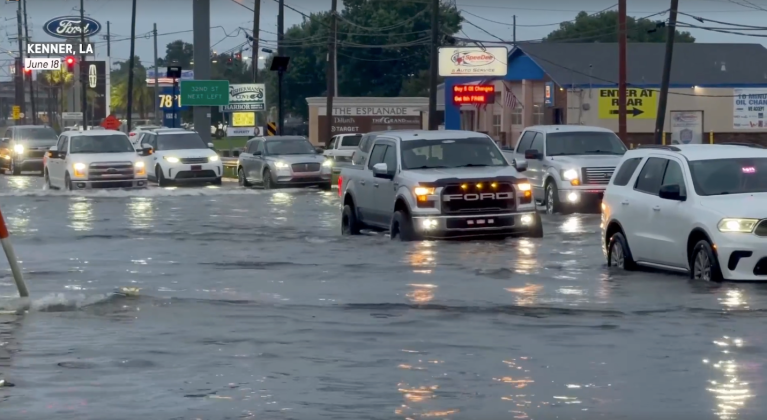
Roads and homes were submerged along the Gulf Coast amid the tropical downpours. Some areas have seen more than 30 inches of rain.
Published Jun 17, 2026 2:20 PM EDT
|
Updated Jun 19, 2026 12:01 PM EDT
AccuWeather’s Bill Wadell reports from southern Mississippi, where towns are underwater and a tornado brought down trees.
Tropical Storm Arthur made landfall along the coast of Texas Wednesday and, as the first storm of the Atlantic hurricane season, is bringing deadly flooding and severe weather to the Gulf Coast.
Arthur formed Wednesday after a sprawling area of showers and thunderstorms over Texas tracked over the warm waters of the Gulf. Hours later, the center of the storm moved inland over the Texas coast. The system was downgraded to a tropical rainstorm but continues to bring a significant flooding threat across the Southern states.
A person looks out towards a flooded neighborhood after Tropical Storm Arthur made landfall on June 17, 2026 in Freeport, Texas. Tropical Storm Arthur becomes the first named storm of the Atlantic hurricane season. (Photo by Brandon Bell/Getty Images)
AccuWeather experts estimate Arthur caused $4 billion to $6 billion in total damage and economic loss after dumping more than 20 inches of rain in some areas, triggering flooding, property and infrastructure damage, power outages, flight delays and business interruptions.
More than 30 inches of rain has fallen over five days in parts of Mississippi and Louisiana, leading to evacuations after a potential dam failure at Anchor Lake in Mississippi. Floodwaters have inundated homes, businesses and roads, prompting water rescues from Texas through the Gulf Coast.
At least two deaths have been reported in Texas and Mississippi in connection with the flooding, according to state officials.
A vehicle that became stranded on a flooded road in The Woodlands, Texas, on June 16, 2026. (@StormChaserHTX via Storyful)
Videos showed floodwaters taking drivers by surprise on roads north of Houston, where a flash flood warning was in place amid the tropical downpours.
On Wednesday morning, part of Interstate 10 near Houston was shut down due to high water, but it was cleared by the afternoon. “Never drive through flooded roadways,” Houston TranStar warned motorists.
World Cup fans braved heavy rain and areas of flooding to reach Houston Stadium Wednesday as Tropical Storm Arthur’s downpours caused travel disruptions around the city. The match itself was not directly impacted by the downpours, as the pitch is protected by the stadium’s roof.
Fans arrive before the World Cup match between Portugal and Congo DR at Houston Stadium on June 17, 2026. (Photo by Lars Baron/Getty Images)
A 15-year-old died Tuesday evening after entering a flooded retention pond in Magnolia, Texas, according to the Montgomery County Sheriff’s Office.
Deputies responded around 6 p.m. CDT to Turriff Circle after a report of a missing juvenile in a flooded retention pond. Preliminary information from the sheriff’s office indicates a group of teenagers was playing near a construction roadway and adjacent retention pond when the 15-year-old entered the water. The depth quickly exceeded the teen’s height, and he went under but did not resurface.
After an extensive search, the juvenile was located underwater using sonar technology. He was recovered and pronounced dead at the scene.
GET THE FREE ACCUWEATHER APP
•Have the app? Unlock AccuWeather Alerts™ with Premium+
Flooding in Kenner, Louisiana, on Thursday, June 18, 2026, after significant rainfall from Tropical Rainstorm Arthur.
Torrential rain has inundated roads and homes in Louisiana and Mississippi, and caused overspill at a dam in Pearl River County, Mississippi, leading to evacuations.
AccuWeather Correspondent Bill Wadell reported from Wiggins, Mississippi, on Thursday morning, where a tornado downed trees and damaged property.
Mississippi Gov. Tate Reeves said a county road crew member was killed in Franklin County while assisting with storm cleanup operations, marking at least the second reported death tied to Arthur’s flooding and severe weather across the Gulf Coast.
Drone video shows water surging over an earthen dam at Anchor Lake, near Picayune, Mississippi. If the back of the dam erodes away from the flooding, it could fail completely.
Water rescues have taken place in Harrison County, and multiple roads remain closed in George, Hancock, Harrison, Pearl River and Stone counties.
Officials are also monitoring the dam at Anchor Lake in Pearl River County. According to MDEQ, the system is functioning as designed, with water flowing through the primary and auxiliary spillways. However, officials said very little storage capacity remains, and additional rainfall could quickly overwhelm the spillways and compromise the structure.
MDEQ’s dam safety director was en route to the scene and remained in communication with local officials, Reeves said. Homes within the potential inundation area were being notified by the Pearl River County Emergency Management Administrator, and about 30 homes were being evacuated as a precaution.
Residents near the East Hobolochitto Creek basin, especially those east of Interstate 59 between East Boley Road and West Union Road, were encouraged to move to higher ground and remain alert for changing conditions.
AccuWeather meteorologists said instances of dangerous flooding continued into Friday morning, with a flash flood emergency in Seminary, north of Hattiesburg, Mississippi.
Areas facing significant flooding have had rainfall amounts over a foot, with isolated areas receiving much higher amounts. In Cottonport, Louisiana, more than 31 inches fell over five days, and 29.70 inches fell in Mansura.
Storm chaser Brandon Clement witnessed homes and businesses inundated by flash flooding from Arthur in the early morning of June 18. Vehicles were seen plowing through the high waters.
Locally severe thunderstorms may add to the risk of damaging wind gusts, and a few tornadoes or waterspouts could develop from the upper Texas coast to southern Louisiana and the panhandles of Mississippi, Alabama and Florida.
AccuWeather meteorologists urge residents and visitors in flood-prone areas to avoid flooded roads and never enter floodwaters on foot or in a vehicle. Water can be deeper and moving faster than it appears, and conditions can deteriorate quickly during tropical downpours.