
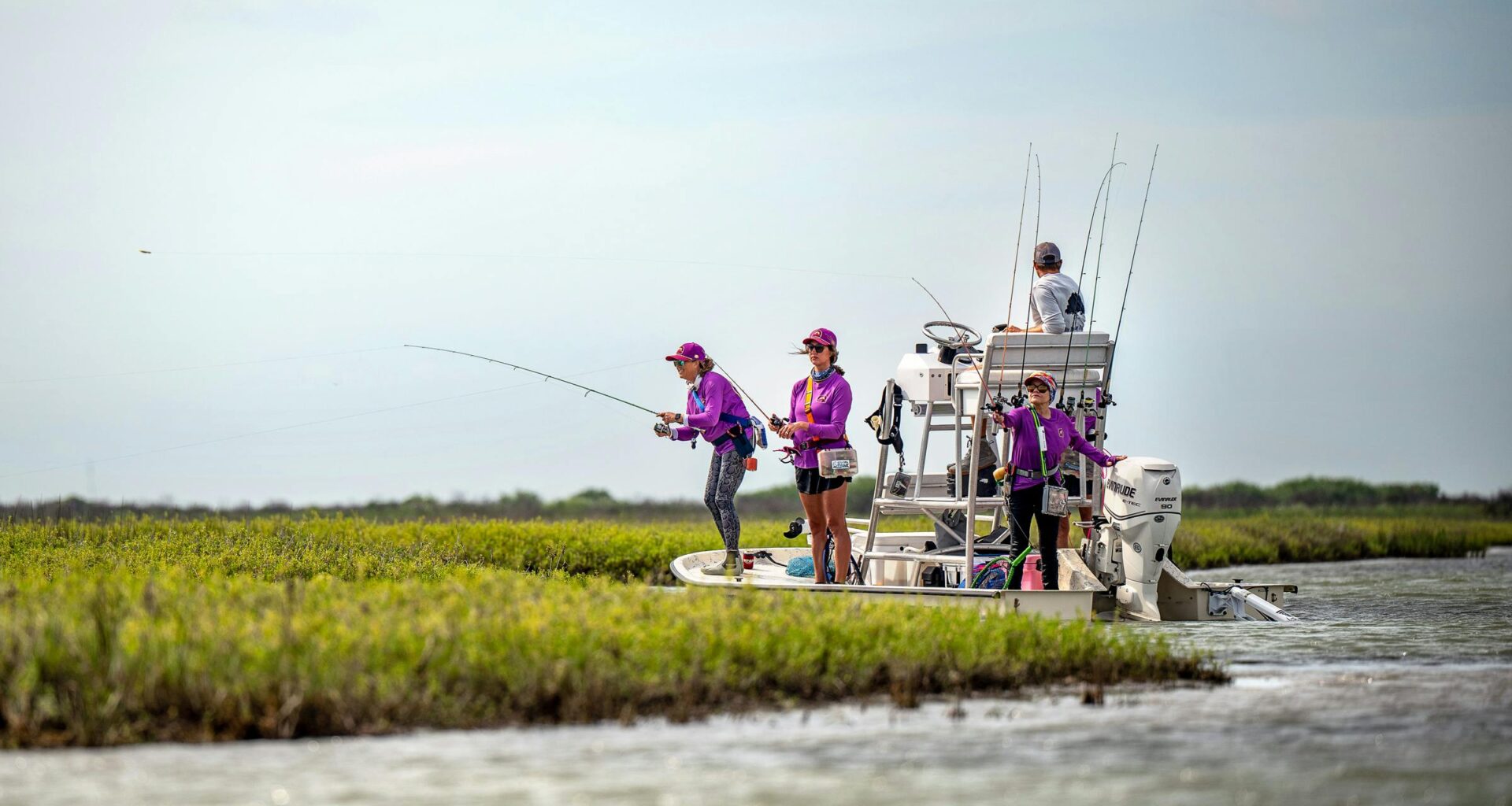
Dawn’s plum-colored skies slowly fade as a windy day of semicompetitive leisure nears its first cast. At 6 a.m. sharp, more than eight hundred fisherwomen drop baits into the Coastal Bend’s shallow waters to compete in Texas’s largest all-woman fishing tournament, Babes on the Bay.
Among 247 four-woman teams—many with bawdy names like Gills Gone Wild, Fish & Tits, and Nibble on This—I’ve been co-opted into the more decorous Fisha Ritas, captained by Houston resident Kristen Faleski. An accountant by trade, she’s participating in the tournament for the fifth year. Faleski got hooked on saltwater angling in 2014 by her former boss, John Blaha, assistant director of the Coastal Conservation Association of Texas (which runs Babes on the Bay) along with his now wife, Jen Blaha, a local realtor and the tournament director. Faleski bit even further into the hobby when Jen introduced her to a vacation home in Rockport, a town where pastel-painted homes fly shrimp and crawfish flags and mailboxes are shaped like largemouth bass.
“The best part of fishing is being on the water,” Faleski tells me at the launch event the night before, where teams are decked out in matching attire and a full bar services a thirsty crowd. Faleski’s niece and fellow Fisha Rita, Caitlyn Wagner, from New Braunfels, adds her take on the appeal of fishing. “I just get so focused,” she says, with a koozie-insulated seltzer in her grip.
Tippling is a theme of the tournament, evident from the first night, when an IV-hydration-therapy trailer is on hand to inject fluids and electrolytes directly into the bloodstream. Among vendors hawking fishing tackle and trucker hats, a lady browses a rack of performance fishing shirts while double fisting a White Claw. I’m offered my first Claw that morning at 9:30 a.m. when I meet another team, the Bahia Amigas, to scope out the landscape for some prefishing. “Well, it’s not illegal!” the retort comes when I decline.
Beyond the boozing, contestants come here for the camaraderie created by rippin’ lips with other women in the outdoors. Bryan resident and Dangler’s Anglers team member Beverly Chaney, who is wearing red-and-white bobbers for earrings, has participated for ten years. “It’s fun, and it’s for the girls only—no husbands or boyfriends,” she says after posing for a team photograph.
Since 2000, Babes on the Bay has been held the weekend after Mother’s Day in Rockport-Fulton. It serves as a membership drive for the Aransas Bay chapter of the CCA Texas, a nonprofit that has worked with Texas Parks and Wildlife to establish a mariculture program where oysters are cultivated in off-bottom cages, among other efforts. According to John Blaha, who worked at Dow Chemical Company before joining the association, these new oyster farms are “an alternative to harvesting from naturally occurring, critically important public reefs, thus removing the pressure that results in their destruction.”
At the Friday captain’s meeting next to the Fulton Convention Center, a crowd of several hundred fishers from Texas, Louisiana, Georgia, and Florida huddle under a large tent as Blaha lays out the rules of a catch-photo-release tournament. Babes instituted this change in 2021 to decrease the fish mortality rate of former kill tournaments. Now, instead of hauling a catch back to base to determine winners, contestants measure and photograph their fish on a 32-inch measuring board, then upload the photo into the Fishing Chaos app for assessment by third-party judges. At poles-up time, the top five teams from five adult categories (along with two in the Babettes division) report to the committee table, where likely winners are selected at random for a polygraph test administered by the local police department. Contestants don’t win money from Babes, although some voluntarily enter a considerable money pot overseen by the CCA. The total paid out this year was $21,000. Otherwise, each category’s first-place winner receives a Waterloo fishing rod, performance sunglasses, and a painting of artificial lures by local artist Debbie Minns.
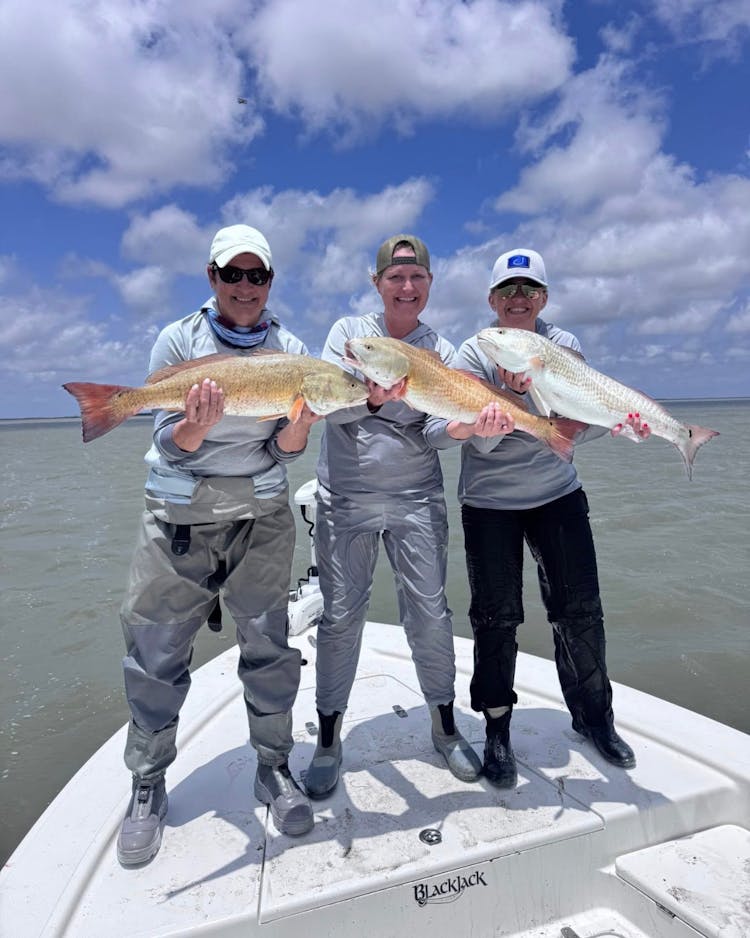 Babes on the Bay grand-champion team the Croaker Soakers, who have fished the tournament since it started. Courtesy of Babes on the Bay
 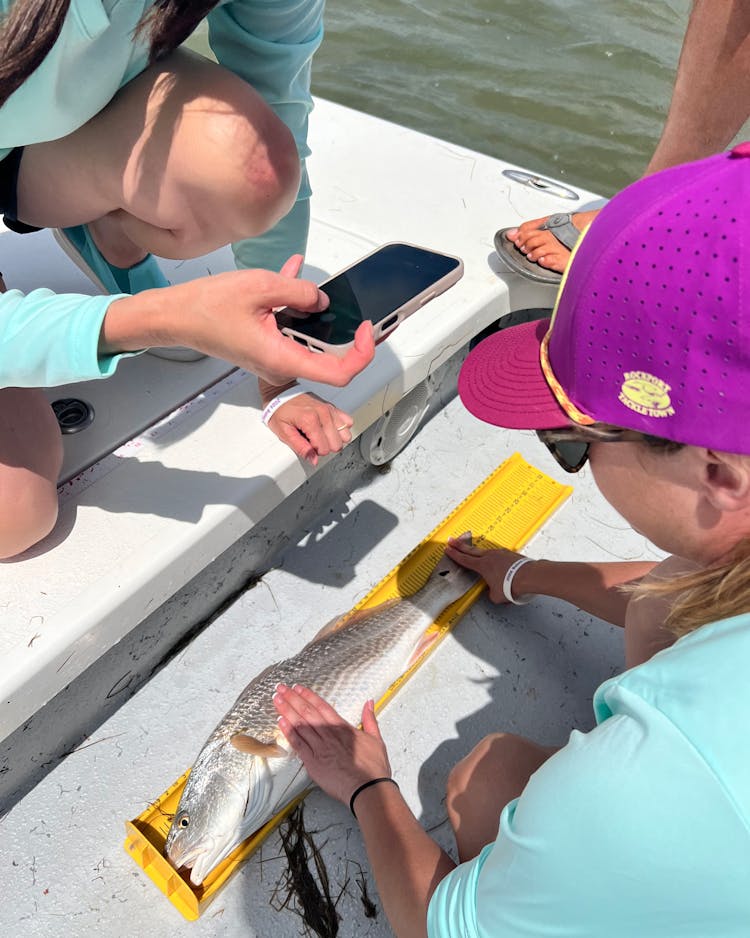 A team of ladies measuring a fish to log into the Fishing Chaos app. Courtesy of Babes on the Bay
At 5:15 a.m. on Saturday, we meet our captain, James Hinton of Redfish Reaper Guide Service, at Cove Harbor. (Many of the boat drivers are men, since they are more likely to own a boat or fishing-guide business.) Among nearly five hundred registered guides facilitating fishing tourism in the Coastal Bend, ours is a former farmer and rancher from Clarendon who moved to Rockport and bought a boat in 2020. As we near the spot Hinton scoped out the day before, he drops the trolling motor so we can more stealthily move around and begins slicing up mullet to attract our goal catch: redfish.
Thirty minutes before sunrise, our lines are cast near mangroves, where redfish typically hide out for shade during warmer months. For the next hour, we stare at the tip of our rods, unspeaking, watching for any tug that would indicate a bite. As Texas Monthly distinguished writer Skip Hollandsworth observed in a 1986 story on the Bass’n Gal Classic, one of Texas’s original all-woman fishing tournaments that ran from 1976 to 1998, fishing is “like an extended game of solitaire.” Only the wind’s eerie screeching fills the air.
The silence is broken by a team scream at 7:01 a.m. Faleski’s best friend, Amy Schultz, also a Houstonian, reels in our first redfish, a 21-incher. Within a couple hours, we’ve caught three larger specimens, which Hinton calls “gorillas.” Wagner describes the thrill of successfully reeling in a catch as equivalent to “going downhill on a roller coaster.”
Soon afterward, the crack of High Noons—“nooners,” as the group calls the hard seltzer—and various other beverages begins to mingle with the low country tunes Hinton has flicked on the boat’s radio. For the next six hours, we ease into a day on the water, telling stories of divorces, new marriages, and children as we catch a total of twelve gorgeous, gleaming redfish. All four women on our boat are immersed in the joys of fishing—some with a passion stretching back a lifetime, others introduced to it later in life by friends. We recount our big fish stories too.
When everyone’s relaxed, I ask Hinton if women make better fishers than men. He concedes that “men have a harder time following directions.” The best customers who sign up to ride with the Redfish Reaper are people who’ve never fished, because they’re better listeners, he says.
As we reel in gorilla after gorilla, Faleski carefully photographs each one and uploads it into the app, which calculates teams’ scores by the total measurement of the four longest fish. By 3 p.m., when the leader board is posted, we all hope to land in the top four teams in our Guided: Any Bait category. But we’re only in fourteenth place, and after one ostensibly big fish—a “grandaddy,” according to Hinton—steals Faleski’s bait and doesn’t bite again, we head back to the dock, passing a boat of four dancing women on the way.
At the awards ceremony, CCA assistant director Taylor Rieck struggles to keep a straight face as he announces the winners. Titty Deep Outdoors wins fourth place in the Guided: Artificial Bait category and second for that category’s longest single fish, at 27.25 inches. The tamer-named Bayberry Babes team beats them by a quarter inch. “The camaraderie . . . and the people who put this together are just amazing,” team captain Kay Miller says, tearing up as she explains why she participates every year.
Earlier in the evening, after I cooled down with a frozen margarita and crab tower at the Paradise Key Dockside Bar & Grill, I spotted a small crowd of people taking in a scene. A boat had accidentally launched itself onto a pier, probably by a driver who overgunned the gas. No matter. No one was hurt, and surely getting the boat back into the water was a small price to pay for the day’s fun.
Read Next