
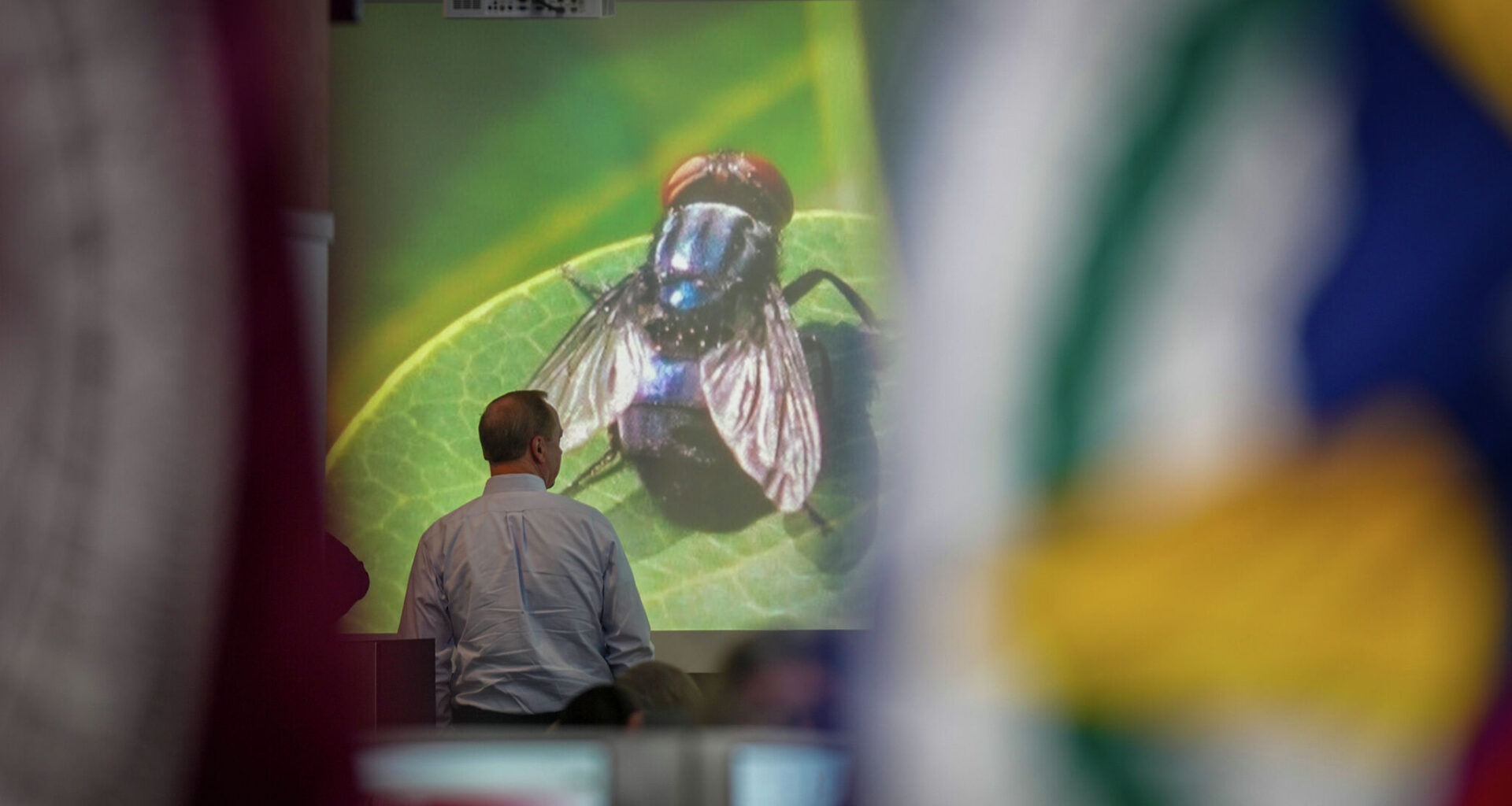
An official with Texas A&M AgriLife Extension works at the State Operations Center during Texas’ response to the New World Screwworm in Austin on Friday, June 5, 2026.
Jay Janner/Austin American-Statesman
The New World screwworm was infesting livestock and draining billions from the U.S. economy the last time Texas fought the pest that’s threatening the cattle industry once again.
Decades before the screwworm crossed the U.S.-Mexico border and jeopardized Texas ranches this month, it drove a devastating outbreak in the state between the 1930s and 1950s. The infestations cost the United States billions of dollars and wiped out hundreds of thousands of animals.
Federal officials spent millions to eradicate the flesh-eating pest and eventually deemed the effort a success by 1966. Cases continued to surge in following years during the summer months, but after the screwworm withdrew to Central America, the U.S. went more than four decades without a single case.
Article continues below this ad
That changed earlier this month, when the U.S. Department of Agriculture said it detected the screwworm in a calf in south Texas. Ten more cases have since popped up in the state.
THE RUNDOWN: Here’s what to know about the flesh-eating screwworm parasite as cases rise in Texas
Is history repeating itself? What will it take to rid the pest from Texas once again?
Here’s a quick history of the screwworm’s time in Texas, from the previous century’s outbreak to the debate surrounding its return.
Article continues below this ad
When did the screwworm last infest Texas?
Despite the screwworm’s much deeper roots in the U.S., 1933 was the first year it posed “significant problem” for the country, according to the U.S. Department of Agriculture. A shipment of infested animals carried the pest from the Southwest to the Southeast, and an ensuing outbreak lasted until 1966, when a $32 million eradication program was deemed a success, according to the agency.
What impact did it have on U.S. livestock, pets and humans?
Texas reported 3 million screwworm cases in 1935, according to the Federal Reserve Bank of Dallas. The pest claimed 180,000 cattle head in more than a third of Texas’ counties, the bank reported, citing a 1975 book called “The Peaceful Atom and the Deadly Fly.”
By the 1950s, livestock ranchers were losing around $200 million per year — equal to about $1.8 billion in 2020 dollars, according to the University of Texas at Austin’s Biodiversity Center.
Article continues below this ad
Texas was part of a region that was considered more susceptible to the pest due to larger livestock populations, more geographic area and better survival conditions through the winter, federal officials said.
How did the U.S. eradicate the pest in the 1960s?
Sterile flies that mated with female screwworms became the vehicle to rid the U.S. of the pest in the 1960s.
An entomologist named Edward Knipling invented a technology that sterilizes male flies with gamma radiation before they mate with females. Female screwworms only mate once, meaning Knipling’s invention — the Sterile Insect Technique — was set to become a population-shrinking tool.
A facility in the south Texas city of Mission was producing up to 150 million sterile flies per week by the time the screwwom was officially eradicated in 1966, according to the USDA.
Article continues below this ad
Despite those innovations, the screwworm remained in northern Mexico and would cross back into Texas every summer in the following years, increasing the U.S. caseload, according to Phillip Kaufman, the head of Texas A&M University entomology department. The last major outbreak in Texas totaled about 90,000 cases in 1972, and before this year, the final case of transmission was recorded in 1982, Kaufman said.
How did the screwworm come back?
It’s unclear why or how the screwworm escaped the Darién Gap — a remote region in southern Panama where its population had receded, Kaufman said. Little livestock lived there, and the USDA has released 30 or 40 million sterile flies over the region since 2004 as a preventative measure, he added.
“That barrier was an impenetrable jungle,” Kaufman said.
A turning point could have come when the gap was cleared for cattle grazing, according to Kaufman. He said the ensuing spread eventually escaped the USDA’s control.
Article continues below this ad
“People who had not really been dealing with screwworm for 20-plus years were still moving animals around as if screwworm wasn’t there, and likely that propagated screwworm to move into other parts of Panama,” he said.
Could the U.S. have done anything more to stop it?
Screwworm discourse has turned into something of a blame game in the arena of national politics.
U.S. Secretary of Agriculture Brooke Rollins has credited the outbreak to former President Joe Biden and his immigration policy, claiming open borders and cartels fueled the pest’s spread. President Donald Trump’s administration has also fielded blame after reportedly withholding funding for sterile fly production for several months during the Department of Government Efficiency’s cost-cutting spree.
Kaufman doubts the U.S. could have done more to keep the screwworm from reaching Texas but said officials could have maintained some of the sterile fly production plants that ultimately shut down in Edinburg, Mexico and Nicaragua. The international barrier between the U.S. and the screwworm’s movement through Central America also posed a challenge, he said.
“Secretary Rollins has tried very hard through her efforts to get cooperation from our Mexican friends to help with animal movement, and in large respects they’ve been successful,” he said. “But of course there are going to be incidents that happen.”
Do sterile flies work?
Sterile flies and their efficacy has been another source of contention in Texas’ latest screwworm saga.
Texas Agriculture Commissioner Sid Miller likened their repeated use to “insanity” in an interview with MS NOW that generated over 250,000 views on X last week. He called on the USDA to use a bait system previously developed by the agency to kill adult screwworm flies before they can reproduce.
Miller said said the bait helped destroy Texas’ screwworm population in the 1970s, but U.S. officials have stood their ground, backing the sterile fly technology. Kaufman said the sterile flies are “100% successful” and said baits could risk killing them off.
Can the U.S. drive out the screwworm again?
Rollins has insisted the U.S. will drive away the screwworm, and Kaufman echoes the optimism.
But the effort could be years in the making. Kaufman said sterile fly production facilities under development in Texas and Mexico should together release 500 million flies, but that benchmark could be 2.5 years away.
“We will win this battle,” Kaufman said. “We just need to get some more tools in the toolbox, and getting those flies is the best thing we can do right now.”