
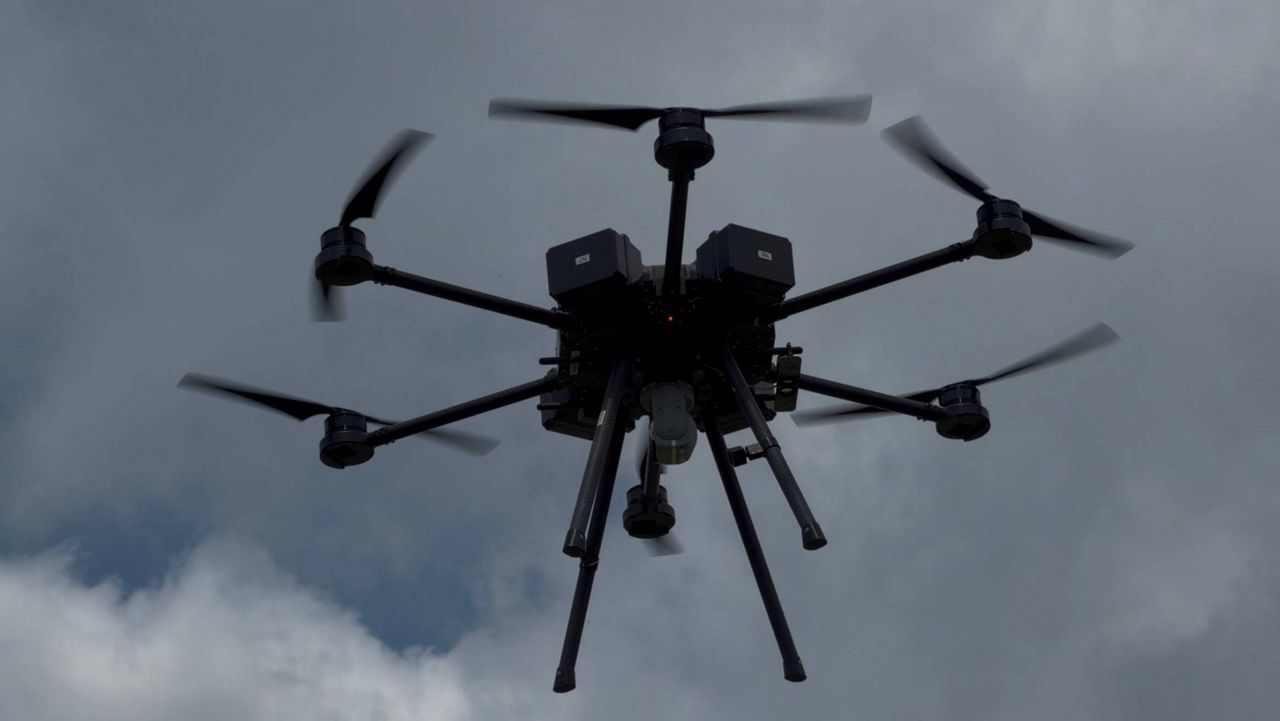
TEXAS — In the latest push to eradicate the New World screwworm, the U.S. Department of Agriculture (USDA), with help from U.S. Customs and Border Protection (CBP) and Texas Parks and Wildlife, is using surveillance technology.
“We’re looking at new capabilities with existing equipment,” said Rear Adm. Michael Schmoyer, the USDA associate administrator and New World screwworm directorate. “We’re looking at new possibilities and innovations that can also be applied to existing approaches.”
At a recent surveillance demonstration on a South Texas ranch in Nueces County, government officials and field expert advisers laid out alternative approaches to confront the parasitic fly.
“At the federal level, USDA Agriculture Secretary Rollins and the White House in August made the decision to establish a single unit focal point within the federal government,” said Schmoyer.
That focal point is dubbed the New World Screwworm Directorate (NWSD).
Here’s how the NWSD lays out the surveillance plan to combat the screwworm. From the air, helicopters and drones will scout and locate wild animals and livestock surveillance in the south and southwestern portions of Texas, where the screwworm is flying north over the U.S.-Mexico border. Spotters from above and on the ground will rely on technology like cameras, infrared, night vision, heat sensors, dogs and AI to take a closer look at animals potentially infected with the flesh-eating fly.
If animals appear to have open wounds on their hide, technology assets can take a closer look to identify if an animal is suffering an attack from the parasitic fly. This effort relies heavily on different government agencies to detect and monitor paths of travel for the fly.
A collection of federal and state agencies will share and pull gathered information as a single entity.
“We have a government body called the One Health Coordination Unit which essentially takes all of the federal government which has assets to bare and have been working on this problem,” Schmoyer said.
The problem of the screwworm has spread to at least 15 documented infections, according to officials.
Confirmed detections in a few Texas counties are under study. Zavala, La Salle and Gillespie counties have infected cases of cattle, a goat and a domesticated dog. New Mexico has also reported positive confirmation of the screwworm.
Right now, the federal government is in a rush to construct a new Domestic Sterile Screwworm Production Facility in Edinburg — the only one in the nation.
When complete, the $750 million investment will be busy sterilizing New World screwworm flies to prevent their reproduction.
John Bellinger, the federal government’s lead adviser for New World screwworm readiness, says the Edinburg plant and another facility in Mexico couldn’t come online soon enough.
The U.S. and Mexico are relying on a Panamanian plant to distribute sterilized flies. That Panama plant is busy trying to sterilize 100 million flies.
After the demonstration on the ranch, Bellinger said the U.S. needs four times as many to eradicate the parasite.
“My job is to plan on the worst. We really need 400 million flies in 2027. We need to increase Panama. We need to have the Mexican flies. We need to get Edinburg open. All of those entities will help us have more sterile flies so we can cover the whole country,” Bellinger said.
The Edinburg plant is expected to open early next year. The Mexican facility could open in approximately 30 days. To date, beyond the 15 cases of screwworm in Texas and New Mexico, Mexico has seen 28,000 cases since November 2024.