
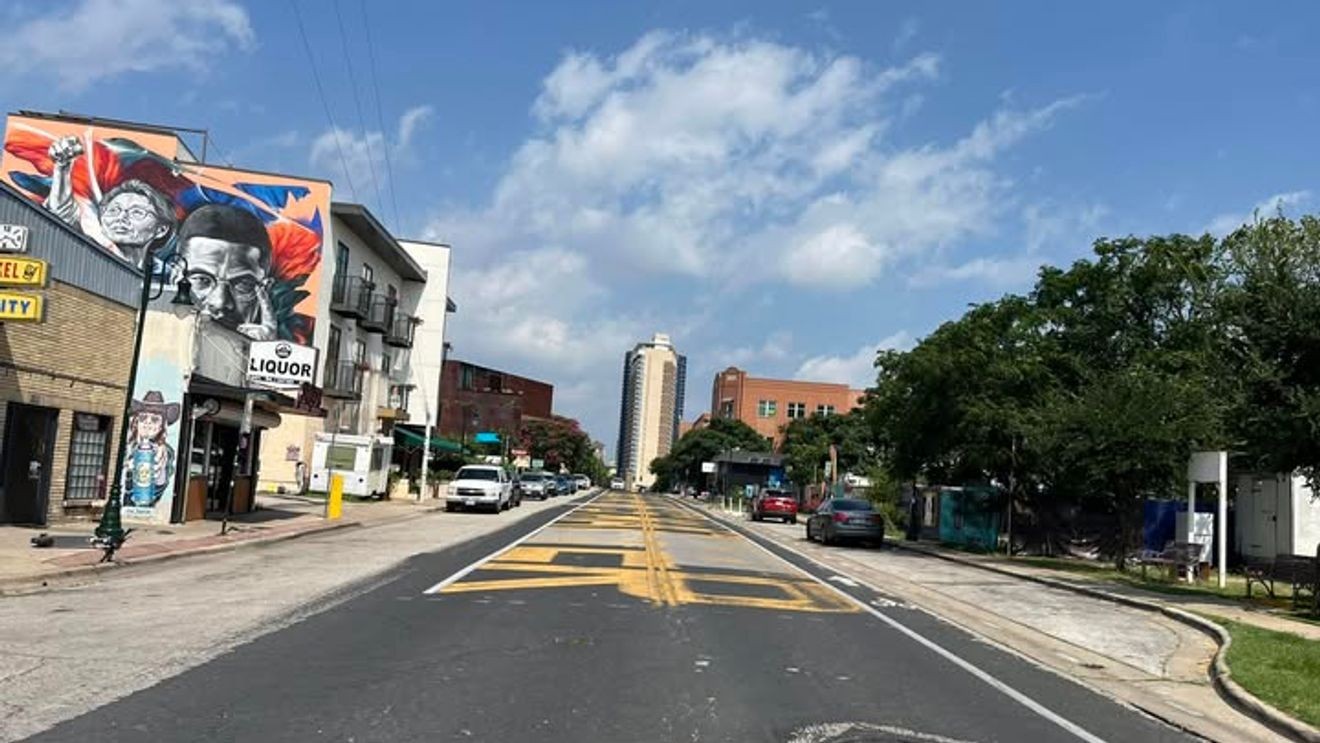
AUSTIN, Texas — The city of Austin’s Transportation and Public Works Department submitted a plan to the Texas Department of Transportation detailing how the city will go about removing the Black Artists Matter street mural downtown, with state funding on the line if the city did not comply.
A spokesperson from the department says the details of the plan would not be made public Monday.
The mural is on East 11th Street near Lydia and Waller streets. Some community members and local leaders criticized the state’s directive and questioned the cost and purpose of removing the artwork.
Chas Moore of the Austin Justice Coalition said the mural reflects how much the city has changed since it was created. “The quantum leap in where we were in 2020 till today. It should be studied,” Moore said. He also called the removal effort “just a waste of money,” adding, “If the state is so adamant about not having political messages on the street, like this is something that just went away with time at some point.”
On May 18, the Texas Department of Transportation denied the city’s request to make an exception for the Black Artists Matter mural, saying the markings “are not acceptable” and that the treatments do not align with the SAFE ROADS Initiative.
After careful review, the current markings are not acceptable and do not fully comply with the Texas Manual on Uniform Traffic Control Devices (TMUTCD) and related federal guidance. Specifically, Sections 3H.01 and 3H.03 of the 2025 TMUTCD address aesthetic surface treatments within crosswalks, permitting only certain materials (e.g., bricks, paving stones), patterns (e.g., mesh, grid), and colors (e.g., brick red, rust) as acceptable treatments. Painted colors outside these specifications—including rainbow or other non-standard hues—are not compliant with MUTCD intent.Additionally, these treatments do not align with the SAFE ROADS Initiative and the Governor’s directive issued October 8, 2025, both of which emphasize uniformity and predictability in traffic control devices to enhance safety statewide.
Andy Hogue of the Travis County GOP said, “There should be at least some motion going forward to neutralize our public spaces and make it accessible and acceptable, in a way, to all taxpayers.”
Hogue also agrees that the city should face a penalty if it does not meet the deadline. “Legally it’s fair because cities are incorporated by the state of Texas, so as long as Austin is a corporation with the state of Texas, then Texas has all, every right to do so,” he said. “It also has the right to oversee cities and make sure that we’re not using, you know, the public trust for propaganda purposes, which this essentially amounts to.”
Nook Turner with the Black Austin Coalition calls the eventual removal of the mural a “slap in the face.”
The mural was commissioned for $55,000 in 2020. Asked whether removal could cost more than that, Moore said, “Oh, I have no idea. I’m not even going to give you an answer like I know.”
Questions about the removal cost remained unresolved. TxDOT directed questions about the cost to the city. The city then directed questions to the Austin Transportation and Public Works Department. A spokesperson there said a the plan had been submitted to TxDOT and that the city met the deadline requirements.
The City has complied with the deadline set by TxDOT, and an action plan has been submitted.
State Rep. Sheryl Cole, D-Austin, said the city must follow the state’s directive but argued the order is unjust. “We received this directive from the state, so we have to comply with it, but it is not fair to be erasing the history of the area or making an attempt to erase the history of the area,” Cole said.
Last Friday, Austin Mayor Kirk Watson, during a Juneteenth celebration, said he had put together a Public Spaces Task Force to deal with trying to figure out how to celebrate the city’s diversity.
That task force announced it would explore alternatives to honor East Austin’s history, but Turner says words aren’t good enough. “We’re beyond the point of making attempts. We’re at the point now, we need to see action.”
The city’s plan was also required to include details on removing the rainbow crosswalk at Fourth Street and Colorado Street, as well as other murals across Austin.
Austin District 9 City Councilmember Zo Qadri’s office shared a statement on behalf of the city councilmember detailing his reaction to Monday’s deadline. In it he said in part that he does not believe the city should be “forced to choose between honoring communities that have historically been marginalized and receiving transportation funding from the State.”
Austin should not be forced to choose between honoring communities that have historically been marginalized and receiving transportation funding from the State. The Rainbow Crosswalk and Black Artists Matter mural are more than paint on pavement. They are public expressions of who we are as a city and our commitment to inclusion, equity, and belonging.It is deeply disappointing that the State continues to target local decisions that reflect Austin’s values. Local communities should have the freedom to determine how their public spaces look and what stories they tell.The fact that Austin is being asked to remove a Rainbow Crosswalk and a Black Artists Matter mural in order to access transportation funding should concern anyone who believes in local control. These installations reflect the values of our community, and the State should not be using its financial leverage to override decisions made by local residents and their elected representatives.Austin’s values are not bargaining chips. We can invest in transportation infrastructure and celebrate the diversity of our city at the same time. The State has created a false choice, and I will continue advocating for Austin’s right to make decisions about our own public spaces without political interference from the Capitol.
Moore said he would trust elected officials but opposed complying with the state order even if it results in lost funding. “I don’t know how that money would affect anything of importance. But I think sometimes at some point, as a city that says we’re all these things, we’re going to have to stand up to that,” he said.
Other cities, including Houston, Dallas and San Antonio, have already removed or covered up similar murals.