
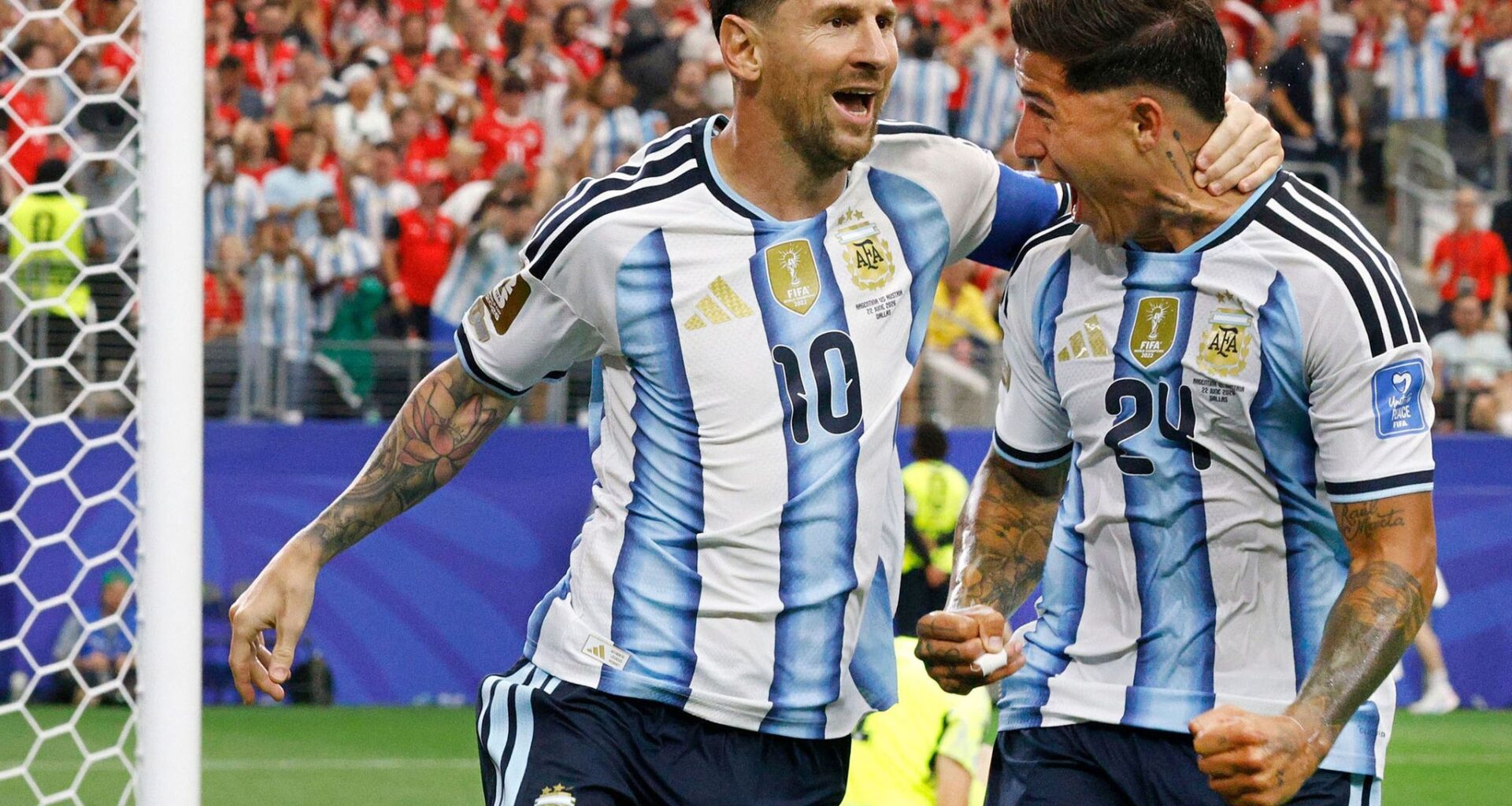
Argentina Lionel Messi (10) celebrates with Enzo Fernández (24) after scoring their first goal of the game during the World Cup Group J soccer match between Argentina and Austria in Arlington, Texas, near Dallas, Monday, June 22, 2026. (Chitose Suzuki/The Dallas Morning News via AP)
Chitose Suzuki/Associated Press
Argentina forward Lionel Messi (10) attempts a shot on goal during the second half of Monday’s FIFA World Cup match featuring Argentina and Austria in Arlington, June 22, 2026.
Angela Piazza/The Dallas Morning News
Austrai players look dejected as Argentina forward Lionel Messi (10) celebrates following his goal during the first half of a FIFA World Cup Group J soccer match on Monday, June 22, 2026 , at Dallas Stadium in Arlington.
Shafkat Anowar/The Dallas Morning News
Argentina’s Lionel Messi falls during the World Cup Group J soccer match against Austria in Arlington, Texas, near Dallas, Monday, June 22, 2026.
Tony Gutierrez/AP Photo/Tony Gutierrez
Argentina’s Lionel Messi leaves the field after the World Cup Group J soccer match between Argentina and Austria in Arlington, Texas, near Dallas, Monday, June 22, 2026.
Tony Gutierrez/AP Photo/Tony Gutierrez
Argentina’s Lionel Messi, center, scores his side’s second goal during the World Cup Group J soccer match between Argentina and Austria in Arlington, Texas, near Dallas, Monday, June 22, 2026.
Julio Cortez/AP Photo/Julio Cortez
Argentina forward Lionel Messi (10) celebrates his second goal as Austria midfielder Carney Chukwuemeka (17) looks down in the second half of a World Cup Group J soccer match on Monday, June 22, 2026, in Arlington.
Chitose Suzuki/The Dallas Morning News
Argentina’s Lionel Messi (10) celebrates scoring his side’s first goal against Austria with teammates during the World Cup Group J soccer match in Arlington, Texas, near Dallas, Monday, June 22, 2026.
Tony Gutierrez/AP Photo/Tony Gutierrez
Argentina’s Lionel Messi reacts after failing to score a penalty shot during the World Cup Group J soccer match between Argentina and Austria in Arlington, Texas, near Dallas, Monday, June 22, 2026.
Sam Hodde/AP Photo/Sam Hodde
ARLINGTON — For a moment, the imposing AT&T Stadium — packed with Argentine fans — fell silent.
Lionel Messi came back down to earth for an instant: he missed a penalty kick and walked away with his head hanging low. It was impossible not to wonder about his state of mind after a difficult week in his personal life.
Yet he summoned his magic, bounced back, and continued building his legendary status. He is now the top scorer in FIFA World Cup history. And on Wednesday, he turns 39 years old.
Article continues below this ad
It took him — and the entire Argentine squad — just a few minutes to find their rhythm, but he stepped up in the 38th minute to open the scoring. He then capped off the performance in the dying moments — five minutes into stoppage time — securing a 2–0 victory over Austria.
WORLD CUP IN HOUSTON: A guide to the events and the games
The win allowed him to continue shattering World Cup records and ensured his team’s qualification for the Round of 32. Argentina now awaits the outcome of Monday’s late match between Algeria and Jordan in San Francisco to see whether it can also clinch first place in Group J with a game to spare.
With his two goals in Arlington — delivered before 70,649 spectators who rose to give him a thunderous ovation as he left the pitch — he reached a career total of 18 World Cup goals, five of which have come in just two matches during this tournament. In doing so, he surpassed former German striker Miroslav Klose, who had held the record with 16 goals prior to this tournament.
Article continues below this ad
Messi also equaled legendary French striker Just Fontaine and Brazil’s Jairzinho as the only players to score in six consecutive World Cup matches — a streak dating back to Argentina’s victory over Australia in the Round of 16 at Qatar 2022, en route to their third world title.
“I feel very happy, above all about the win. We knew it was going to be a very intense and tough match,” Messi said in the postmatch press conference, sidestepping a question focused on his individual achievements. “It was important to get to six points so we could have a calmer week. We are very happy.”
For the first goal, Messi finished with his left foot, sending the ball beyond goalkeeper Alexander Schlager, who had previously declared himself a fan of Portugal’s Cristiano Ronaldo and had celebrated in Messi’s face after the Argentine missed a penalty kick earlier in the match.
The Argentine captain — playing in his sixth World Cup, yet another record — received a low cross from left-back Facundo Medina. The play had been initiated by Messi himself; midfielder Thiago Almada, who had set up Medina, let the ball run through for the captain’s arrival.
In doing so, Messi bounced back from that missed penalty in the ninth minute. The earlier miss came after striker Lautaro Martínez was brought down by Stefan Posch and Xaver Schlager while heading toward goal. Egyptian referee Amin Mohamed Omar awarded the penalty following a VAR review.
Article continues below this ad
That moment showed that, for all his greatness, Messi is still mortal.
The penalty spot does not seem to agree with him in Texas. He also missed a spot kick during the shootout in Argentina’s victory over Ecuador in Houston, a match on the team’s path to winning back-to-back Copa América titles in the summer of 2024.
Late in the match, five minutes into stoppage time, the Argentine star capped off the scoring with a left-footed finish from inside the six-yard box after his initial attempt had been saved.
He had launched the counterattack with a brilliant cross-field pass to striker Julián Álvarez, whose shot was stopped by Schlager. The ball fell to midfielder Leandro Paredes, who laid it off to Messi. The captain’s first shot was blocked, but, showing quick reflexes, he pounced on the rebound and scored with his magical left foot while lying on the ground inside the six-yard box.
With this latest victory, Argentina — having beaten Algeria 3–0 in its opener behind a Messi hat trick — continued its successful title defense campaign, building on the championship won in Qatar four years ago.
Article continues below this ad
Argentina will wrap up its group-stage run on Saturday night, again in Arlington, against Jordan. That same day and at the same time, Austria will face Algeria in Kansas City.
The only downside to Argentina’s victory was the injury sustained by center-back Cristian Romero, who had to be replaced by Nicolás Otamendi midway through the second half due to discomfort in his right knee — the same knee he had injured while playing for Tottenham Hotspur in England, an issue that prevented him from finishing the Premier League season with his club.
“Obviously, securing these two wins was part of the plan. We knew it wouldn’t be easy, especially given how things are playing out, with very evenly matched, high-intensity games where we can’t maintain the long spells of possession we’re used to,” Messi explained. “It’s not that they really hurt us, but it was a very scrappy, intense match.”
This latest glorious outing for Messi came at a significant moment and on a special date.
The moment was shaped by his state of mind following the midweek revelation regarding his father’s health struggles back in Argentina, as well as false media reports claiming that his father had passed away. His celebration after the opening goal — much like in Kansas City — was charged with emotion and relief, perhaps even more so this time given the earlier missed penalty.
Article continues below this ad
The date is directly linked to Argentina’s second World Cup title, led by the icon who preceded Messi and the current generation in the pantheon of Argentine footballers: Diego Armando Maradona.
It was also on June 22, 1986, that Argentina defeated England 2–1 in the World Cup quarterfinals in Mexico. In that match, Maradona cemented his status as both hero and villain. He scored a goal with his hand — a move unnoticed by the referee and his assistants — and later capped a magnificent performance with what is arguably the greatest goal in World Cup history, embarking on a run from his own half, weaving past opponents before beating English goalkeeper Peter Shilton.