
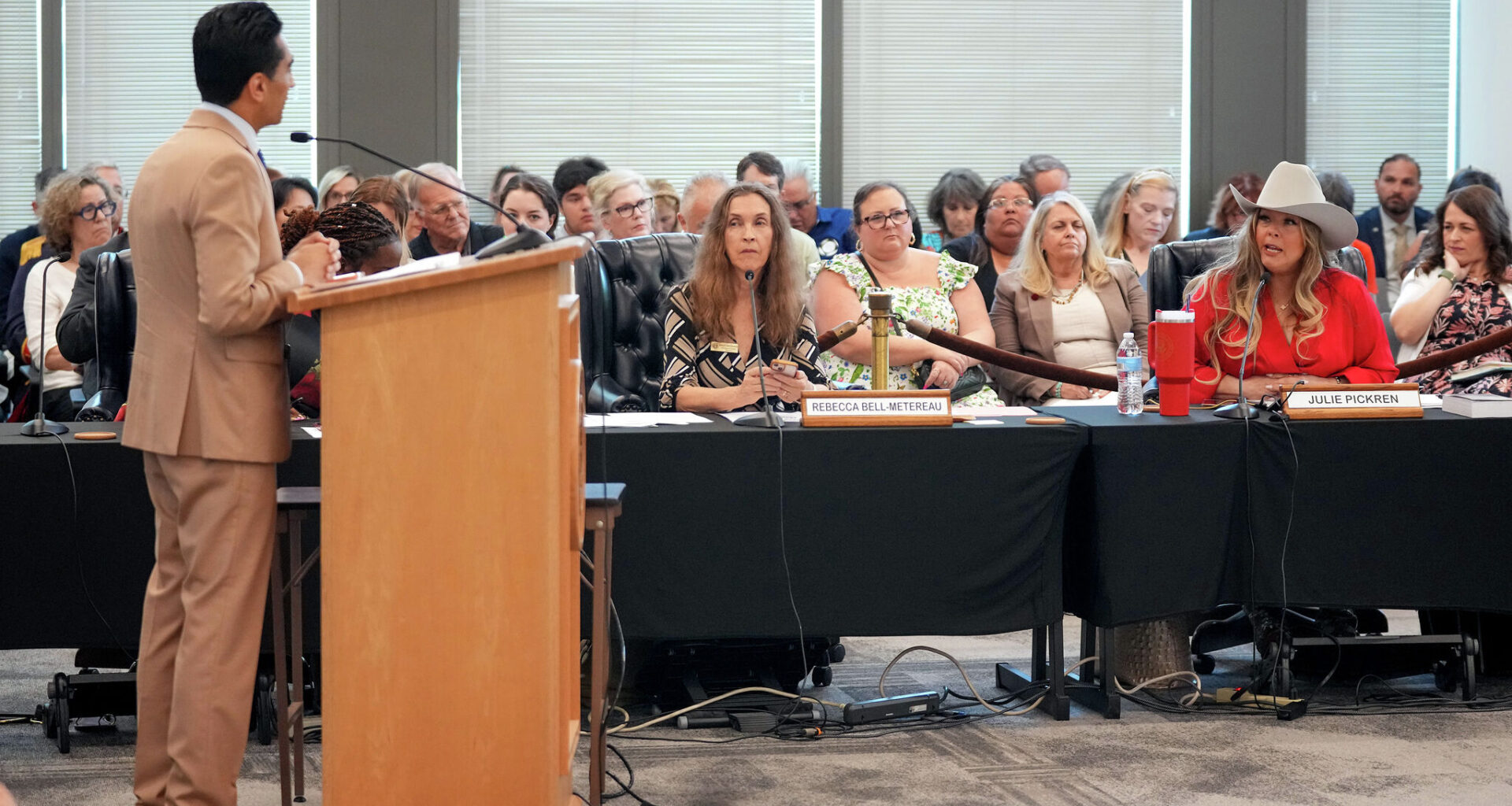
State Board of Education member Julie Pickren speaks during a meeting on proposed social studies standards at the Barbara Jordan Building in Austin on Monday, June 22, 2026. The board is considering revisions that would place greater emphasis on Christian history and biblical content in public school classrooms.
Jay Janner/Austin American-Statesman
The State Board of Education heard public comment Monday on a proposed reading list with Bible materials as it moved toward a final vote.

The list includes 13 biblical readings, with at least one Bible passage or story in every grade except kindergarten. The debate over the reading list continues a yearslong battle over what role religion should have in the classroom.
State Board of Education member Julie Pickren (right) questions state Rep. Salman Bhojani, D-Euless, during a meeting at the Barbara Jordan Building in Austin on Monday, June 22, 2026. The board is considering revisions that would place greater emphasis on Christian history and biblical content in public school classrooms.
Jay Janner/Austin American-Statesman
Robert Mearns of Granbury, dressed as an American Revolutionary War soldier, listens during a meeting on proposed social studies standards at the Barbara Jordan Building in Austin on Monday, June 22, 2026.
Jay Janner/Austin American-Statesman
Public testimony drew people to Austin, where the board met, from across the state. This week, the board is also consider changing social studies standards to emphasize American and Texas history over world cultures and geography.
Article continues below this ad
Advocates for the list emphasized the historical value of biblical texts, especially to American history. They argued that Texas’ reading list should honor the United States’ “Judeo-Christian” roots.
Related: Texas board hears heated testimony on social studies standards as final vote nears
“America and Texas have been a Christian nation and a Christian state forever,” Republican board member Brandon Hall said at the meeting. “The proportion of the impact [Christians have] had is why they are included. There are other faiths that are represented, but they’ve had a minimal impact, especially in our founding and our culture and laws leading up to this point.”
State Board of Education members LJ Francis and Audrey Young speak to each other during a meeting on proposed social studies standards at the Barbara Jordan Building in Austin on Monday, June 22, 2026. The board is considering revisions that would place greater emphasis on Christian history and biblical content in public school classrooms.
Jay Janner/Austin American-Statesman
Teaching about religion vs. teaching religion
The list draws from the Books of Luke, Genesis, Matthew and more, but it does not include any central texts from other religions, prompting concern that the state is violating the separation of church and state. The reading list would be required for Texas public school students starting with the 2030-31 school year.
Article continues below this ad
“It’s vital that this board make a distinction between teaching about religion and teaching religion,” said Joshua Fixler, a rabbi from Houston.
Related: Are you smarter than a first grader? See if you could pass Texas’ controversial
In response to the idea that the list promotes Christianity, supporters of the list said the biblical references give students a “more complete” education, arguing that including the Bible does not equate to indoctrination.
“If our goal is to educate, we should not exclude one of the most significant influences on our nation’s development,” Stephen Lara, a Turning Point USA leader in Lubbock, said at Monday’s meeting in Austin.
The final list is significantly pared down from the version proposed in January, with over 300 texts cut in the interim, including seven Bible lessons and texts from Mary Shelley and Booker T. Washington. State Rep. Salman Bhojani, D-Euless, said at the meeting that the list does not include enough Hispanic and Black authors, and is therefore not representative of the state’s population.
Article continues below this ad
State Rep. Salman Bhojani, D-Euless, testifies during a meeting on proposed social studies standards at the Barbara Jordan Building in Austin on Monday, June 22, 2026. The board is considering revisions that would place greater emphasis on Christian history and biblical content in public school classrooms.
Jay Janner/Austin American-Statesman
“A reading list that does not reflect the full breadth of who we are as Texans is not a Texas reading list,” Bhojani said. “It is a selective one.”
Republican board member L.J. Francis said the issue of author diversity is an “adult problem” rather than a “children’s problem,” and diversity in literature goes beyond an author’s identity.
Texas is creating its reading list in compliance with a 2023 state law, which only requires one mandatory text per grade level. However, the proposed list requires as many as two dozen texts for some grade levels, including novels, short stories, poems and excerpts. Some educators and community members said the sheer volume of texts would take up too much instructional time, causing teachers to neglect other educational priorities.
Thomas Ray Garcia, an English professor at South Texas College, pointed out that several texts such as Aesop’s Fables and Davy Crockett are repeated in different grade levels, leading to redundancy, and argued those repetitions should be removed.
Article continues below this ad
“Every entry you remove from these lists is instructional time given back to a teacher who knows their students best,” Garcia said.
Exclusive use of the King James translation faulted
Some witnesses also objected to the list’s almost exclusive use of the King James translation of the Bible, including for Old Testament excerpts. Jewish and Catholic speakers said that the reading list discriminates even among Christians by centering Protestant Christianity.
Those in favor of the King James translation, including Hall, said it has stood the test of time and is more “poetic” than other, more modern translations. According to Texas education code, students taking elective courses on the Bible may not be confined to one specific translation of the Hebrew Scriptures or New Testament, but it is unclear if that statute applies to the required reading list.
The reading list is just one in a series of measures that would increase the role of religion in Texas public schools.
Article continues below this ad
In March, school districts decided whether to institute a daily period for praying or reading religious texts. However, most North Texas districts did not implement a prayer period, citing logistical concerns.
Additionally, a federal appeals court in April upheld a Texas law mandating the display of the Ten Commandments in classrooms. Following the ruling, Texas Attorney General Ken Paxton began investigating several districts, including Dallas, Fort Worth and Plano ISDs.
The DMN Education Lab deepens the coverage and conversation about urgent education issues critical to the future of North Texas.
The DMN Education Lab is a community-funded journalism initiative, with support from Bobby and Lottye Lyle, Communities Foundation of Texas, The Dallas Foundation, Dallas Regional Chamber, Deedie Rose, Garrett and Cecilia Boone, Judy and Jim Gibbs, The Meadows Foundation, The Murrell Foundation, Ron Steinhart, Solutions Journalism Network, Southern Methodist University, Sydney Smith Hicks, and the University of Texas at Dallas. The Dallas Morning News retains full editorial control of the Education Lab’s journalism.