
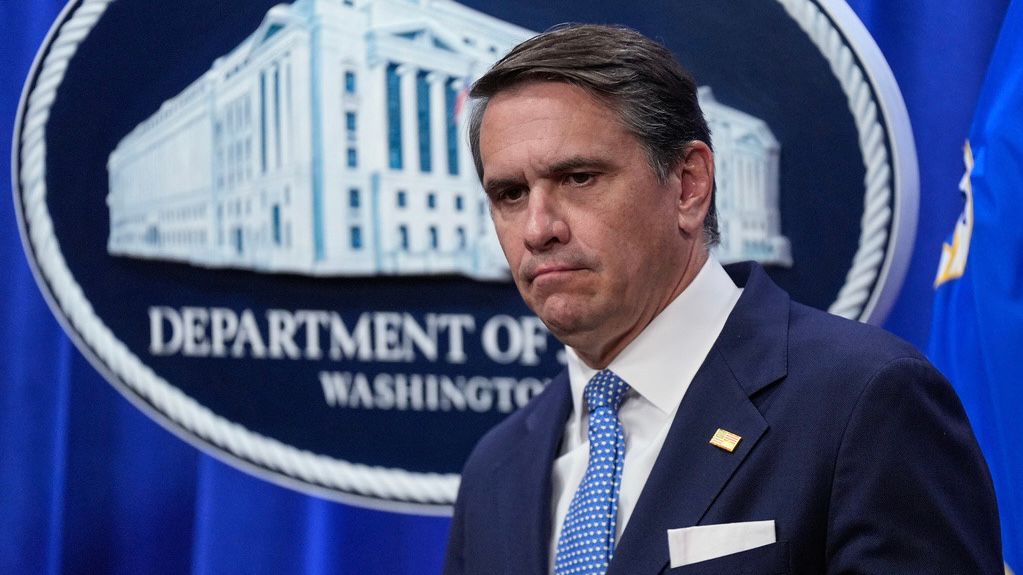
WASHINGTON — Acting Attorney General Todd Blanche announced Tuesday that 455 defendants have been charged with healthcare fraud over the past two weeks as part of a multiagency, nationwide crackdown.
Located in 45 states and U.S. territories, the defendants participated in fraud schemes involving $6.5 billion in false claims submitted to Medicare, Medicaid and other healthcare programs, Blanche said.
What You Need To Know
Acting Attorney General Todd Blanche announced on Tuesday that 455 defendants have been charged with healthcare fraud over the past two weeks as part of a multi-agency, nationwide crackdown
Located in 45 U.S. states and territories, the defendants participated in fraud schemes involving $6.5 billion in false claims submitted to Medicare, Medicaid and other healthcare programs, Blanche said
During his second term, President Donald Trump has made healthcare fraud a top priority. An executive order the president signed in March “Establishing the Task Force to Eliminate Fraud” said rooting out fraud helps to protect taxpayer dollars from government waste and lowers healthcare costs
Blanche said the indictments took place in both red and blue states
“This is just the beginning. Fraudsters can no longer rip off American taxpayers,” Blanche said at a Justice Department event where he was joined by Health Secretary Robert F. Kennedy Jr., Centers for Medicare & Medicaid Services Administrator Dr. Mehmet Oz, FBI Director Kash Patel and U.S. Drug Enforcement Administration head Terrance Cole.
“This is just the beginning,” Blanche said. “Fraudsters can no longer rip of American taxpayers. If you seek to harm or cheat Americans, we will find you, seize any assets and prosecute you to the fullest extent of the law.”
During his second term, President Donald Trump has made healthcare fraud a top priority. An executive order the president signed in March titled “Establishing the Task Force to Eliminate Fraud” said rooting out fraud helps to protect taxpayer dollars from government waste and lower healthcare costs.
The order directed the leaders of several federal agencies to prevent improper payments from federal benefits programs, evaluate indicators of fraud, promote data sharing and disrupt fraud networks.
Tuesday’s announcement of the DOJ’s annual healthcare fraud takedown results and fraud enforcement actions showed the fruits of those efforts. It was the second largest amount ever charged in a single healthcare fraud operation and the largest Medicaid fraud enforcement action in the Health Department’s history, Kennedy said Tuesday.
“The allegations in these cases are particularly disturbing,” he said. “Some defendants allegedly ordered medically unnecessary tests. Others prescribed products that patients did not need. Some allegedly fueled opioid addiction to increase their own revenue. In certain cases, patients allegedly died, all believing they were receiving legitimate medical care from providers who only viewed them as billing opportunities.”
Kennedy highlighted an indictment of a Los Angeles area hospice owner in a $27.7 million Medicare fraud scheme. The indictment alleges the owner paid illegal kickbacks to obtain the personal information of deceased Medicare beneficiaries.
“This particular owner was actually going out and purchasing names from coroners of dead patients and then billing us for those,” he said.
While Kennedy highlighted a case in a Democratic city and state, Blanche said the indictments took place in both red and blue states with the help of 56 U.S. attorneys’ offices.
Patel said four of the indictments over the last two weeks also took place through foreign custody transfers. One was an individual in Turkey who was arrested after allegedly perpetrating a multibillion-dollar fraud, and another was an American citizen apprehended in the Philippines for what authorities said was $1.2 billion in Medicaid fraud involving telemedicine.
“This should be a clear message to the world that the FBI, along with our interagency partners, are not tolerating fraud anymore,” Patel said. “We will chase them down, just like we chase down terrorists, narco traffickers, gang bangers and those that want to do harm to our communities, because this type of harm is equally as harmful to our most vulnerable.”
During Tuesday’s event, Oz reiterated a claim he makes frequently: $100 billion annually is fraudulently stolen from Medicare and Medicaid.
“If we were able to just take that out of what’s being stolen from Medicare, it would double the life expectancy of the Medicare Trust Fund,” he said. “It massively changes what people pay when we tolerate this kind of fraud.”
Earlier this month, the Trustees for Social Security and Medicare released their annual report, which found Medicare will face insolvency in 2033, leading to an 11% cut in payments and undermining patients’ access to care. About 70 million Americans rely on Medicare for their healthcare, according to CMS.
Oz said Tuesday that CMS had created a fraud-fighting team to close loopholes that fraudsters have been exploiting for years. The use of new fraud detection tools, he said, has resulted in 1,000 Medicare payment suspensions in the first half of 2026 — a 500% increase compared with last year.
HHS announced agreements with the Federal Trade Commission and Customs and Border Protection on Tuesday “to eliminate data silos and enrich our algorithms,” Kennedy said.
To combat healthcare fraud, officials from the Justice and Health departments said they are leveraging artificial intelligence and using data analytics and financial intelligence to follow money flows and seize assets.
Among the assets the DOJ seized as part of its recent indictments: a $135,000 Maserati, a $865,000 Bulgari necklace and $182 million in cash and other assets.
“We’re taking back the money, the luxury cars, the jewelry,” Blanche said. “These alleged fraudsters will face justice.”
The DOJ estimates its healthcare fraud task force is saving $106 for every dollar it is spending.