
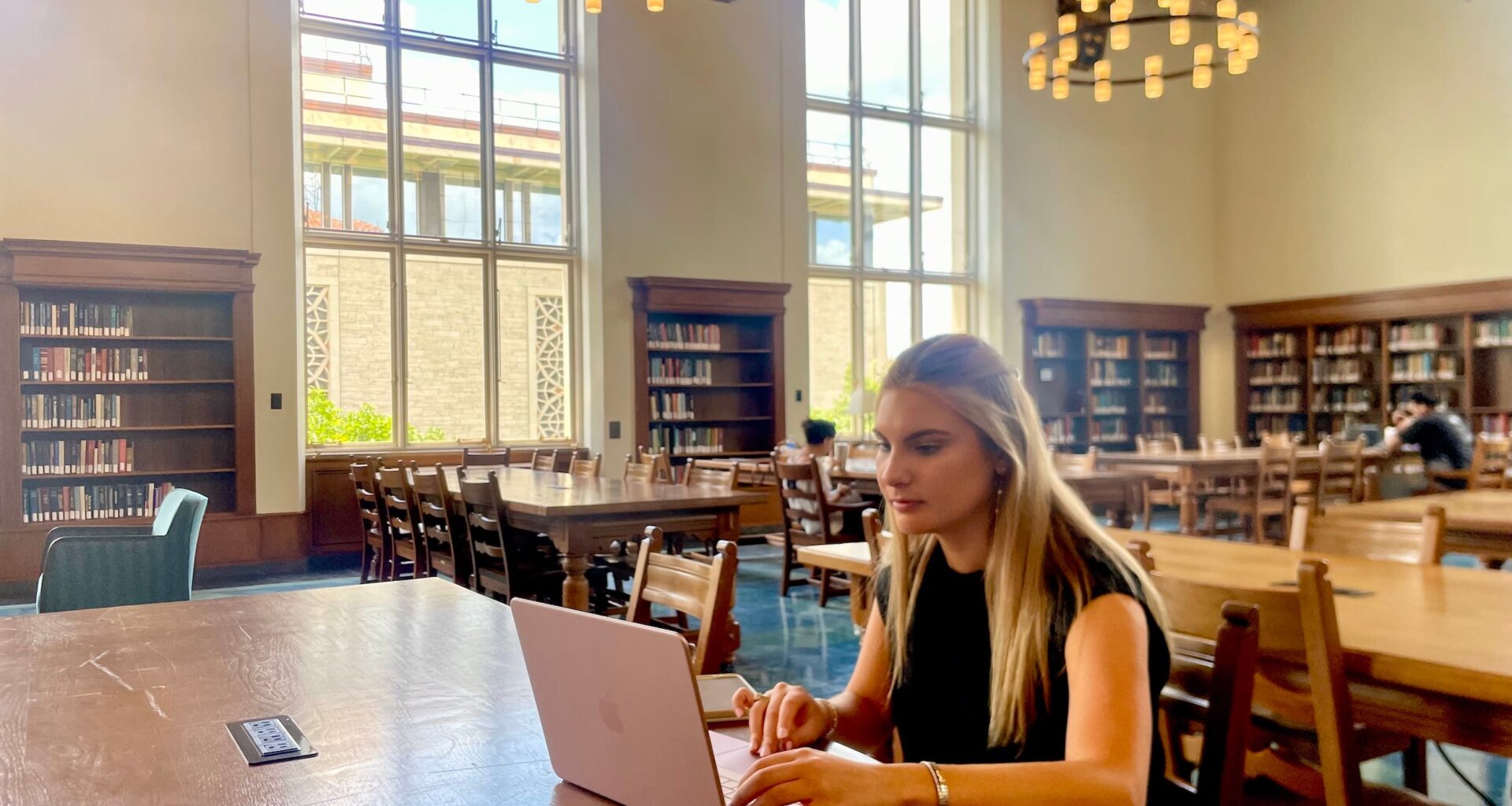
On a Tuesday afternoon in early June, a time of year when the campus is at its quietest, eight people sit silently in the Life Science Library’s Hall of Texas. Evenly distributed throughout the massive, ornate reading room, they sit at tables and carrels looking at their laptops, most with headphones on or earbuds in. A reporter quietly asks if he can have a word.
Two of them, when asked what they think of the library, independently call it the same thing. “This is a hidden gem, in my opinion,” says Alec Hari, a neuroscience senior from Memphis. A few minutes later, recent graduate Emma Grace Alvey, who is studying for the LSAT, says, “This is one of my hidden gems.”
The “gem” part is easy to see; just look around at the intricately painted ceiling beams, chandeliers and original walnut furniture. But why do they and so many others consider it “hidden”? For that, we must back up to 1977.
* * *
“UT was in a race to have one of the top libraries,” says Jennifer Lee, director of research, discovery and collections for University of Texas Libraries. “And at the time [the 1970s], that was largely based on: how much stuff do you have? To be one of the big libraries, you’ve got to have a lot of space, and so they determined in the early ’70s they needed a new, modern library. That’s when they started planning the Perry-Castañeda Library (PCL).”
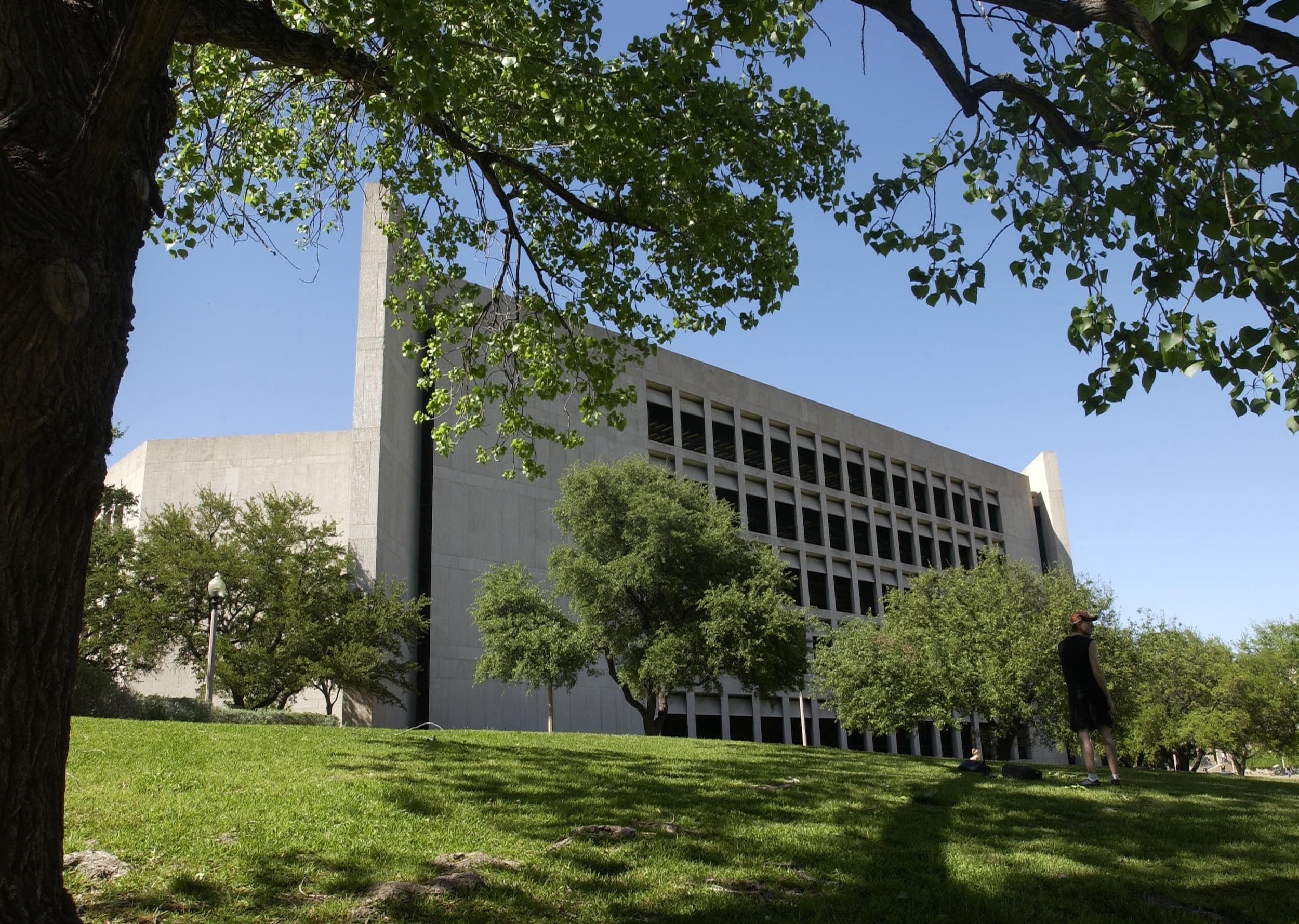 The Perry-Castañeda Library in 2003, Photo: Marsha Miller
In August 1977, after two years of planning followed by three years of construction, the PCL — almost a half-million square feet — opened as UT’s main library. In 1963 the University had opened the Undergraduate Library, now substantially remodeled and known as the Flawn Academic Center. Both libraries were open-stack, meaning students found their own books, in contrast to the old closed-stack library that required students to wait and a larger staff.
By 1992, when Lee came to UT as a freshman, UT was so thoroughly an open-stack campus that it wasn’t until her junior year, when she studied abroad in Prague, Czech Republic, that she even learned what a closed-stack library was. “I didn’t even know such a thing existed. So, it was a shock to me to go to the university library, and it was, ‘You need to write down what you want, and then you go sit over there!’”
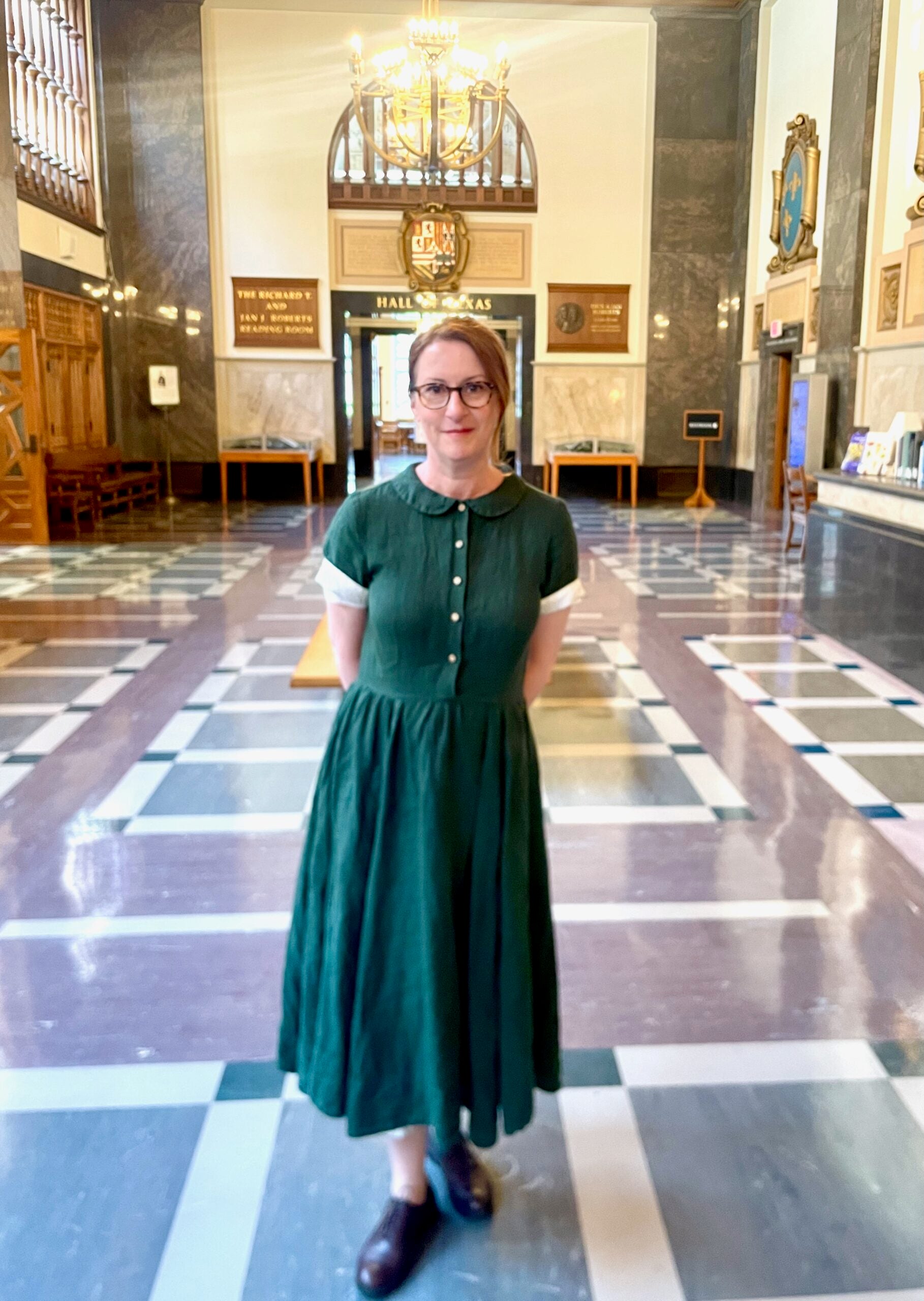 Jennifer Lee, two-degree Longhorn and Director of Research, Discovery and Collections for UT Libraries
But there was no practical way to convert the library in the Main Building into open stacks. Rather, it would live on as a reminder of how all major libraries used to be. In 1978, the Biology and Pharmacy libraries were combined to create the Science Library, which included two floors of stacks. The collection, which served the College of Pharmacy and the departments of botany, microbiology and zoology, included more than 77,000 books.
Today, the Life Science Library holds some 172,000 volumes on three stories within the Tower stacks. The second floor of the Main Building, where the grand public spaces are, is even with the fifth floor of the Tower, and the stacks reside on Tower floors 4, 5 and 6.
Books also reside in the reading rooms, which had not always been the case. Even in the 1950s, journals and other periodicals were kept on the shelves, but not books. When Lee was given charge of the library, “neither room had many books on the shelves, even the one that was open to the public, which I just thought was such a shame,” she says. Lee remembers wondering how many people had popped in, seen empty shelves, “and then just thought libraries are sad. I really wanted to put books on the shelves.”