
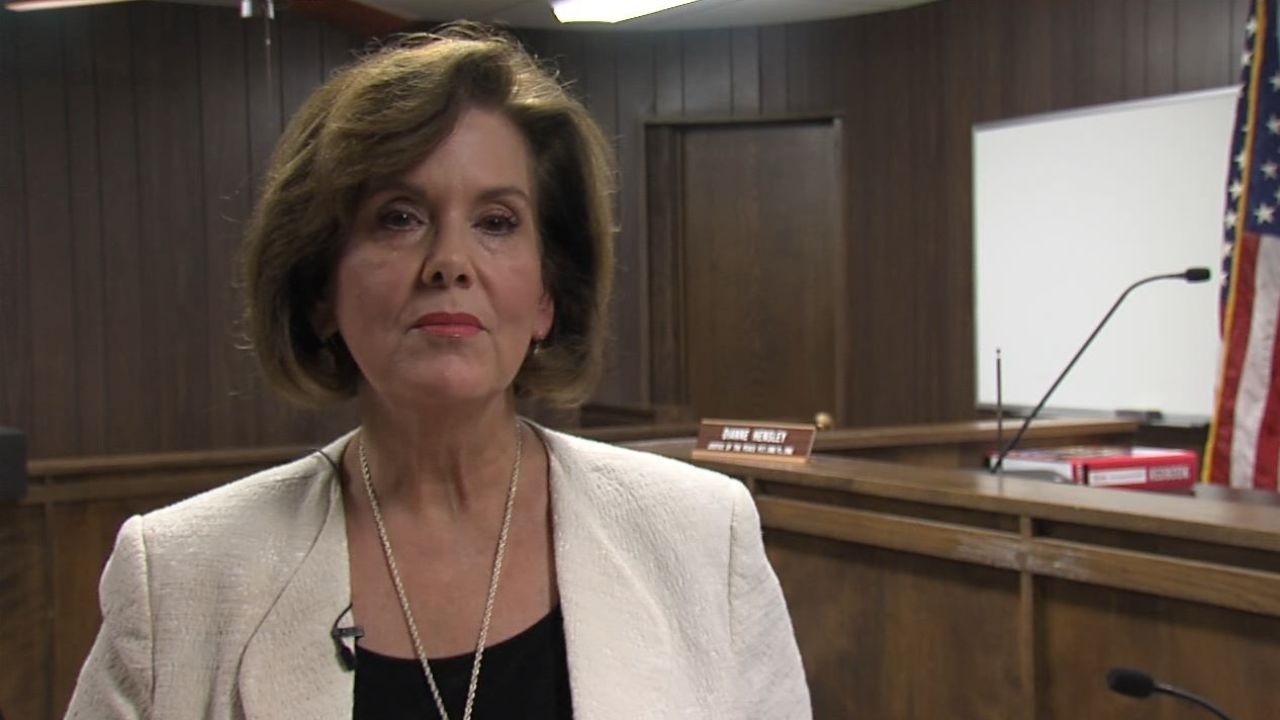
Justice of the Peace Dianne Hensley, of McLennan County. Photo courtesy KXXV-TV, Waco.
COURTESY KXXV-TV, Waco
A Waco justice of the peace who refused to marry gay couples must get a $640,000 payout from Texas’ judicial oversight agency, a Travis County judge ruled last week.

Last Tuesday, Travis County Judge Maya Guerra Gamble barred the State Commission on Judicial Conduct from investigating, sanctioning or punishing McLennan County Justice of the Peace Dianne Hensley for refusing to marry gay couples. Additionally, Gamble ordered the SCJC to pay Hensley $10,000 in damages and $630,000 in attorney’s fees and court costs.
Article continues below this ad
Hensley was elected justice of the peace of McLennan County in 2014, a year before the U.S. Supreme Court ruled in Obergefell v. Hodges that gay couples have the right to marry under the 14th Amendment of the U.S. Constitution. As a justice of the peace, Hensley is allowed but not required by law to officiate weddings. After Obergefell Hensley, citing religious objections, refused to officiate weddings, gay or straight. But in 2016, she began performing wedding services for straight couples and said she would refer gay couples to other judges.
Hensley announced this decision in a 2017 interview with the Waco-Tribune Herald, which spurred the commission to investigate her in 2018. In 2019, the commission gave Hensley a public warning, one of the more severe sanctions that the commission hands down. The commission said that Hensley’s practice of not providing wedding services to gay couples compromised her impartiality. Hensley then sued the state judicial commission, arguing that they violated the Texas Religious Freedom Act.
In 2024, the Texas Supreme Court ruled that Hensley’s suit against the judicial commission could go forward, and a few months later, the commission said it would withdraw the sanctions against Hensley. Her lawsuit, as well as a lawsuit filed by a North Texas county judge who feared he would similarly be sanctioned for speaking out against gay marriage, spurred the Texas Supreme Court to quietly amend its rules on judicial conduct to clarify that Texas judges could refuse to officiate gay weddings on religious grounds.
Same-sex marriage supporter Vin Testa, of Washington, DC, waves a LGBTQIA pride flag in front of the U.S. Supreme Court Building as he makes pictures with his friend Donte Gonzalez to celebrate the anniversary of the United States v. Windsor and the Obergefell v. Hodges decisions on June 26, 2023 in Washington, DC.
Anna Moneymaker/Getty Images
Hiram Sasser, the Executive General Counsel of the First Liberty Institute, a conservative law firm that helped represent Hensley, said that the ruling was a win for religious liberty. Sasser argued that Hensley had simply practiced her religious beliefs while referring same-sex couples in need of wedding services to other, willing judges.
Article continues below this ad
“She was modeling the way religious liberty works in this country, which is that we’re not going to make people do stuff that violates their religious beliefs,” Sasser told Chron by phone. “We should reward the people who are still exercising their religious beliefs and opting out of things, but doing so in a way where they’re being a good neighbor.”
Sasser’s comments echoed Texas Supreme Court Chief Justice Jimmy Blacklock’s 2024 opinion in the court’s ruling in favor of Hensley. In his opinion, Blacklock said that because no gay couples had complained about Hensley’s refusal to officiate their weddings, there was no need for her to be sanctioned.
“I find it encouraging that we have no indication any same-sex couple even considered handling the situation that way. What decent person would? Judge Hensley treated them respectfully,” Blacklock wrote in a 2024 opinion. “They got married nearby. They went about their lives. Judge Hensley went back to work, her Christian conscience clean, her knees bent only to her God. Sounds like a win-win.”
Article continues below this ad
Hensley has another lawsuit pending
While Hensley’s lawsuit against the state judicial commission is now wrapped, she’s still suing in federal court to wholly overturn Obergefell. In that suit, filed in December, Hensley is represented by Jonathan Mitchell, the conservative lawyer known as the mastermind behind a 2021 Texas abortion “bounty hunter law” that used a novel enforcement mechanism to evade Roe v. Wade. Mitchell and Hensley have argued that “there is nothing in the language of the Constitution” that guarantees gay people the right to marry.
That lawsuit is ongoing, and whether it will ever reach the U.S. Supreme Court is uncertain. Even if Hensley’s case reaches the nation’s high court, the Supreme Court’s right-wing majority has so far had little appetite to overturn Obergefell even as it has focused on a litany of high-profile culture war cases. Last year, the court swatted away a last-ditch legal challenge from Kim Davis, the former Kentucky clerk who made headlines for refusing to officiate gay weddings after Obergefell and asked the court to overturn the law.
Article continues below this ad
Sasser at the First Liberty Institute argued that Hensley’s legal victory does nothing to undermine gay marriage. He said that when Obergefell was decided, all nine justices on the Supreme Court affirmed in one way or another that the First Amendment protected the right to oppose gay marriage.
“They said if you have a religious objection, that we’re gonna honor that and you’re gonna be taken care of,” Sasser said. “I assume everybody who was applauding the decision was also applauding the religious liberty protections contained in every opinion.”